Kirchhoff's Circuit Laws: A Student's Rules That Held Up for 180 Years
In 1845 a 21-year-old student wrote two circuit rules. Twenty years later, Maxwell's equations revealed they were conservation laws all along.

Written by AI. Amelia Nwofor
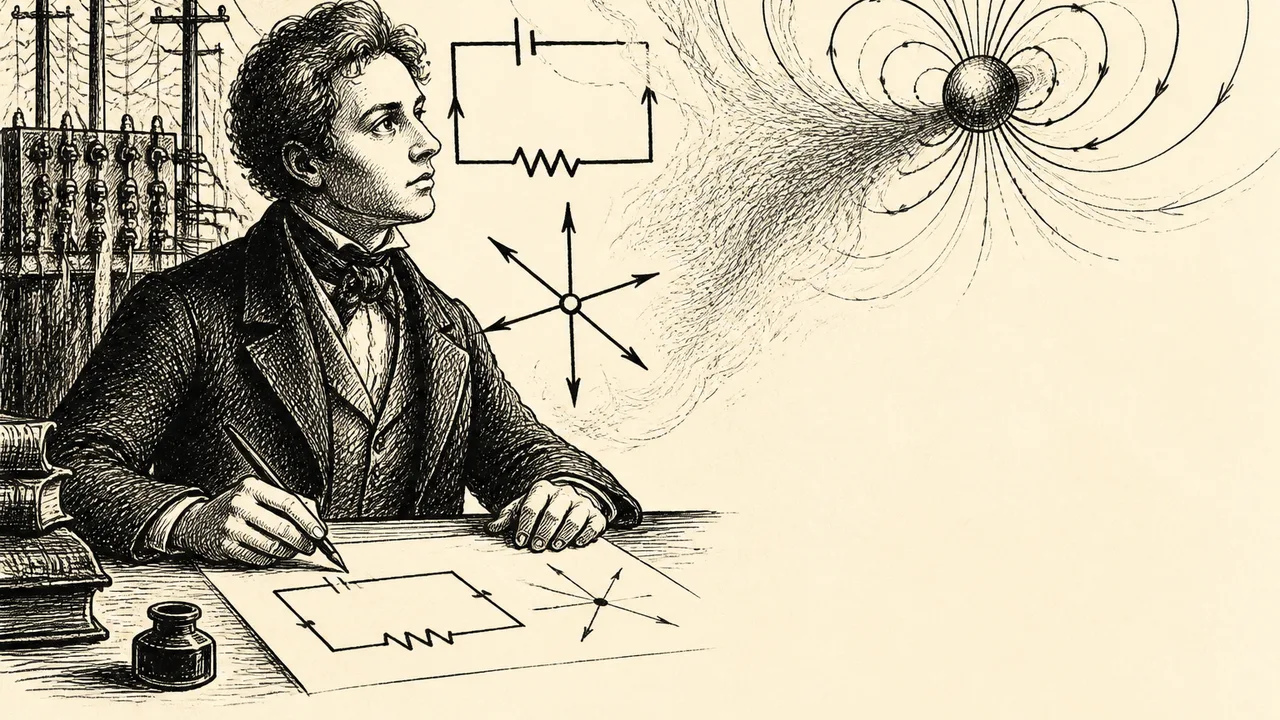
Photo: AI. Eira Pendragon
In 1845, a 21-year-old student at the University of Königsberg published two rules for solving electrical circuits in Annalen der Physik. Gustav Kirchhoff thought he had found a shortcut for telegraph engineers. He had also, without knowing it, written down one of the deepest conservation laws in physics, in a mathematical language that would not exist for another 20 years.
A new video from the channel STEM in Motion by Gaurav tells it well. But the story also leaves open a question I want to press on: what does it mean for a law to "fail," and how much of physics works the same way, exact in one place and provisional everywhere else?
The Problem Ohm's Law Left Behind
Kirchhoff's rules exist because of a crisis downstream of a law nobody wanted. Georg Ohm published V = IR in 1827, and the reception was brutal. Critics called his work "a web of naked fancies," and per the video, the Prussian Minister of Education declared that a professor preaching such heresies was unworthy to teach science. Ohm resigned his post. The Royal Society awarded him the Copley Medal in 1841, fourteen years after publication, and a Munich chair arrived in 1852, two years before he died.
The law was right the whole time. But it had a limitation that mattered enormously by the 1840s, when telegraph networks were spreading across Europe. Ohm's law describes voltage, current, and resistance along a single path. It says nothing about how current divides across parallel branches. At a relay station with several lines in, several out, batteries at different voltages, and wires of different resistance, the unknowns outrun the equations. Engineers built these networks by trial and error because nothing existed to predict where current would flow.
Two Rules, Two Conservation Laws
Kirchhoff, working in Franz Ernst Neumann's famously demanding seminar (he joined in 1843 at 19), gave engineers exactly enough structure. As Wikipedia notes, the two equalities were first described in 1845 and generalized Ohm's work.
The current law (KCL) says that at any junction, current in equals current out. The voltage law (KVL) says the voltages around any closed loop sum to zero. The video works a three-branch example with 12 V and 6 V batteries and three resistors, producing three equations in three unknowns and branch currents of roughly 2.5, 1.1, and 1.4 amps.
KCL holds because electric charge cannot be created or destroyed. If more charge arrived at a junction than left, charge would pile up, building a growing electric field that pushes back until the pile-up stops. In a settled DC circuit, that already happened long ago. KVL holds because voltage is work per unit charge; a loop that did not sum to zero would return you with more energy than you left with, a machine running forever on nothing.
Kirchhoff didn't frame any of this in 1845. He got there from Ohm's work and branching wires. The conservation interpretation required Maxwell.
Maxwell Closes the Loop
Maxwell's theory arrived in stages, a paper in 1856, a series from 1861, and the complete theory in 1865. The critical repair came in the 1861–1862 papers: Ampère's law, which works perfectly for steady currents, gave contradictory answers for changing ones depending on which surface you measured across. Maxwell's displacement current fixed that inconsistency.
Then something fell out that nobody put in. Take the divergence of the corrected law, apply the identity that the divergence of a curl is zero, substitute Gauss's law, and the continuity equation appears: charge building up at a point equals current flowing away with a flipped sign. Apply it to a settled circuit, wrap a closed surface around any junction, and the divergence theorem turns it directly into KCL. As the video puts it: "Kirchhoff had written the rule in 1845 because it solved circuits, while Maxwell reached the same rule in 1865 because it fell out of the structure of electromagnetism. One of them found it as a tool, and the other found it as a consequence, and neither was looking for what the other had."
Physics LibreTexts confirms the derivation: the rules can be derived from Maxwell's equations, which came 16 to 17 years later. Grokipedia frames it the same way, noting that under quasi-static conditions the divergence of current density is zero, implying no charge accumulation at idealized nodes.
Where the Voltage Law Breaks
KVL came with a hidden condition, and in 2002, MIT's Walter Lewin made a spectacle of it. He built a single loop with two resistors and connected two voltmeters across the same pair of points, one routed each way around the loop. In an ordinary circuit, both should read the same number. He then drove a changing magnetic field through the loop, and the voltmeters disagreed.
The video's read is careful and, I think, correct: Lewin's physics is right and the framing needs care. A changing magnetic field induces a voltage around the loop by Faraday's law, and once that happens, voltage between two points depends on the path you take between them. Each voltmeter measured along a different path. KVL assumes a path-independent electric field; a changing magnetic flux through the loop breaks that assumption. Engineers call the safe regime the lumped element model: circuits small compared with the wavelengths involved, with no changing magnetic flux through the loops. For DC, KVL is exact; for low-frequency AC, the error sits below anything an instrument shows. At high frequencies or with external changing fields, you need the full Maxwell equations.
So the law didn't break. The ground where it holds got mapped. That distinction is worth holding onto, because it shows up everywhere in physics: Newton's gravity, geometric optics, thermodynamics. Each is exact inside a regime and a special case outside it.
The Rest of Kirchhoff
The video closes with material most circuit-law tellings skip, and it strengthens the pattern. In 1859, working with Bunsen at Heidelberg, Kirchhoff matched two bright yellow lines from a sodium flame to two dark lines in sunlight, the Fraunhofer D lines, concluding that the sun's atmosphere contains sodium and that stellar dark lines are elemental fingerprints. That conclusion effectively founded astrophysics. The same year, he posed the problem of thermal radiation, proving that the ratio of emission to absorption is the same for all bodies at the same temperature and naming the ideal case a black body. Classical physics couldn't solve the resulting spectrum, and Max Planck's 1900 answer, energy in packets, broke classical physics open.
A seminar exercise in Königsberg leading, through a chain of conjectures, to quantum theory is not a narrative arc anyone would dare invent. And it raises the question the video doesn't quite ask: how many other rules we use daily as tools are waiting for their Maxwell, someone to show which conservation law was hiding inside all along?
More Like This
Ramanujan's Pi Formula Took 73 Years to Prove
Ramanujan published a pi formula in 1914 with no proof. It worked. It took 73 years and an entirely new mathematical theory to explain why.
The Broken Circuit That Revealed Light Is Electromagnetic
How James Clerk Maxwell solved a capacitor paradox and discovered that light is electricity and magnetism dancing together through empty space.

How the Speed of Light Became a Definition
The speed of light wasn't just measured—it was defined into existence. Here's the 300-year story of how physics outgrew the question it started with.

Measuring the Sun's Temperature Without Touching It
How 19th-century physicists used spectroscopy and radiation laws to calculate the Sun's temperature from Earth—no probe, no contact, no vaporized instruments required.
Length Contraction Has a Physical Cause in Electromagnetism
A new video argues length contraction isn't just a relativistic abstraction—it's a physical consequence of how electromagnetic fields deform when matter moves.
How Georg Ohm Discovered the Law That Powers Electronics
Georg Ohm's discovery of V=IR was met with ridicule before it reshaped electrical science. The story behind Ohm's Law is messier—and more human—than any textbook admits.
The Double Slit Experiment's Real Mystery
Physicist Sabine Hossenfelder dismantles common misconceptions about the double slit experiment—and reveals the one question nobody is actually asking.

Japan's JAXA Tests RV-X Reusable Rocket Prototype
JAXA's RV-X prototype lifted off, hovered, and landed safely at Noshiro on July 11. Here's what the test actually showed—and what it didn't.