How Accelerating Electric Charges Produce Light
A Physics Explained video walks through the classical mechanics of electromagnetic radiation—how a wiggled charge creates the ripple we call light, and why that matters.

Written by AI. Priya Sharma
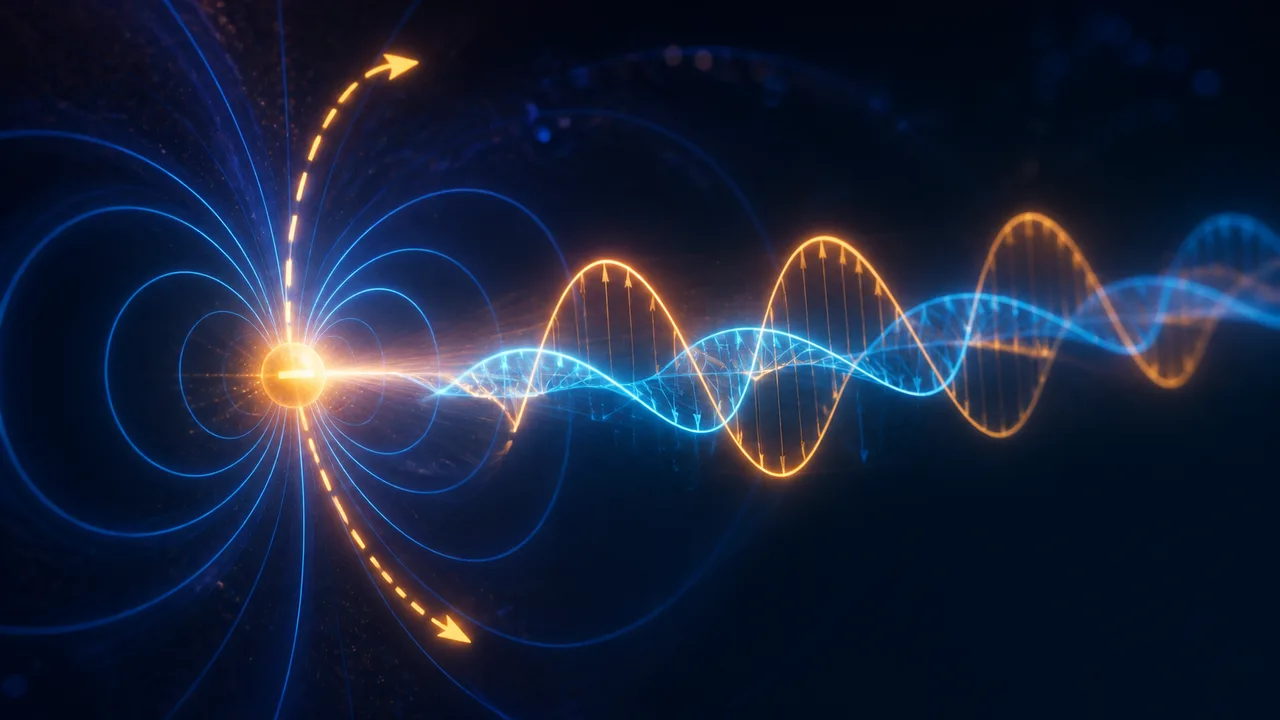
Photo: AI. Dante Nwosu
You have probably been told, at some point in your education, that wiggling an electric charge produces light. It is one of those statements that gets repeated often enough that most people stop questioning it. The Physics Explained channel recently devoted nearly half an hour to the question of why that is actually true — and the answer turns out to be more geometrically intuitive than you might expect, and more historically fraught than the textbooks tend to let on.
The core claim is well-established classical physics: an accelerating electric charge emits electromagnetic radiation. This is not a hypothesis or a contested finding. It is a consequence of Maxwell's equations, confirmed by more than a century of experiment, and it is the operating principle behind everything from your Wi-Fi router to the X-ray machine at your dentist's office. What the video does — and does well — is explain the mechanism rather than just asserting the result.
The field does not update all at once
The key insight begins with a simple but easy-to-overlook fact about electric fields: a change in a charge's motion cannot propagate through the surrounding field instantaneously. When a charged particle accelerates, the field close to it begins adjusting immediately, while the field further away retains its original configuration — the configuration appropriate to wherever the charge was, not where it now is. The two regions, old and new, must stitch together. That stitching is the disturbance. And the disturbance travels outward at a finite speed: the speed of light.
"Because that change cannot spread throughout space instantaneously," the video explains, "a disturbance begins to propagate outwards at the speed of light. And that disturbance is electromagnetic radiation."
The visualization that makes this concrete is the kinked field line. In a static or uniformly moving charge, electric field lines radiate outward neatly, each one pointing directly away from the source. But when a brief acceleration event occurs, those neat radial lines develop a bend — a kink — in the region between the boundary corresponding to when the acceleration started and the boundary corresponding to when it ended. That kinked region is not stationary. It expands outward at speed c, carrying the news of what the charge did.
J. J. Thomson's geometry, still earning its keep
What makes the video's treatment more than a qualitative tour is the geometric argument it attributes to J. J. Thomson — the same Thomson who discovered the electron in 1897. Thomson's construction, laid out in his 1904 book Electricity and Matter and reproduced in sources including Purcell and Morin's Electricity and Magnetism, allows you to extract a quantitative expression for the transverse electric field purely from the geometry of the kink.
The logic runs roughly as follows. The kinked shell has a measurable radial thickness (proportional to the duration of the acceleration) and a measurable transverse displacement (proportional to how far the charge moved laterally relative to any given observation direction). The ratio of those two spatial quantities must equal the ratio of the transverse electric field to the radial Coulomb field, because the field vector at any point within the shell points along the kink. Two similar triangles, one geometric and one in field-component space, yield an expression for the transverse field that depends on the charge's acceleration, the distance from the source, and the angle between the acceleration direction and the line of sight.
Two features of that expression are worth pausing on. First, the transverse component falls off as 1/R — not 1/R², as the Coulomb radial component does. This distinction is physically consequential: far from the source, the radiation field dominates, which is precisely why a radio transmitter in one city can reach a receiver in another. The radial near-field component loses the contest with distance. Second, the transverse component is zero along the direction of acceleration itself. Radiation is not emitted equally in all directions; it is concentrated broadside to the motion, which has practical implications for antenna design and, in the relativistic regime, for the spectacular beaming effects seen in astrophysical jets.
The delay is not a technicality
One element of the video that deserves particular attention is its treatment of retarded time — the idea that the field at a given observation point depends not on the charge's current state but on its state at an earlier time, specifically the time it took light to travel from source to observer. This is sometimes introduced as a mathematical correction and then quietly set aside. Here it is treated as genuinely physical, and rightly so.
When the animation first shows an oscillating charge updating a distant field point, it deliberately gets it wrong — using the charge's instantaneous state rather than its retarded state — and then corrects it. The corrected version shows a wave pattern emerging from the delay structure alone, with no additional assumptions required. "The field observed at P must therefore depend on where the charge was and how it was accelerating at an earlier time," the video notes. That earlier time introduces a phase difference across space, and phase difference across space is a wave.
This is not a small point. Retarded time is the reason that electromagnetic radiation exists as a propagating phenomenon rather than a synchronous updating of the field. It is also the conceptual bridge between the classical picture being built here and the more sophisticated treatment in texts like Jackson's Classical Electrodynamics, which the video cites.
The quantum problem hiding in the classical picture
The video does not linger here, but it does acknowledge the historical crisis that this radiation picture created for atomic physics. If electrons orbit nuclei under continuous centripetal acceleration — and circular motion is continuous acceleration, because velocity direction is always changing even when speed is constant — then classical electrodynamics predicts that atoms should be continuously radiating. A radiating electron loses energy. An electron losing energy spirals inward. The atom collapses.
"Resolving this contradiction became one of the developments that helped drive the emergence of quantum mechanics," the video observes, "in which electrons do not follow classical planetary orbits."
This is stated accurately and without inflation. The instability of the classical hydrogen atom was one of several convergent crises that made the quantum framework unavoidable, not the single dramatic proof that textbooks sometimes imply. Quantum mechanics resolves the problem by abandoning the planetary orbit model entirely — electrons in atoms are described by probability distributions, not trajectories, and the ground state simply has no lower energy state to decay to. The radiation mechanism that is so beautifully described by classical electrodynamics does not apply in the same way to bound quantum systems.
Two fields, not one
The final piece assembled in the video is the magnetic component. The treatment up to the point of the kink geometry is essentially two-dimensional — a picture of a propagating disturbance in the electric field. But electromagnetic radiation is not simply a propagating electric field. Rotating the perspective into three dimensions reveals an oscillating magnetic field accompanying the electric one, perpendicular to it, and both perpendicular to the direction of propagation. This is the full electromagnetic wave structure that Maxwell's equations require.
That both fields are present, mutually perpendicular, and both perpendicular to the propagation direction is not incidental. It is what makes electromagnetic radiation self-sustaining in vacuum: a changing electric field induces a magnetic field, which in turn sustains the electric field, and the structure propagates without requiring any medium to carry it. The video defers the full Maxwell treatment to a subsequent installment, but the groundwork for understanding why those equations predict waves — and why those waves travel at a particular speed — is thoroughly laid.
"In a transmitting antenna, an alternating current drives electrons back and forth, causing them to accelerate and produce an electromagnetic wave," the video notes. "When that wave reaches a receiving antenna, its oscillating electric field pushes the electrons in the antenna back and forth, generating an alternating electric signal." Every radio broadcast, every wireless data transfer, every optical fiber — all of it reduces to this: a charge moved here, and a charge was moved there, and the disturbance traveled between them at 299,792,458 metres per second.
What remains unaddressed — and this is not a criticism of the video's scope, which is classical electrodynamics — is the quantum electrodynamic picture, in which light emission is described not as a continuous wave disturbance but as the exchange of photons between charged particles. The classical and quantum descriptions are consistent within their respective domains of applicability, but they are not the same picture, and the relationship between them is not trivial. Whether a "kink in the field line" and "a photon being emitted" are two descriptions of the same thing, or genuinely different ontological claims, is a question that classical electrodynamics, however elegantly presented, cannot resolve on its own.
Priya Sharma is a science and health correspondent for BuzzRAG.
More Like This

Exploring Black Holes and Asteroids with StarTalk
Neil deGrasse Tyson delves into black holes, asteroids, and more in StarTalk's latest Cosmic Queries episode with Chuck Nice.
Electric and Magnetic Fields Explained From First Principles
From ancient amber to Gauss's law: how physicists replaced "action at a distance" with the field concept that underpins all of modern physics.
Einstein's Proof: Atoms Exist Through Brownian Motion
Explore Einstein's 1905 revelation on atoms using Brownian motion, bridging macro and micro physics.
Einstein's Real Quantum Objection Was Not Determinism
Tim Maudlin's landmark lecture traces Einstein's actual complaint against quantum mechanics—non-locality, not indeterminism—from Solvay 1927 to Bell's theorem.
Have Astronomers Found the Universe's Missing Mass?
Astronomers may have discovered the universe's missing mass in cosmic filaments, a breakthrough in understanding cosmic evolution.
Kirchhoff's Circuit Laws: A Student's Rules That Held Up for 180 Years
In 1845 a 21-year-old student wrote two circuit rules. Twenty years later, Maxwell's equations revealed they were conservation laws all along.

The Maths Behind Palindrome Ages Explained
Mathematician Kat Phillips unpacks why some pairs of people have reversible ages—and the surprisingly elegant number theory that governs when it happens.

Asteroid Impact on a City: What the Science Actually Shows
A Science Channel scenario imagines an 1,800-ft asteroid striking New York in 2029. Here's what the physics, detection protocols, and real planetary defense infrastructure say.