Starship Flight 14 Reached Orbit, but Lunar Tests Remain
Starship delivered 26 satellites to orbit on Flight 14, then ended its test early. Its result clarifies what remains for reuse and NASA's lunar lander plans.

Written by AI. Priya Sharma
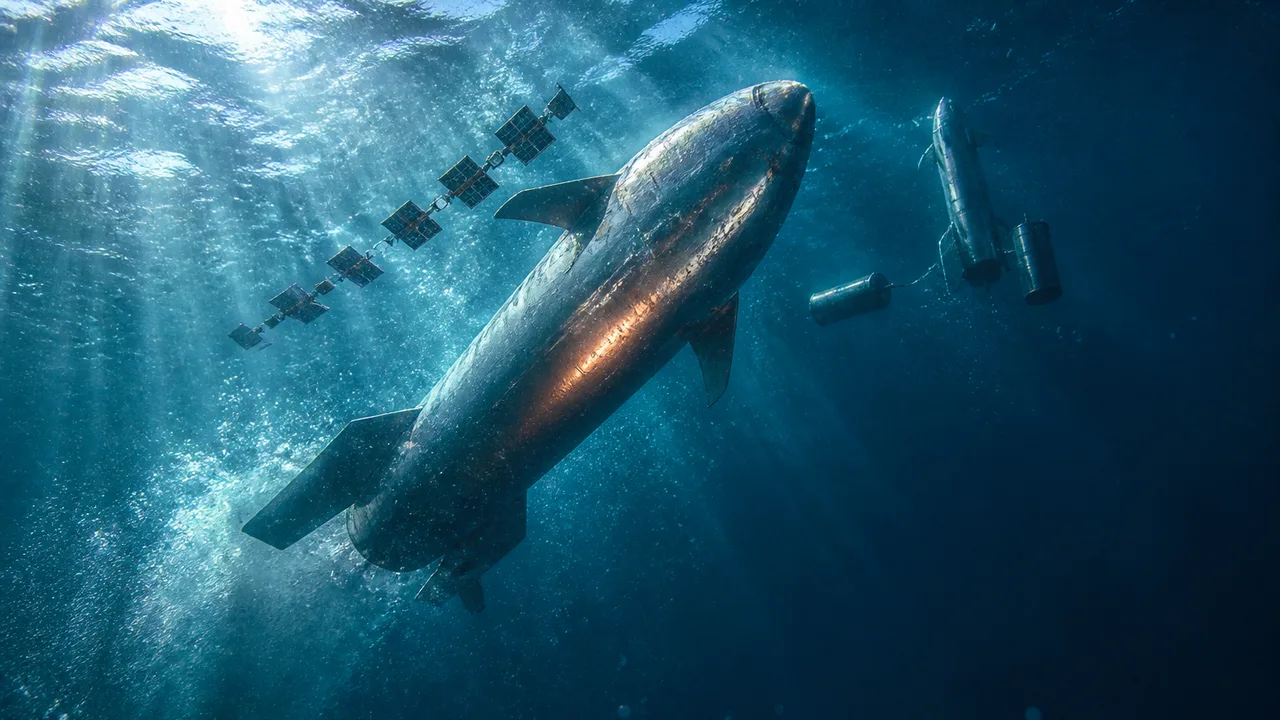
SpaceX’s Starship reached Earth orbit for the first time on September 28 and deployed 26 Starlink V3 satellites. Its 14th integrated test flight also ended far sooner than planned: the spacecraft spent approximately three hours in orbit, rather than completing a mission planned to last nearly 10 hours. Starship has now delivered a payload to orbit. This flight did not complete its planned duration, recover a vehicle for reuse or refuel another spacecraft.
The satellite deployment and early return happened on the same flight. SpaceX said its Starlink team contacted all 26 newly deployed satellites, confirming contact after release. An engine failed during ascent, but SpaceX continued to orbit. Engadget linked the subsequent decision to shorten the orbital phase to the engine being offline; the precise considerations behind that decision remain unclear. The Super Heavy booster splashed down in the Gulf of Mexico. Starship later splashed down in the Pacific and exploded after reaching the water, as Live Science reported. SpaceX had planned a controlled Pacific splashdown. The spacecraft reached the water, but it did not remain intact there.
What Changed Between the Earlier Flights and This One
SpaceX began flying Starship and its Super Heavy booster together in 2023 on suborbital trajectories. Those flights could test launch, separation and return without asking the spacecraft to remain in orbit. Flight 14 added the orbital insertion and satellite delivery that those trajectories could not provide. An engine burn to enter orbit was part of the planned flight profile; reaching space on a suborbital path had never answered whether the vehicle could complete that step.
Earlier Starship missions also carried V3 satellites, but those payloads remained on suborbital flights. Flight 14 put the satellites into the region where they are intended to operate. Contact with them adds evidence that they could communicate after release, though it does not establish their eventual operating performance. For a company hoping to use Starship to launch satellites, this was a delivery test with actual satellites left in orbit, rather than another rehearsal of their release.
Flight 4, in 2024, demonstrated controlled splashdowns of both stages. Flight 5 achieved a tower catch of the Super Heavy booster. Later flights introduced the third-generation vehicle flown on Flight 14; Flights 12 and 13 tested that generation, although Flight 13 lost its booster during landing. SpaceX had caught a booster before it delivered these satellites, yet neither that catch nor the new delivery shows that the latest vehicle can be recovered and flown again. The tests accumulate evidence, but they answer different engineering questions.
Flight 14 attempted no tower catch of either stage. The vehicle’s intended reusability calls for more than guiding hardware toward a landing area: SpaceX must recover spacecraft and boosters and fly them again. Before launch, the plan called for the booster to enter the Gulf, rather than return to the Starbase launch site.
Elon Musk described caution about returning Starship over land if it might break apart and scatter debris, in remarks carried by the Associated Press. The booster’s Gulf splashdown followed that plan; neither stage attempted the return-to-pad and catch sequence on this flight. Caution about where a test vehicle comes down is compatible with a serious recovery ambition. It postpones that particular test.
Kathleen Curlee, a senior analyst at Georgetown University’s Center for Security and Emerging Technology, told AFP before launch that “just achieving flight and getting data” could count as success from an engineering perspective. Flight 14 demonstrated that this vehicle could reach orbit and release satellites on this attempt. SpaceX had intended six orbits and nearly 10 hours; the early return leaves the planned longer orbital stay untested. One delivery also gives little basis for estimating how frequently Starship can repeat the feat. Engineers can learn from a test that falls short of its full flight plan, while a future launch service would need repeatable performance.
A Satellite Mission and a Lunar Lander Share Only Part of the Route
A Starship-based lunar lander also has to get into Earth orbit. Flight 14 crossed that threshold with a payload. For satellite delivery, the cargo separates from Starship. Under the planned lunar architecture, a Starship Human Landing System must acquire propellant in orbit before travelling onward, then rendezvous with astronauts in lunar orbit for a journey to the surface and back. The lunar mission asks Starship to keep working after orbital insertion, across operations that a satellite drop-off does not require.
NASA has contracted SpaceX to develop that lander and Blue Origin to develop another option, Blue Moon. For Starship HLS, launching with all the propellant needed for the lunar journey would impose too much mass. Its proposed solution is to supply propellant after launch, trading a launch-mass problem for a sequence of launches, storage, docking and transfers in space. Blue Moon also faces an orbital-refueling requirement, although its vehicle and propellant arrangements differ from Starship’s. The shared constraint does not make the two lander designs interchangeable.
For Starship, the proposed sequence includes tanker flights filling a depot, followed by a separately launched lander that docks and takes on propellant. SpaceX plans a demonstration in which two Starships launch weeks apart, meet in orbit, dock autonomously and transfer cryogenic propellant. Cryogenic propellant must remain extremely cold. Storing it for successive flights raises the question of losses over time; transferring it between vehicles requires managing liquid and gas without Earth’s gravity to separate them. Releasing satellites tested neither operation.
The transfer demonstration had already slipped from an original March 2025 target to March 2026 and then beyond it, according to Astronomy’s account of a NASA inspector general report and the subsequent schedule. As of the magazine’s September 16 article, there was no confirmed launch date for the test. Flight 14’s orbital insertion supplies a prerequisite for the planned rendezvous, but it offers no measurement of how much cold propellant a tanker could deliver after waiting in orbit. That uncertainty feeds directly into how many tanker launches a lunar mission would need.
NASA’s revised Artemis plan reflects the work ahead. Artemis III is planned as a low-Earth-orbit test involving Orion and one or both commercial landers, rather than the lunar landing once assigned to that mission. Artemis IV is now planned as the first crewed lunar landing, no sooner than 2028. NASA has said it will choose between the commercial landers based on readiness, according to Astronomy. An uncrewed lunar landing demonstration also lies on the proposed path for Starship HLS.
Another satellite flight could begin to establish whether September 28’s delivery can be repeated. Recovering and reflying a vehicle would examine the reuse ambition left aside on Flight 14. For the lunar lander, the planned two-Starship test poses a more pointed measurement: after weeks between launches, how much propellant can one spacecraft actually put into the other?
More Like This
Starship Flight 14 Tests the Leap From Rocket to Utility
Starship Flight 14 aims for orbit, 26 working satellites and controlled deorbit, testing whether SpaceX's prototype can begin functioning as infrastructure.
SpaceX Plans First Starship Upper Stage Tower Catch
SpaceX plans to catch the Starship upper stage with its launch tower arms for the first time. Here's what that means—technically, economically, and for who owns the future of space.
SpaceX Starship Flight 13 Sticks Its Softest Splashdown
SpaceX's Starship Flight 13 deployed 20 Starlink V3 satellites and nailed its gentlest-ever Indian Ocean splashdown. Here's what that actually means.

SpaceX Starship Flight 13 Aborts at Launch
SpaceX's Starship Flight 13 aborted at the last second when engines failed to ignite. What the scrub reveals about iterative testing, redundancy, and real stakes.

Homo Erectus Survived 1.9 Million Years. We've Managed 300,000.
Homo erectus outlasted us by six to one. A new look at the fossil record asks whether our big brains are an advantage—or a liability with a slow fuse.
Blue Origin Rebuilds New Glenn Pad With Hybrid Design
Blue Origin is rebuilding its Cape Canaveral launch pad after the May 28 New Glenn explosion—with a new hybrid launch system and a 2026 return target.