Stadium Food Prices and the Captive Fan Economy
How exclusive concession contracts, private stadium operations, and public subsidies created a system where fans pay 249% more for a hot dog.

Written by AI. Elena Vasquez-Moreno
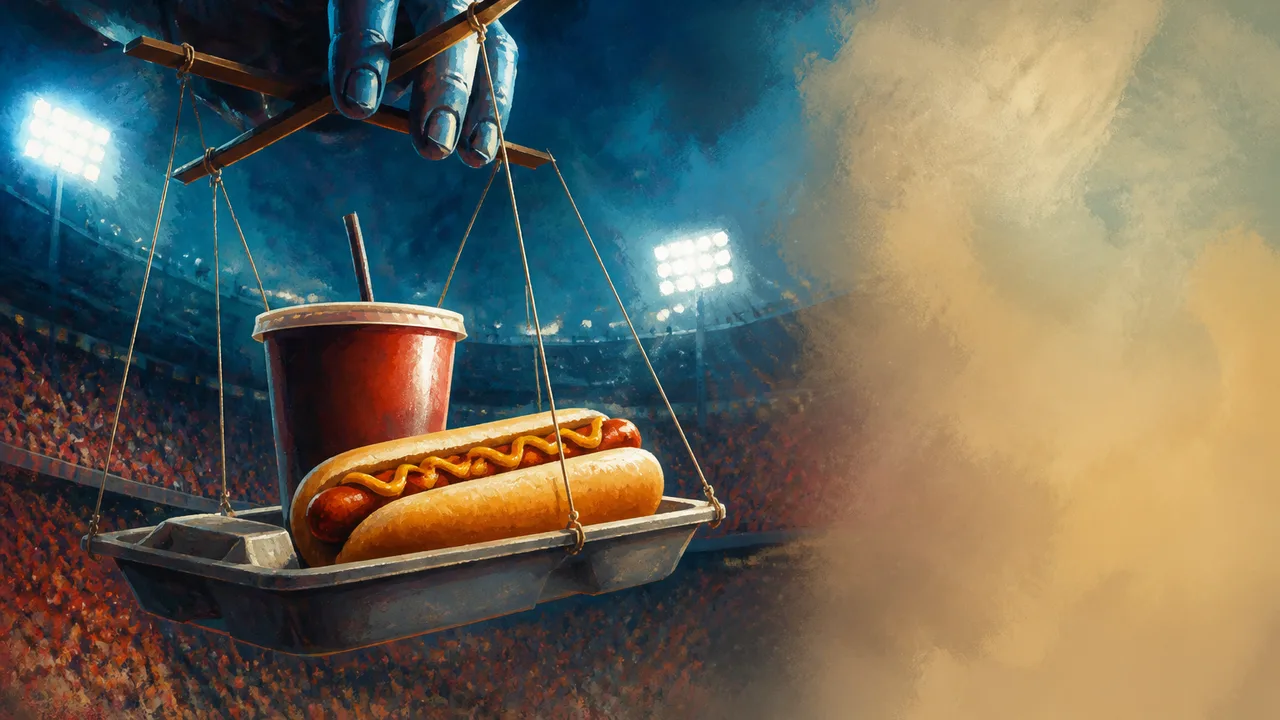
Photo: AI. Yuna Blackwood
A $7.99 hot dog. Less than a mile from Dodger Stadium, the same hot dog costs $2.29. That 249% markup isn't an accident or an oversight — it's a business model, constructed deliberately over more than a century, and it works precisely because you have no other options once you're inside.
A recent Business Insider investigation traced how stadiums became what they are: not just venues for sport, but highly engineered consumption environments where pricing operates outside the ordinary rules of market competition. The mechanics are worth understanding, because the policy debate now forming around them is genuinely consequential.
How the Monopoly Got Built
The concession monopoly didn't arrive fully formed. America's earliest ballparks ran on independent vendors — people who showed up, set their own prices, and competed for your dollar. That changed in the late 1800s, when vendors started consolidating into larger concession businesses and signing exclusive contracts with individual teams or venues. One vendor, one stadium, no competition.
The template was set early. Harry M. Stevens, who founded Harry M. Stevens Incorporated, secured exclusive concession deals with three of New York's major league teams simultaneously — the Yankees, the Giants, and the Dodgers. His model was straightforward: he took a cut of every item sold. As Business Insider noted, "He would establish his pricing based on a cut. So, if a hot dog was 10 cents, then he would get the cut of that hot dog."
That structure — exclusive vendor, percentage cut, captive audience — is essentially what still governs most major stadiums today. Dodger Stadium has 39 places to buy food. Every one of them operates under or in partnership with Levy Restaurants, which has held the concessions contract since 2005. The illusion of choice is doing a lot of work in that number.
The Ownership Shift That Changed Everything
For decades, despite the exclusive vendor model, concession prices stayed relatively modest. The reason, according to the Business Insider reporting, was ownership structure: most US stadiums were owned and operated by local governments, which meant cities collected a share of food-sale revenues. The incentive to gouge wasn't particularly strong when the profits went back to the municipality.
That dynamic broke down as stadium construction costs escalated sharply in the 1980s and 1990s. As venues became more expensive to build, teams started contributing more capital — according to Business Insider, estimates suggest teams were typically contributing around 40% of construction costs on average. With larger financial stakes came demands for larger operational control.
The contract that crystallized this shift is a matter of public record. A 2006 lease agreement between Yankee Stadium and the New York City Industrial Development Agency explicitly grants the Yankees management and control of stadium operations, including "all revenues derived from concessions facilities." Put plainly: the team helped build it, so the team keeps the food money. Once that logic took hold across the league landscape, the pricing incentive flipped entirely.
Today, across the NFL, the average price of a 16-oz domestic beer runs about $10.96, per Business Insider's 2025 figures. The most expensive sells for $16.99 at Northwest Stadium, home of the Washington Commanders. A 12-pack of equivalent beer at a grocery store costs roughly $14 total. The math is not subtle.
The Captive Audience Problem
The term "captive audience" gets used loosely, but it applies with unusual precision here. Business Insider puts it cleanly: "You have thousands of fans in your venue for a two-to-three-hour window, where the only items available for them to purchase as amenities are items that you control the price of."
There's a meaningful distinction between sports leagues on this point. Most MLB stadiums — Dodger Stadium included — allow fans to bring in outside food and non-alcoholic beverages. The NFL, NBA, and NHL generally do not. That outside-food restriction converts a merely uncompetitive market into a genuinely closed one. You're not choosing between a $7.99 stadium hot dog and a $2.29 street-cart dog. You're choosing between the $7.99 hot dog and hunger.
The airport comparison is instructive. Airports also trap consumers — you're through security, your gate is far from the exits, and you're hungry. But most major US airports operate under a "street pricing plus" policy, typically capping prices at street rate plus a set percentage. In the New York area, for example, a $8.27 chocolate bar can be marked up by 15%, capping at $9.51. The mechanism isn't perfect — enforcement is genuinely difficult — but the principle exists: a captive audience in public infrastructure deserves some price protection.
Stadiums, even publicly subsidized ones, have operated without any such constraint. That's the opening that legislators are now trying to close.
The Legislative Argument
Two bills currently in play represent different theories of the problem.
The Fair Concession Pricing Act, championed by New York State Senator April Baskin, would cap stadium food prices at 20% above the average street price within a 10-mile radius. As Baskin explained: "If the 10-mile radius around the arena has establishments that have hot dogs priced at $5, that means that in the arena, the hot dog cannot be any more than $6." Violations would trigger loss of tax exemptions, fines up to $10,000, and repayment of a portion of received public funds.
The enforcement hook is the public subsidy. Yankee Stadium cost approximately $2.3 billion to build in 2009; roughly $1.2 billion came from public subsidies and city tax breaks. The team also pays no property taxes because the stadium sits on publicly owned land. The Fair Concession Pricing Act would attach conditions to that public money — essentially arguing that if you want the subsidy, you accept some pricing accountability.
The legal complication is real, as the Business Insider piece acknowledges. Airports are understood as public infrastructure. Stadiums, even publicly financed ones, are frequently operated as private entities. Once you're inside Yankee Stadium, you're arguably in a private commercial environment, which limits what the government can directly mandate about pricing. The subsidy-condition approach is a workaround — you can't force a private operator to cap prices, but you can say the tax break comes with strings.
The second bill, the Honest Oversight of Ticketed Dining and Onsite Grub Act — the Hot Dog Act, which is exactly what it sounds like — takes a more modest approach: it would direct the FTC to study concession prices nationwide and recommend affordability measures. Less of a hammer, more of a flashlight. Transparency as a first step.
Neither bill has passed into law.
One Stadium That Ran the Experiment
The most interesting data point in the Business Insider investigation isn't legislative — it's operational. When Mercedes-Benz Stadium opened in Atlanta in 2017, it launched what it calls "fan first pricing": concessions at or near street prices, including $2 hot dogs and $5 beers.
The expectation would be that cheaper prices mean less revenue. The outcome was the opposite. The stadium reported fans spent 16% more on food and drink, a 30% increase in total transactions, and an overall spending increase of 20%. Tim Zue, the stadium's executive who spoke to Business Insider, explained the mechanism: "They have the freedom to further invest in the experience. So that ultimately results in hats being purchased or a jersey being purchased or other items within the experience now going into the basket."
The model suggests that current stadium pricing may be leaving money on the table — that the extractive approach optimizes for margin per transaction while suppressing transaction volume. Whether other teams find that argument persuasive depends on whether they're willing to run the same experiment. So far, most haven't. Some have introduced "fan-friendly meal packs" as a partial gesture, but the fan first model at scale remains largely Atlanta's alone.
The Open Question
What the Business Insider investigation surfaces, stripped of any advocacy overlay, is a system with a coherent internal logic: teams accepted construction risk, so they extracted operational control; operational control includes concession revenue; concession revenue is maximized under captive-market conditions. Each step follows from the last.
The counterargument — that public investment in a venue creates public obligations around how that venue operates — also has a coherent internal logic. Both are genuine positions, and the legislative battles ahead will test which one the political system actually values.
State Senator Baskin framed the outcome accurately: "The success of all of these bills really depends on the people, and how much they push people like myself and my colleagues to get it over the finish line."
That's not a dodge. It's the correct description of how this resolves. The $7.99 Dodger dog stays $7.99 until someone with standing to change it decides the political cost of doing nothing exceeds the political cost of acting.
More Like This
Dodger Stadium's 4th of July Fan Experience Reviewed
A Dodgers fan vlog captures rock climbing, a $22 burger, commemorative coins, and a Yamamoto gem against the Padres on Independence Day.

Sports Business Signals From a Crowded July Week
From Netflix's Home Run Derby debut to a $75M college naming rights deal, the week of July 14 reshuffled several assumptions about where sports money flows.
How Technology Is Reshaping the Live Sports Venue
From AI-driven personalization to AR glasses and sensory rooms, sports venues are in the middle of a tech arms race—and the fan is both the beneficiary and the product.

Marathon Running's Rise as a Commercial Powerhouse
From shoe sales to title sponsorships, marathon running has become a serious commercial enterprise. Here's who's profiting—and what the growth costs.

MLB Proposes Five-Year Contract Cap in New CBA Talks
MLB's latest CBA proposal caps free agent contracts at five years and raises minimum salaries—but the fine print reveals a much bigger ask from the league.

How FIFA Engineered the 2026 World Cup Grass
FIFA spent $5M+ with a UT turf scientist to grow, test, and install 16 World Cup pitches. The farms, the students, and the contract pressure behind the grass.
MLS Bets on a Post-World Cup Surge
MLS commissioner Don Garber says the World Cup was always the plan. Now comes the harder part: turning a soccer moment into a soccer market.

France's World Cup Exit Handed Sportsbooks a Windfall
France's 2026 World Cup elimination relieved sportsbooks of their biggest liability. Here's how public betting patterns turned one team's loss into the industry's gain.