How FIFA Engineered the 2026 World Cup Grass
FIFA spent $5M+ with a UT turf scientist to grow, test, and install 16 World Cup pitches. The farms, the students, and the contract pressure behind the grass.

Written by AI. Dorothy "Dot" Williams
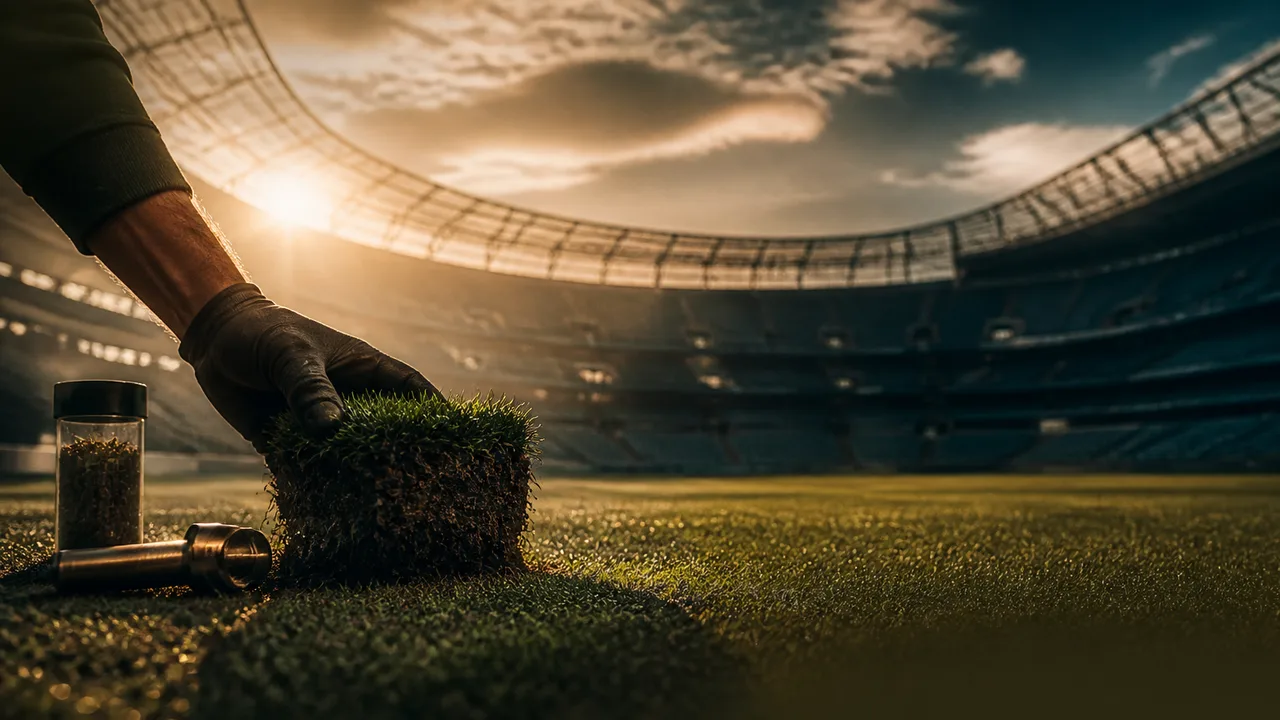
Photo: AI. Astrid Lehmann
John Sorochan has spent seven years figuring out how to make grass in Miami feel the same as grass in Vancouver. That is, in its entirety, the job. And if it sounds straightforward, you've never tried to run a single product consistently across 16 locations, three countries, multiple climate zones, and a handful of stadiums that don't let in any sunlight at all.
Sorochan is a turf grass researcher at the University of Tennessee, and he's the person FIFA called when it decided that the 2026 World Cup needed a grass strategy. The result is more than 170 tests conducted since 2021, a multi-million-dollar indoor research facility built specifically for this project, and pitches grown on 11 farms spread across North America — each one planted on plastic sheeting so the roots stay intact all the way to installation day.
FIFA has put more than $5 million into Sorochan's operation. That's real money for a university turf program, and it comes with real stakes. "Grass is a living organism," Sorochan says in a Business Insider video covering the project. "You abuse it, it will die."
The contract nobody talks about
Here's what I keep coming back to when I look at this story: eleven farms.
FIFA and the University of Tennessee get the spotlight, but someone had to actually grow this grass. Eleven farming operations across North America took on contracts to produce pitches built to precise, tournament-grade specifications — planted on plastic, managed to a protocol, harvested on a schedule that runs through the night to beat traffic. The pitch destined for MetLife Stadium in New Jersey — the site of the World Cup final — was grown in North Carolina and transported north in a convoy of trucks, according to the Business Insider reporting. (Those logistics figures come from Sorochan's project; they should be understood as the researcher's account rather than independently verified numbers.)
I don't know which farms these are, or how they found their way to a contract with one of the largest sporting organizations on earth. But anyone who's ever taken a big institutional contract — a school district, a hospital system, a government agency — knows exactly the shape of that relationship. The specs are theirs. The timeline is theirs. The quality standards are theirs. You provide the product, you absorb the risk if something goes wrong, and you hope the relationship continues past the event that justified it.
One bad harvest. One field that comes up short on root density, or ships at the wrong moisture level, or gets cut at the wrong moment — and you are the farm that ruined the World Cup final. That's not a hypothetical. That's the actual weight of the contract.
The video doesn't spend much time here. That's understandable — Sorochan is the main character, the university is the setting, the science is the story they came to tell. But the farms are where the science becomes a crop, and someone is out there right now managing that relationship with everything they've got.
What $5 million buys a turf program
FIFA's investment funded tools that wouldn't exist otherwise. The most visible is the Flex device — a robotic cleat on a mechanical arm, 3D-printed to simulate a soccer player, that slams into turf and measures how the surface responds. Sorochan's team uses it to map 77 points across a pitch and produce a heat map of surface variability. Too soft in one corner, too firm in another — the crew knows before a player ever sets foot on it.
There's also a ball launcher that fires soccer balls at the turf at different speeds and angles to measure how the surface affects trajectory. The specification Sorochan describes — a ball entering the surface shouldn't deflect at an angle greater than the entry angle — is presented as a FIFA standard, though readers who want to dig in should check FIFA's official Pitch Quality Programme documentation directly.
And then there's the shade house: a dome built on the Tennessee campus with 12 bays, each one replicating the light conditions of a different World Cup venue. Some of the 2026 host stadiums are fully enclosed — Atlanta's Mercedes-Benz Stadium is the most prominent example — which means the grass inside gets no natural sunlight at all. Sorochan's team has been growing grass under LED arrays for years now, learning how different varieties respond, how quickly they recover between matches, what management schedule keeps them tournament-ready through a multi-week event.
None of that infrastructure existed at this scale before FIFA wrote the check. The question that doesn't have a clean answer yet: what happens to it after the tournament?
A $5 million research relationship with a single client is a significant dependency for any program. The tools — the Flex device, the shade house, the testing protocols — those have obvious continuing value in sports turf management well beyond 2026. But the funding that built them was FIFA's, tied to FIFA's timeline and FIFA's event. Anyone who has structured their business around a single major client knows what that conversation looks like when the contract ends. Sometimes the client becomes a long-term partner. Sometimes the work simply stops. Sorochan's program is now the world's leading authority on tournament-grade natural grass management. Whether that translates into sustained institutional support — from FIFA, from other sports organizations, from the university itself — is a genuinely open question.
Growing the right grass in the wrong place
The core challenge Sorochan is solving is genuinely hard, and it's worth understanding why. The 2026 host cities span a range that no single grass variety can handle. Miami wants Bermuda. Vancouver and Boston want Kentucky bluegrass and ryegrass. The mix at each location gets chosen based on climate — what grows there, what recovers fastest, what holds up to heavy use.
"So when a team plays in Miami for instance on Bermuda grass, and they go to their next game in Boston on Blue Rye," Sorochan explains, "it's going to be the same feel of foot."
That "feel of foot" is the target, and it's harder to standardize than it sounds. Different grasses grow at different rates, respond differently to mowing height, and interact differently with the hybrid fiber system that gets stitched into the sand base after installation. (Artificial fibers are injected into the field to act, as Sorochan puts it, "like rebar to stabilize the sand" — 95% of the playing surface is natural grass, with the fibers working below the canopy where players never touch them.)
The indoor stadium problem is its own chapter. Any stadium that doesn't admit natural light is, from a turf science perspective, a complicated promise. Grass needs light to recover. It needs to photosynthesize between matches, ideally for days. In a closed dome running a tournament schedule, the grow lights have to carry the entire biological load. The shade house research is specifically designed to figure out whether and how that can work — not just to grow the grass, but to keep it viable through the back half of a grueling tournament.
The freshman going to Houston
One student on Sorochan's team started working on this project in high school. He's now a freshman at Tennessee, and this summer he's going to Houston to help manage the pitch at one of the host cities.
That trajectory — high school kid, university research program, World Cup deployment — is the kind of thing that tends to get a single line in a video and a lot more thought from anyone who works in a skilled trade or runs a business that depends on people who are genuinely good at what they do. Turf management is a specialized field. The people who know how to do it at this level are not interchangeable, and they don't appear out of nowhere. They get trained, usually by someone who cares enough to teach them.
"The people that are all involved love what they're doing," Sorochan says. "It's not work for them. This is a passion."
I've heard versions of that exact sentence from landscapers, from chefs, from electricians, from every kind of skilled tradesperson who found the work before the work found a job title. The students coming out of this program will know things about natural grass performance that almost nobody else on earth knows. What they do with that knowledge — whether they go on to careers in professional sports, municipal parks, golf course management, or something else entirely — depends on whether the field they've been trained for continues to exist and grow after the World Cup packs up and leaves.
That part is still being written.
More Like This
The Giants' Walk Rate Is Historically Bad in 2026
The SF Giants have a 5.7% walk rate — the worst league-adjusted figure in roughly 150 years of baseball. Here's what the numbers actually mean.
World Cup 2026 Economics: Who Pays, Who Profits
FIFA will make billions from World Cup 2026. Host cities will foot the bill. Dynamic pricing and immigration fears are leaving ordinary fans—and Main Street—behind.
Who Really Profits From the 2026 FIFA World Cup
FIFA projects $11B in revenue and $80B in global economic activity for 2026. But host cities are quietly getting cold feet. Here's where the money actually flows.
Jess Pegula on Fighting for Tennis Players' Cut
Jess Pegula is fighting for tennis players' revenue share. Her challenge is one every independent contractor understands: no floor, no union, no guaranteed income.
AJ Andrews on Building Baseball's and Softball's Future
AJ Andrews tells Bloomberg's The Deal how authenticity and storytelling can grow baseball and softball—lessons that go well beyond sports.
Egypt's New Delta Project: Green Miracle or Mirage?
Egypt is engineering a new Nile in the desert. But satellite data, groundwater depletion, and a troubling history raise urgent questions about who this is really for.
Jennifer Doudna on CRISPR, AI, and Gene Editing's Limits
Nobel laureate Jennifer Doudna maps CRISPR's real progress, AI's actual role in biotech, and the funding threats reshaping American science.
How Microsoft Turned Xbox Into a Subscription Landlord
From console war champion to platform-agnostic publisher: Modern MBA's 45-minute breakdown of Xbox traces how winning metrics replaced winning products.