Jess Pegula on Fighting for Tennis Players' Cut
Jess Pegula is fighting for tennis players' revenue share. Her challenge is one every independent contractor understands: no floor, no union, no guaranteed income.

Written by AI. Dorothy "Dot" Williams
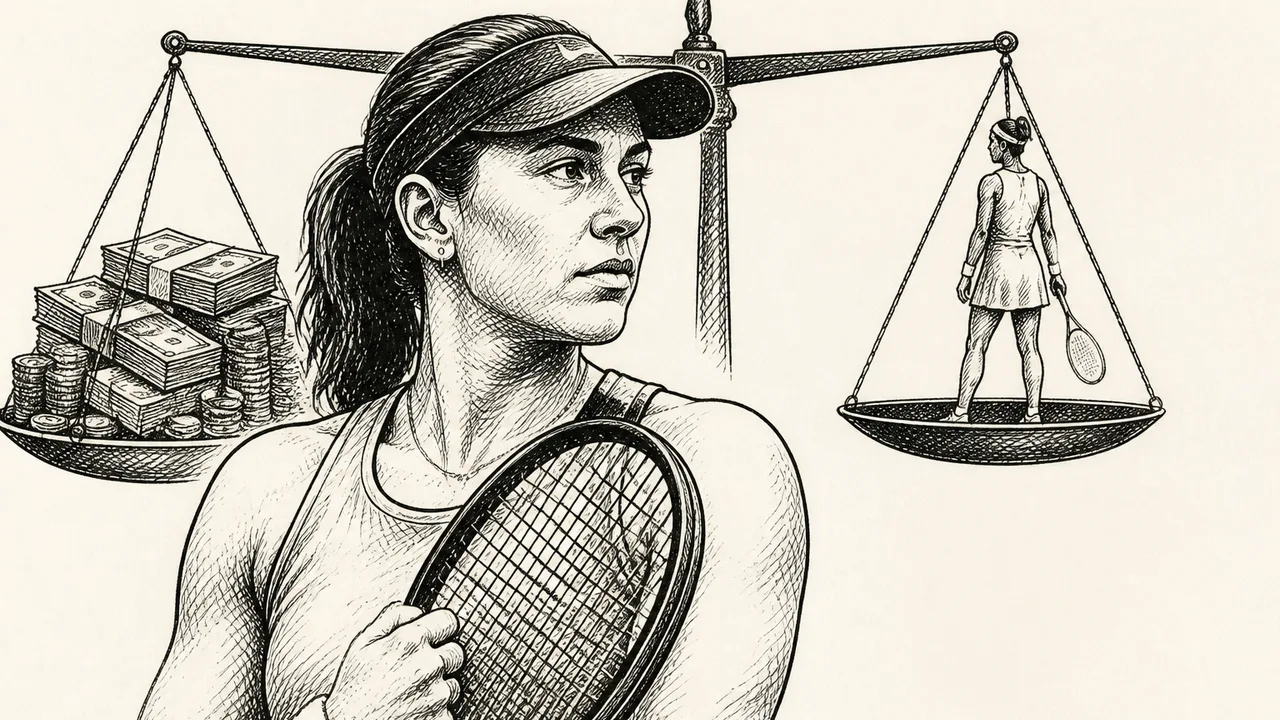
Photo: AI. Eira Pendragon
There's no guaranteed paycheck. No salary floor. No one coming to save you if you have a bad quarter. You show up, you perform, you get paid — and if you can't perform, you don't.
That's not a description of the freelance economy, though it could be. That's professional tennis. And it's exactly why what Jess Pegula is trying to do — build a collective advocacy movement among people who are structurally, contractually, and temperamentally wired to go it alone — is so much harder than it sounds.
In a recent Bloomberg interview on The Deal, Pegula sat down with hosts Jason Kelly and Alex Rodriguez a few days after winning the Charleston Open for the second consecutive year. The conversation moved quickly past the trophy and into territory that doesn't usually make sports highlights: revenue splits, independent contractor economics, tournament prize money disparities, and the mechanics of building solidarity among people who have no union, no collective bargaining agreement, and an almost existential financial incentive to keep playing no matter what.
I found myself watching this thing twice. Not because Pegula is a particularly polished talker — she's refreshingly not — but because she kept describing problems I recognized from a completely different world.
When I ran my bookstore in Asheville, I couldn't go on strike against my landlord. I couldn't boycott my distributors. If I stopped operating for a week to make a point, I lost a week of revenue I couldn't get back, and nobody was coming to compensate me for the principle. That's not weakness. That's the math of running your own operation with no floor underneath you. Pegula described exactly the same trap, just with a different backdrop: "In tennis, you know, you make your money a lot by winning matches. You don't get paid a salary or get paid anything for just the year. So I think that always changes everyone's mind — I have to keep playing. I'm not going to strike. I'm not going to boycott."
She's not describing cowardice. She's describing the structural reality of being an independent operator in a high-stakes, short-window business. Every consultant, every sole proprietor, every freelancer reading this knows the feeling. The leverage you theoretically have evaporates the moment you actually need to use it.
This is the wall Pegula is trying to scale. And she's trying to scale it without the tool that every other major American sport used to get players their share: a union. The NFL, NBA, MLB, and NHL all have collective bargaining agreements that govern revenue splits — though the specific percentages vary by league and shift with each CBA cycle, so the shorthand of "roughly 50-50" that gets thrown around is more ballpark than precision. Tennis has the WTA Player Council, which Pegula joined almost by accident around four years ago when a player retired and left an open seat. She took it unsure whether it was really for her. She's been sitting in the middle of the sport's business structure ever since.
What she's actually proposing is unusual enough to be worth noting. She's trying to get ATP and WTA players — men and women — to make a joint push for a larger share of Grand Slam revenue. Two separate organizations, two separate competitive circuits, one ask. "Quite frankly, we've never really had both the men and the women on both sides actually come together," she said. "Which is super rare in any sport, because when would that really ever happen?"
She's right that it's rare. She's also right that it benefits both sides, which is the only reason it's even a viable conversation. But I've watched enough small operators try to build coalitions — merchant associations, downtown business districts, buying cooperatives — to know that "everyone's for it" and "everyone acts on it simultaneously" are two very different things. The people who want change most are the ones who can least afford to wait. The people with enough cushion to hold the line long enough to make change happen are usually comfortable enough that the urgency fades.
Pegula acknowledged this with striking honesty. The opposition, she said, is playing a long game: "They're going to wear you down." And she admits the players get worn down. The advocacy narrative is hard to sustain when you're also trying to train, travel eleven months a year, and actually win matches.
The season length, by the way, isn't a separate grievance — it feeds directly into the leverage problem. An eleven-month circuit with constant travel means players are perpetually exhausted and perpetually dependent on the next tournament's income. That's not a scheduling inconvenience. That's a structural feature that makes collective action harder, not easier. Tired, financially exposed people do not hold the line.
The Charleston Open story Pegula told is a useful case study in how change actually moves in this ecosystem — and in its limits. Tournament owner Ben Navarro announced after last year's final that he'd bring his WTA 500 event's prize money in line with the equivalent ATP 500 level. It was a meaningful move. Pegula, who confirmed she'd won the tournament in consecutive years, joked she wished he'd done it a year sooner. Several other elite-level events — Madrid, Miami, Indian Wells among them, according to Pegula — have reportedly moved toward prize money parity as well. Progress, by any fair accounting.
But here's what I keep coming back to: it happened because one owner decided to do it. Ben Navarro made a choice. There's no mechanism that required it, no structure that compels the next owner to follow. The lower-tier tournaments Pegula mentions — where the prize money disparities are still real, and where the players competing are the ones who can least absorb them — those owners can watch Charleston and do nothing. Good behavior in a decentralized system is contagious only if someone makes it so.
Billie Jean King, who Pegula says texts her regularly and is firmly in the players' corner, built her career fighting these same fights. The history is worth getting right: King co-founded the Virginia Slims circuit in 1970 and the WTA in 1973, and the US Open became the first Grand Slam to offer equal prize money that same year. But equal prize money didn't reach all four Grand Slams until Wimbledon and the French Open equalized decades later — in 2006 and 2006 respectively. What looks from a distance like a moment was actually a thirty-year arc. Pegula knows this lineage. "She's set the standard and the bar very high for us," she said of King. She also knows that thirty years is a long time to be asking.
The most interesting thing Pegula said in the whole conversation was about her own education. She didn't walk onto the Player Council as a business mind. She walked on because a seat was available and someone talked her into it. And then she started learning — not from a textbook but from being inside the room where decisions get made. She credits her parents, Kim and Terry Pegula (owners of the Buffalo Bills and Buffalo Sabres), with teaching her to hold both sides of a negotiation in her head at once: "There's the player side, and there's also a business side. And sometimes it isn't as black and white as people think."
Kim and Terry Pegula figured out how to own an NFL franchise the same way most small business owners figure out anything — by doing it with no prior manual. Nobody grows up owning a sports team. You just get the thing and you learn. Jess Pegula absorbed that lesson, and it shows in how she talks about tournament operators. She doesn't frame them as villains. She frames them as people with their own business pressures who might, under the right conditions, choose to do the right thing.
That's a mature read. It's also, I'd argue, a somewhat optimistic one — and here's where my thirty years of watching coalitions form and dissolve makes me the uncomfortable voice in the room.
Goodwill and moral example are real forces. But they're not durable ones. The Charleston standard holds as long as Ben Navarro holds it. The momentum toward equal prize money at major events continues as long as the right people stay engaged and the financial conditions favor it. What tennis players don't have — and what Pegula is essentially trying to build from scratch through sheer force of relationship and persuasion — is a structure that doesn't depend on everyone staying motivated at the same time.
She might get it done. She's clearly smart, clearly committed, and clearly understands the business well enough to be taken seriously across both sides of the table. But the thing that undone more coalitions than I can count isn't bad faith or opposition. It's fatigue. And she already knows that's the game her opponents are playing.
More Like This
Ted Turner, PWHL Detroit, and a Turbulent Sports Media Day
Ted Turner's death, PWHL's Detroit expansion, FanDuel's CEO ouster, and ESPN's NFL rights silence made May 7 a defining day in sports business.
Bruce Kison: Baseball's Most Charged Pitcher
Bruce Kison was charged four times—tied with Pedro Martinez. Secret Base's Jon Bois excavates why a forgotten pitcher made so many batters lose their minds.

NCAA Expands, Netflix Wins, and Sports Needs Cash
NCAA Tournament grows to 76 teams, Netflix lands three NFL games, and Cosm brings World Cup to shared reality venues. The week's sports business, mapped.

When Your Partner Calls Your Dream "Loser Stuff"
Dr. K unpacks what it really means when a partner dismisses your gaming ambitions—and why rigidity, not the hobby, is the real red flag.

Conway's Constant and the Power of Slow Attention
A children's counting game hides a degree-71 polynomial. What John Conway's slow, patient method reveals about how real insight actually works.
AJ Andrews on Building Baseball's and Softball's Future
AJ Andrews tells Bloomberg's The Deal how authenticity and storytelling can grow baseball and softball—lessons that go well beyond sports.

Texas Is Becoming the Hub of Commercial Space
From SpaceX's Starbase to Firefly's moon landing, Texas has become the center of commercial space. Here's what's driving the shift—and what it costs.

Spain's Immigration Boom: Real Gains, Real Costs
Spain's mass immigration wave is propping up its pension system — but stagnant wages and a housing crisis reveal what the government isn't building alongside it.