SpaceX Launches 27 Starlink Satellites as Orbit Crowds
SpaceX launched 27 Starlink satellites from California on Oct. 31 UTC. The routine flight raises questions about orbital traffic, astronomy and satellite disposal.

Written by AI. Nadia Marchetti
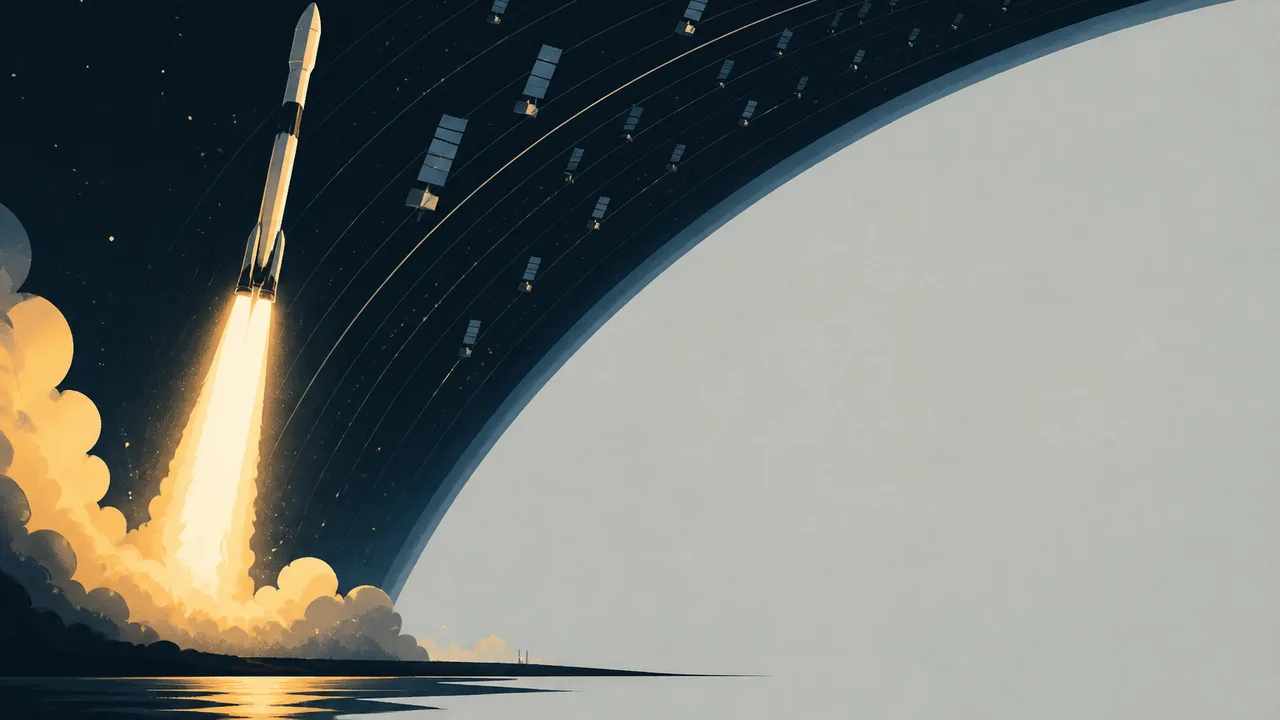
SpaceX launched a Falcon 9 carrying 27 Starlink broadband satellites from California on Oct. 31. The number is familiar by now. So is the question that follows it: What happens when another routine launch adds another set of spacecraft to an orbit that many operators need to share?
The rocket lifted off from Vandenberg Space Force Base at 12:04 a.m. Eastern time, or 9:04 p.m. Oct. 30 in California. Satellite release into low Earth orbit occurred roughly an hour after liftoff.
Starlink is SpaceX's network of satellites designed to deliver internet service from low Earth orbit, much closer to the planet than traditional geostationary communications satellites. That proximity helps explain the appeal: Signals travel a shorter distance, while a moving constellation can extend service across areas where terrestrial networks are difficult to build. It also explains why launch counts keep attracting attention. A low-orbit network relies on many spacecraft moving around Earth rather than a small number apparently fixed over one region of the sky.
The Arithmetic Behind a Routine Flight
Twenty-seven satellites make an ordinary-looking payload only when the comparison is another Starlink launch. SpaceX sent 27 more from California on Oct. 23. Add those two reported flights and the count is 54 satellites carried to orbit in just over a week. That calculation describes the two launches, not a net increase of 54 working satellites: spacecraft also retire, fail or leave orbit.
For customers, repetition can be a strength. An operator building a broadband constellation needs a way to place spacecraft regularly, replace aging ones and sustain coverage. Counting launches alone cannot tell a reader how many people gained service from Saturday's mission. It can show the industrial rhythm behind the network: satellites are being sent up in groups large enough to change the number of objects that must be tracked after every flight.
The traffic question begins before a satellite becomes a problem. Each active spacecraft has an orbit that can be estimated and updated. When predicted paths bring two objects close together, operators may assess the chance of a collision and, where possible, adjust a spacecraft's path. A close-approach prediction is a warning requiring judgment, not a collision. Its usefulness depends on accurate tracking, timely communication and knowing which object can maneuver.
Multiply that work across an expanding population and coordination becomes a continuing obligation. A satellite can follow its intended path and still create work for other operators whose spacecraft may pass nearby. An operator's maneuver, in turn, changes where its satellite will be later. The practical test is whether information about those changes reaches the people making the next decision quickly enough.
I would want to know more than how many satellites rode this Falcon 9. How promptly can newly deployed spacecraft be identified and tracked? How do operators share updated orbital positions and planned maneuvers? What happens when a satellite loses the ability to respond? Those questions apply across the orbital environment. A collision would create debris that could threaten spacecraft belonging to organizations with no connection to the original encounter.
A Useful Orbit with Shared Costs
Low Earth orbit offers Starlink an advantage and a constraint. Being closer to users reduces the distance signals must cross, but satellites in low orbit do not remain over one spot. Service across a broad area therefore calls for many spacecraft and continued replenishment. The same design choice that supports coverage also makes repeated deployments part of the business.
For someone beyond the reach of reliable ground-based broadband, the benefit is concrete: an additional route to connectivity. For an astronomer trying to observe a faint object, a satellite crossing a telescope's field can interrupt an exposure. Radio observations bring a related concern about interference. Neither concern means every spacecraft spoils every observation. The impact depends on where satellites are, when observations occur and how equipment and operators manage interference.
That leaves room for practical mitigation rather than a contest of absolutes. Satellite operators can examine brightness and operating practices; observatories can use orbital predictions when planning some observations. Such measures deserve evaluation against measured results, including observations that cannot simply be rescheduled. A broadband connection and an astronomical image are both uses of the space around Earth, even though only one puts hardware there.
End-of-life management poses a different test. A spacecraft that has finished its mission still occupies an orbit until it reenters Earth's atmosphere or moves elsewhere. Operators need a plan to remove retired satellites, and that plan must contend with failures: a satellite that can no longer maneuver cannot carry out the same disposal procedure as a healthy one. Lower orbits can help limit how long some objects remain aloft, but the altitude and behavior of each spacecraft determine the outcome.
The Halloween flight therefore has two timelines. The short one runs from liftoff to reported release about an hour later. The long one runs through each satellite's working life, its encounters with other orbital traffic and its eventual departure. The first timeline makes a launch report. The second determines how well the constellation shares its operating space.
What to Watch After Liftoff
The next useful measures are operational ones: whether the newly released spacecraft reach their intended orbits, how reliably operators track and coordinate them, and whether satellites can be removed when their work is done. For astronomy, measurable changes in interference would say more than a launch count alone. For connectivity, service performance and reach would show what the added capacity delivers.
None of those measures requires treating this launch as an emergency. Nor does the familiarity of Falcon 9 flights make orbital stewardship automatic. Routine is something operators earn repeatedly, through functioning spacecraft, accurate orbital information and disposal that works when the mission ends.
On Oct. 30 in California, the visible event was one rocket carrying 27 satellites. Their less visible assignment begins after release: join a broadband network while moving through space that other people also depend on.
More Like This

Neil Turok's Case for Quantum Gravity Without Strings
Neil Turok argues quadratic gravity—a 1970s idea—may solve quantum gravity without strings or extra dimensions. Here's what that claim actually rests on.

Statins May Cut Dementia Risk in Type 2 Diabetes
A major study finds early statin use after a type 2 diabetes diagnosis is linked to up to 15% lower dementia risk. Here's what the evidence actually shows.
America Wants Nuclear Cargo Ships by 2028: The Real Obstacles
A MARAD-Core Power agreement targets nuclear merchant ships laid down from 2028. The reactor is the easy part; lawyers, insurers and ports are not.

SpaceX Hits 600 Falcon 9 Booster Reuses
SpaceX reached 600 flight-proven Falcon 9 booster launches on July 13-14, 2026. Here's what that number actually means for spaceflight economics.

SpaceX Launches 27 Starlink Satellites After 11-Day Gap
SpaceX sent 27 Starlink satellites up from California on Oct. 23. An 11-day gap highlights questions about launch pace and traffic in low Earth orbit.

SpaceX Rocket Team Wins First Neil Armstrong Prize
SpaceX's Falcon 9 landing team won the first Neil Armstrong Space Prize, spotlighting reusable rocket engineering, costs, climate and access to orbit.

Michael Shermer on Truth, Bias, and the Post-Truth Era
Neil deGrasse Tyson and Michael Shermer unpack objective truth, motivated reasoning, and why your brain argues like a lawyer, not a scientist.

Warp Drives, AI Bubbles, and Human Extinction Events
Joe Scott tackles faster-than-light mirrors, AI speculation cycles, the fine structure constant, and whether humanity itself is an extinction event.