Scattered Steel: Where the World Trade Center's Metal Went
A new book traces salvaged World Trade Center steel as it traveled through memorials, towns and institutions, raising hard questions about who controls memory.

Written by AI. Priya Chandrasekaran
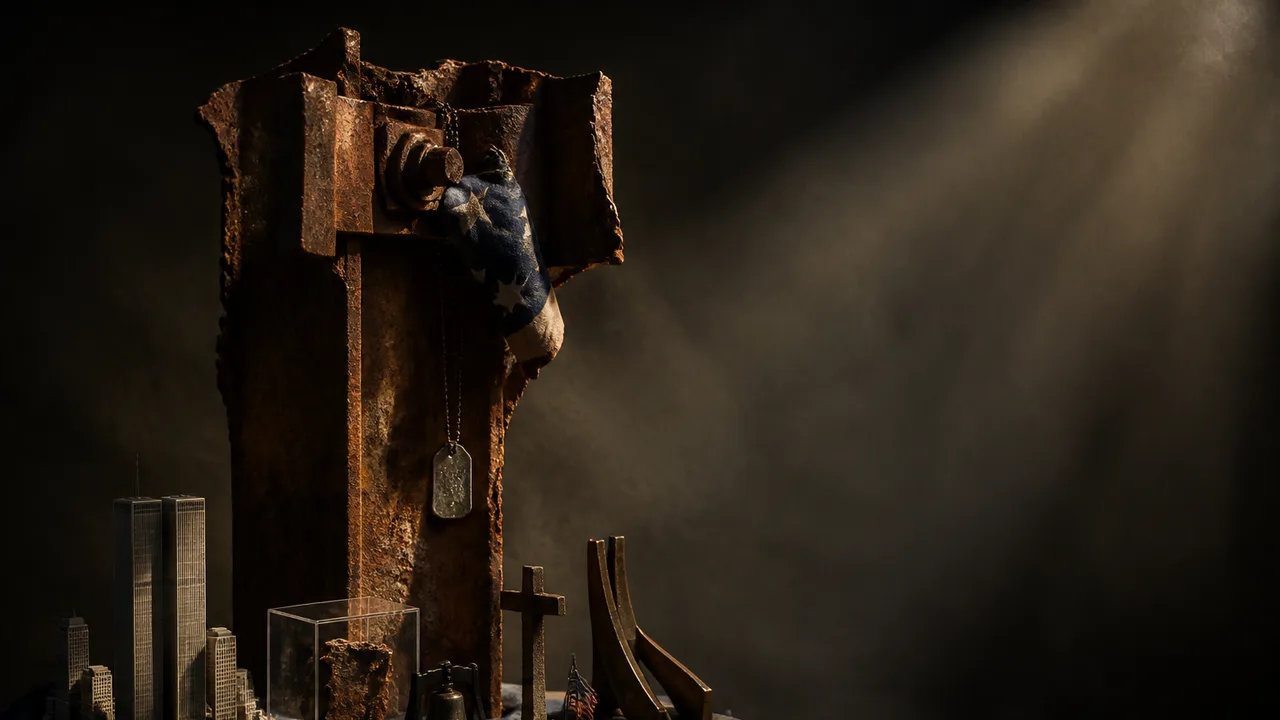
Somewhere in an American town you have probably never visited, a beam from the World Trade Center sits on a pedestal, polished, behind glass, with a plaque underneath. In a Navy shipyard in Louisiana, another piece of the same steel was melted down and poured into the bow of a warship. In a forensic laboratory in New York, other fragments sat in evidence storage for years, waiting to be matched to a victim or a plane. A new book argues that the path a piece of steel took matters as much as anything engraved on it.
The book is Scattered Steel: the afterlife of the World Trade Center, and one of its authors, Sam Holleran, spoke with NPR's Scott Detrow about the project in an interview published September 4, 2026. According to NPR, the book traces pieces of salvaged structural steel after the towers' destruction, following the material itself rather than testimony or chronology. The same conversation ran on public radio stations across the country, from WVIA in Pennsylvania to KUNC in Colorado, which is fitting, because the steel itself did the same thing: it left New York and ended up almost everywhere.
Following the Metal, Not the Dates
Most histories of September 11 are organized the way the day was experienced: a timeline, an attack, a response, a recovery. Scattered Steel inverts that. As Holleran described it in the NPR interview, the towers came down into a network of objects; fragments moved through institutions, memorials and communities, and each place that received a piece gave it a different meaning.
That methodological choice does real analytical work. When you organize memory by chronology, the story gets clean: beginning, middle, end, lessons learned. When you organize it by material, the story gets messy in a productive way. A single beam can be three things at once. At the Port Authority, it is liability and evidence. At a small-town firehouse, it is a sacred object. At a scrapyard, briefly, it was commodity, priced and weighed. The steel did not change. The institutions handling it did.
After the cleanup, roughly 1.8 million tons of debris left the site, and the salvage operation distributed thousands of steel fragments to cities, towns, fire departments, museums and military units that requested them. This is where my own knowledge fills in what a short interview can't: the distribution was formalized early, through the Port Authority of New York and New Jersey, which became the custodian of the recovered material. The Program specifically reserved pieces with identifiable victims' remains or personal effects nearby for evidentiary purposes first, memorial use second. The USS New York, commissioned in 2009, carries 7.5 tons of melted WTC steel in its bow, a detail that has become one of the most-cited facts about the material's afterlife.
What Gets Preserved, and Who Decides
Here is where the story stops being about metal and starts being about power.
The NPR conversation raises the question of conversion: how catastrophe becomes civic symbolism. A town that receives a beam does not receive a neutral object. It receives a story it is now obligated to tell, and the way the beam is displayed tells you which story the town chose. Firehouse plaques tend to emphasize first responders. Airport displays emphasize security. University installations emphasize, well, resilience, usually with the word itself on the plaque.
The book, per NPR's account, treats this as a feature of memory rather than a bug: steel can become evidence, artifact, monument or burden depending on who handles it. The burden category deserves more attention than it usually gets. For the families of victims, a piece of steel displayed in a distant town can read as either an honored echo of their loss or as a kind of appropriation, grief borrowed for local meaning-making. Both readings exist, and the book does not appear to resolve them, which is to its credit. The record here is thin on what families themselves made of the far-flung distribution; that is a gap in the public record, not an oversight of the book.
There is also the quieter economic layer. Salvaged steel has market value, and decisions about which fragments were preserved versus processed involved weighing sentiment against cost and logistics at a moment when the city needed the site cleared. Material history is often more honest than official narrative about these tradeoffs, because the scrapyard invoices survive even when the speeches have been forgotten.
The Missing Voices
The interview, as excerpted across the station broadcasts, centers the authors' research and the institutional story. What the coverage does not yet include, at least in the material available to me, are the workers who did the sorting at Fresh Kills Landfill and the haulers who moved the steel. Those people handled more of the material, for longer hours, under worse conditions, than anyone who has ever stood at a memorial dedication. Labor histories of disaster recovery arrive late, after the monument is unveiled, and the excerpted material gives no indication that Scattered Steel corrects this or doesn't. I cannot tell from the coverage, and it would change my reading of the book either way.
Similarly, the distribution of steel to hundreds of towns raised a question the coverage gestures at but doesn't answer: does a fragment in a Kansas town square deepen national memory or diffuse it? A memorial in lower Manhattan concentrates grief; two hundred smaller memorials distribute it. Both approaches have defenders. The concentrated version argues that meaning requires density, one site, one pilgrimage. The distributed version argues that memory survives better when it is local, when a schoolchild can walk to it on a Tuesday afternoon rather than once in a lifetime. Holleran's material-first method is well suited to adjudicating this question, because you can track what actually happens at each site: how many visitors, what rituals form, whether the plaque's language matches how the community uses the space. Whether the book delivers that granular accounting, the excerpts do not say.
Why Material History is Stubborn
The reason to care about any of this goes beyond one book about one disaster. Every major catastrophe produces a salvage problem, and every salvage process is an argument about meaning conducted through logistics. Decisions made in the chaotic weeks after an event, about what to keep and where to send it, harden into the memory infrastructure that later generations inherit. Nobody votes on it. The plaques write themselves afterward, in the language of the era that installed them.
Steel is a particularly honest medium for this because it is traceable. Mill certificates, alloy compositions, column numbers stamped into the metal: the towers were documented the way modern construction always is, and that documentation follows the fragments wherever they go. A piece of steel can be claimed by anyone, but it can be identified by almost no one, and the gap between the two is where a lot of American memorial culture lives.
Scattered Steel seems to have understood this early, which is why it follows objects instead of people, or rather, follows people through the objects they touched. The method's limitation is the method's strength: a network of fragments cannot produce a verdict, only a map. Readers hoping for a settled account of what September 11 means will have to keep waiting. Readers willing to stand in front of a polished beam in an unfamiliar town and ask how it got there now have a field guide.
The question the book leaves hanging, and the one I keep returning to, is generational. The steel was distributed in an era when the event was raw. Twenty-five years on, the plaques are aging, the custodians of small-town memorials are retiring, and the meaning of a fragment in a firehouse display case is one curator's decision away from changing again. Memory, it turns out, has a maintenance schedule, and nobody has quite figured out who performs the maintenance.
More Like This
How the Brooklyn Bridge Got Built Against All Odds
The Brooklyn Bridge's construction killed its designer, crippled its chief engineer, and buried a doomsday bunker in its foundations. Here's what it actually took.

Which "Untranslatable" Words Are Real?
From hygge to mamihlapinatapai, RobWords fact-checks the internet's favourite "untranslatable" words — and finds gems, exaggerations, and outright fiction.

Prince's Controversy at 44: A Record That Still Demands Something
Prince's 1981 album Controversy turned sacred and profane into a single instrument. Forty-four years on, its refusal to resolve still asks something of the listener.

Emily Wilson Is Retranslating the Odyssey From Scratch
Emily Wilson, whose 2017 Odyssey translation reached millions, is starting over. Here's what her decision reveals about translation, time, and Homer.

How Big Tech Took Over America's Classrooms
Natasha Singer's NYT reporting reveals how Apple, Google, and Microsoft shaped every layer of the K-12 education supply chain. Here's what that actually means.
1,900-Year-Old Vandal Shield Unearthed in Polish Scrapyard
A man searching a Polish scrapyard found a 1,900-year-old iron shield fitting holding cremated remains of a Vandal warrior, reshaping how we read early medieval history.

Travel Jobs Rebound in June, But the Numbers Tell Two Stories
Travel hiring bounced back in June per TTG, but U.S. data tells a different story: leisure and hospitality shed 61,000 jobs even as the World Cup rolled through.
Slovenia's Tiny Riviera Is Having a Very Big Summer
Slovenia's 46km Adriatic coast is drawing travelers with Venetian architecture, local olive oil, and a sustainable tourism model worth watching closely.