Saturn's South Pole Decagon: A 10-Sided Storm Explained
Hubble has tracked a 10-sided cloud pattern at Saturn's south pole. Here's what scientists know, what they don't, and why the geometry matters.

Written by AI. Nadia Marchetti
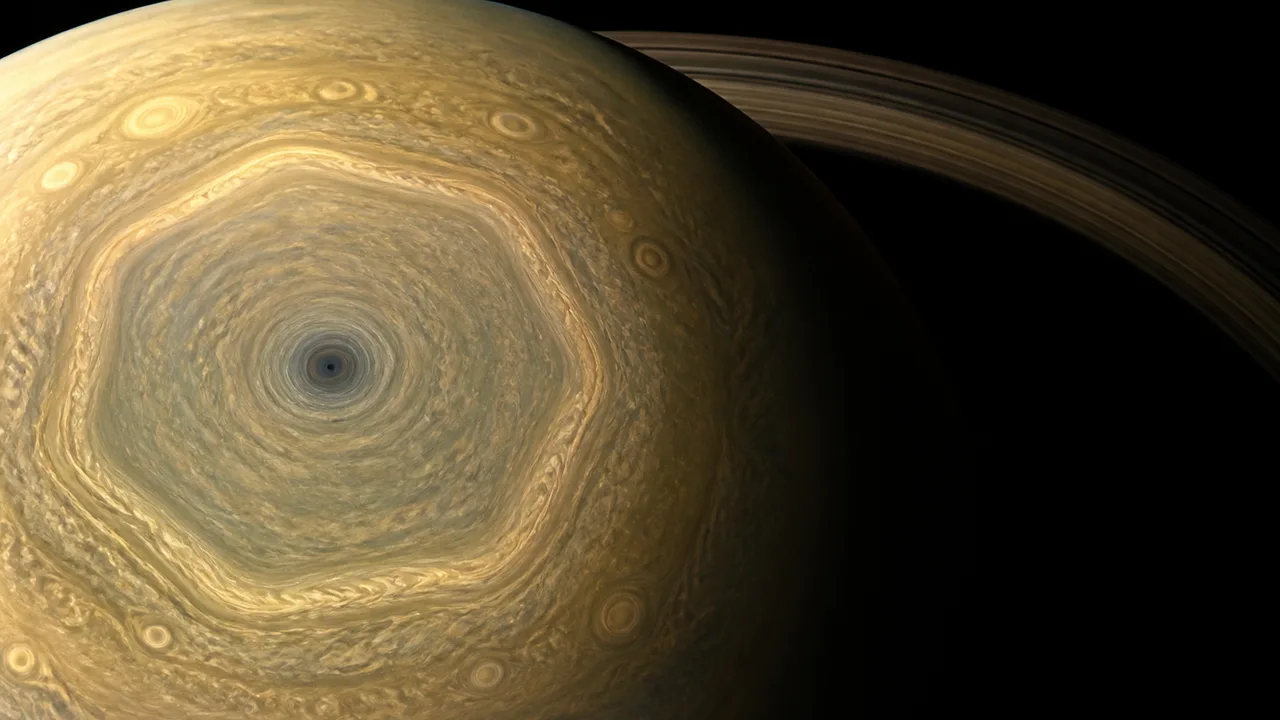
Saturn already had one geometric party trick: a hexagonal storm system at its north pole, first spotted by Voyager in the 1980s and confirmed by Cassini as a persistent, planet-scale structure roughly 30,000 kilometers across. Planetary scientists spent decades working out how a gas giant could sustain a six-sided vortex without solid walls to hold it. Now, according to NASA (science.nasa.gov) and confirmed reporting from ESA (esa.int), Hubble has been tracking something at the south pole with ten sides.
Ten.
The discovery was announced in early September 2026, and the reaction from the planetary science community landed somewhere between fascinated and stumped. According to ScienceAlert, researchers described the structure as "uncannily geometric," a phrase that carries more weight when you consider that no fluid dynamics textbook predicted it. New Scientist called it "big" and "weird."
What Hubble actually found
The structure is a decagonal wave encircling Saturn's south pole, observed through high-resolution Hubble imaging. According to Phys.org, the feature appears as a cloud pattern forming a distinct 10-sided figure at polar latitudes. ScienceNews characterized it as a "bizarre decagon," with the emphasis on the persistence of the geometry over the observation period, not just a one-frame fluke.
ScienceDaily notes this as a NASA-attributed discovery, framing it as a "giant 10-sided pattern." Sci.News described it as a "decagonal wave," which is a meaningful distinction: this may be a wave phenomenon rather than a closed vortex, implying different physics from the north polar hexagon.
Space.com frames it as challenging existing models of planetary weather systems, and EarthSky flags that it has now been "confirmed," meaning the structure survived long enough across multiple observations to rule out instrumental artifact or atmospheric noise.
Why polygons form in planetary atmospheres
The hexagon at Saturn's north pole gave researchers a template for thinking about this. Laboratory experiments, notably work done by researchers at Oxford in the early 2000s, demonstrated that rotating fluids can spontaneously produce polygonal structures. When you spin a tank of water and introduce a differential rotation speed at the center, the boundary between the two rotation rates becomes unstable and locks into a polygon. The number of sides depends on the rotation rates and fluid properties.
This is called a Rossby wave, more precisely: a polar Rossby wave, a large-scale oscillation in rotating fluids caused by the variation in rotation rate with latitude. For Saturn's north pole hexagon, the six-sided shape corresponded to a wave number of six, meaning the wave completes six full oscillations as it circles the pole.
A decagon implies a wave number of ten. That's a higher-frequency wave than the hexagon, which means either the south pole's atmospheric conditions differ substantially from the north, or something about the geometry of polar circulation at that latitude favors a tighter wave pattern. Scientific American describes it as a "mysterious wave," and the mystery lives in exactly that question: what physical conditions set the wave number at ten rather than six, or four, or some other value?
The asymmetry problem
Saturn's poles are not interchangeable. The north pole hosts a mature, documented hexagonal vortex. The south pole hosts something formally different: a wave structure with twice as many sides. That asymmetry demands an explanation.
One possibility is seasonal forcing. Saturn's axial tilt is about 26.7 degrees, close to Earth's, meaning it experiences seasons. The south pole is only now emerging from a long southern winter and re-entering sunlight. Cassini's south pole observations, conducted during a different seasonal phase, did not document a decagon. That absence could mean the structure is seasonal; it could mean the resolution wasn't sufficient to detect it; it could mean it didn't exist yet.
Gizmodo frames the decagon as a potential "twin" to the north polar hexagon, which is a compelling narrative but probably oversimplifies the physics. A twin would share the same wave number. A ten-sided structure at the south is either a different atmospheric regime entirely or a product of different forcing conditions, and scientists have not yet settled which.
The honest gap in the current literature: no confirmed mechanism has been published explaining why south polar conditions would produce wave number ten specifically. The observations are confirmed; the explanation is still open.
Why this matters beyond Saturn
The standard journalistic hedge here would be to mention exoplanets and leave it vague. The more specific version: gas giants in other solar systems are now being characterized through atmospheric spectroscopy, and understanding how wave dynamics produce large-scale structure in rapidly rotating, hydrogen-dominated atmospheres feeds directly into interpreting those spectra. If polar wave patterns are sensitive to seasonal forcing or internal heat flux, that's a diagnostic tool. A planet with a high-wave-number polar structure might be telling you something about its rotation rate or heat budget that you couldn't read from disk-integrated measurements alone.
Space.com notes the implications for studying exoplanets with similar characteristics, and this is the area where the Saturn finding does the most upstream work. Saturn is the control case: we can observe it in detail, track changes over seasons, and eventually cross-check atmospheric models against structures we can actually see. That's not a luxury planetary scientists get with a planet 40 light-years away.
What comes next
Hubble will continue tracking the structure. The key observational questions are whether the decagon is stable over Saturn's seasons the way the north polar hexagon has proven to be, whether it drifts in longitude (which would carry information about the wave's phase speed), and whether its shape or amplitude changes as the south pole continues its transition into sunlight.
Laboratory fluid dynamics experiments and numerical simulations will almost certainly follow. The hexagon generated a substantial modeling literature, and a ten-sided counterpart at the opposite pole is a comparative constraint that makes models either more credible or clearly wrong.
Saturn has spent forty years as the most visually striking planet in the solar system, and it keeps adding structure. The north pole has a hexagon that's been spinning since before Voyager photographed it. The south pole, now confirmed by Hubble, has a ten-sided wave that no existing model fully predicted.
If the hexagon took decades to explain, the question worth keeping in mind is not just what makes a decagon, but what it says about how little we still understand of the basic physics operating inside a world we've been photographing since Galileo pointed a telescope at its rings.
More Like This

We've Been Teaching Heisenberg's Uncertainty Principle Wrong
The story we tell about Heisenberg's Uncertainty Principle is misleading. Professor Aephraim Steinberg explains what the textbooks got wrong—and what's right.

Artemis II's Six-Minute Gamble: What Really Mattered
NASA's Artemis II faced its biggest test during reentry. But the mission's real significance might be what happened at a crater called Carroll.
Triton's Strange Orbit and the Ice Giants' Secrets
Triton's retrograde orbit, nitrogen geysers, and the chaotic magnetic fields of Uranus and Neptune reveal how little we understand our own solar system.
Solar Cycle 25 Was Twice as Strong as Predicted
Solar cycle 25 peaked at nearly double forecast levels. Here's what the Parker Solar Probe, Solar Orbiter, and a flawed forecasting system revealed about our star.
Solar Orbiter Captures First Direct View of the Sun's Poles
Solar Orbiter has captured the first direct images of the Sun's poles, revealing a chaotic magnetic field mid-reversal—and what it means for space weather forecasting.
Two Small Worlds With Atmospheres They Shouldn't Have
A Kuiper Belt rock and a distant rocky exoplanet both carry atmospheres that shouldn't exist. What these discoveries reveal about planetary science.

A Physicist Calls UFO Disclosure a Distraction
Physicist Brian Keating tore through the latest government UFO release and found nothing. His argument: the timing alone makes it suspect.

Do DMT Entities Point to Alien Consciousness?
Cognitive scientist Donald Hoffman claims DMT entities may be real alien minds. The math is real. Whether it proves anything about consciousness is a different question.