Reykjavík and the Golden Circle: What Iceland Serves
From fermented shark to geothermal pools, Rick Steves' Iceland episode reveals a country where geology, history, and food are inseparable from each other.

Written by AI. Priya Chandrasekaran
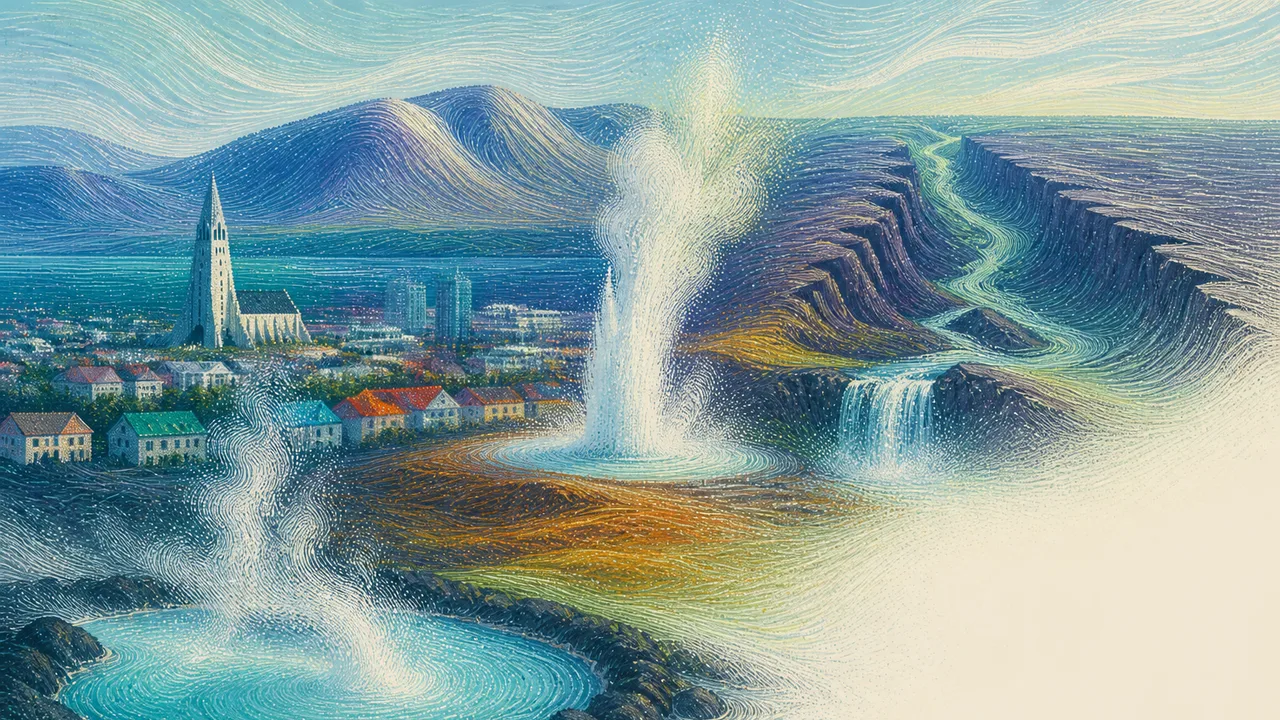
Photo: AI. Dexter Bloomfield
There is a dish in Iceland that summarizes the entire national character more efficiently than any museum exhibit. It is called hákarl — fermented Greenland shark — and the process of making it is, on its face, an argument against eating it at all. The shark is toxic when fresh. You bury it, let it ferment for months, hang it to dry, trim away the ammonia-crusted exterior, and then eat the interior cubes with a shot of brennivín to chase down the gas-station aftertaste. As local guide Saga Friðriksdóttir explains it in Rick Steves' recent episode on Reykjavík and the Golden Circle: "If you would eat the shark straight away, when it's fresh, you would die, unfortunately."
Her follow-up is the more interesting observation: "I always think, how many tries did it take to figure out this method of not getting killed by eating the shark?"
That question — how many tries, at what cost, before survival became technique — is the question Iceland keeps answering across every domain you look at. Geology, architecture, agriculture, democratic governance. The island's entire identity is built from the iterative logic of hardship foods: you transform the toxic thing into the edible thing, and then you serve it to guests.
A Capital That Fits in Your Pocket
Reykjavík is the northernmost capital on Earth, and it holds roughly the same population as Berkeley, California or Fargo, North Dakota. These comparisons are Steves' own, and they do useful work: they calibrate expectations. This is not a city that competes with Paris or Copenhagen on the density of world-class institutions. What it offers instead is coherence — the sense that you can actually understand a place in a few days, that the scale is human.
The architecture tells this story efficiently. Hallgrímskirkja, the Lutheran church that crowns the city's central hill, had its design commissioned in 1937 by state architect Guðjón Samúelsson, according to the church's own historical record — though construction didn't begin until 1945 and the tower wasn't completed until 1986. That 49-year gap between conception and completion says something about a country that has always been building against the odds. The church's stepped basalt-column silhouette is not decoration; it is a formal argument that the landscape and the built environment should speak the same visual language.
Down at the harbor, the Harpa concert hall makes the opposite argument — that Iceland can also speak the language of global contemporary architecture. Its honeycomb glass facade opened in 2011, and it landed the country on international design maps. Both buildings are worth seeing, not because they are individually extraordinary by global standards, but because together they bracket the range of what Reykjavík is attempting.
The city's street art operates on similar logic. As Friðriksdóttir notes walking through the colorful neighborhoods: blank walls get tagged with graffiti regardless, so homeowners began commissioning murals instead. It is a policy born of pragmatism that produced something genuinely beautiful — which is roughly the Icelandic method applied to urban aesthetics.
The Pool as Social Infrastructure
Before you go to the Blue Lagoon, understand what it is. The Blue Lagoon began as industrial runoff — a geothermal plant's mineral-rich waste water that pooled in a lava field near the airport. Locals discovered it was pleasant to bathe in. Developers noticed the locals, built luxury infrastructure around the phenomenon, and now charge roughly ten times the price of a neighborhood thermal pool for the privilege of soaking in what is, technically, someone else's hot wastewater. That is not a complaint; the Blue Lagoon is genuinely beautiful and the experience is well-managed. But it is worth naming what it is.
The neighborhood pools are what Steves chooses, and the choice is instructive. These are community thermal baths fed by natural hot springs, where, as he puts it, "student, truck driver, doctor, and tourist — everybody's equal in the pool." That is the democratic promise of geothermal infrastructure: when heat is essentially free, it becomes public in a way that heat rarely is anywhere else. Icelanders crack their windows open in winter not because they are unconcerned about energy costs, but because geothermal heating is cheap enough that temperature regulation via window is easier than adjusting the radiator.
The pool, in this context, is not a luxury amenity. It is where Icelanders go after work. It is the pub, the town square, the place where social fabric gets maintained in a country where farms were once so isolated that the annual parliament was the only gathering that mattered.
What the Ground Is Actually Doing at Þingvellir
The Golden Circle day trip — a roughly 150-mile loop from Reykjavík — is structured around three anchors: Þingvellir National Park, the Geysir geothermal field, and Gullfoss waterfall. Each one would justify a standalone journey. Together they make the case that Iceland is a place where natural science and human history literally occupy the same ground.
Þingvellir is where the North American and Eurasian tectonic plates are pulling apart. According to Atlas Iceland, the rift valley here widens at a rate of around 2.5 centimeters per year — slow enough to be imperceptible in a human lifetime, consequential enough to have split a continent. You can walk along the fissure and feel, or try to feel, what it means to stand at the edge of two geological worlds. The lava fields on either side look identical. The gap between them is the story.
The same site is also where the Alþingi — Iceland's parliament — first convened roughly a thousand years ago. Chieftains from isolated farms across the island traveled to this plain every summer to make collective decisions. In an era of near-universal illiteracy, proceedings opened with an oral recitation of the previous year's rulings. The Alþingi was later suspended during the centuries of Danish rule, then revived and re-established in the 19th century. What persists is the name and the symbolic inheritance — not unbroken institutional session, but a deliberately recovered identity.
The Geysir field, just up the road, is where the word "geyser" comes from — it derives from the Old Norse "gusher," and the original geological feature that gave English the word is still active here, though the main show now is the neighboring Strokkur, which erupts reliably every few minutes. Tourists line up, cameras raised, and wait. Sometimes the wait is long enough that the weather actually improves, which Steves notes with the delivery of someone who has spent a lifetime making the best of blustery conditions.
Gullfoss closes the loop. A glacial river drops in two stages into a narrow canyon, producing a roar that functions as physical pressure on the chest and a mist that soaks you from twenty meters away. The experience is not subtle.
Agriculture at the Fringe of What's Possible
What gets less attention in most Iceland itineraries — and what Steves spends real time on — is how the country feeds itself. The climate is hostile to conventional agriculture: thin topsoil, short growing seasons, relentless wind. Iceland's response has been geothermal greenhouses, which use the same heat that warms houses and pools to extend growing seasons artificially and produce vegetables that have no business thriving this far north.
The Golden Circle route passes working farms that have pivoted, at least partly, toward food tourism. A family farm lunch stop — soup, fresh bread, ice cream made from the cows visible through the dining room window — is both a practical meal and an argument about how rural Iceland is adapting to the visitor economy. According to IcelandData.is, Iceland received approximately 2.3 million visitors in 2025. That number, recovered and grown from pandemic-era lows, represents a pressure that small-scale farms are learning to absorb and, in some cases, to profit from.
The Icelandic horse is part of this landscape in a way that goes beyond tourism novelty. Brought to the island by Viking settlers in the ninth century — chosen specifically because they were compact enough to fit in a ship's hold — these horses have been bred in isolation ever since. A strict ban on importing other breeds means the Icelandic horse is genetically distinct, and its unusual fifth gait, the tölt, is a product of that isolation. The horses you see in fields along the Golden Circle road are not decorative. They are a living record of a thousand-year breeding experiment conducted by an island.
The Saying That Explains Everything
Saga Friðriksdóttir, walking through Reykjavík's Rainbow Street, offers the most compressed version of the Icelandic worldview available in a 25-minute travel documentary. There is a phrase in Icelandic, she explains, that translates roughly as: "It's going to be fine. Don't worry about it. It's going to work out."
This is the same philosophy that produced hákarl — the recognition that if you bury the toxic thing long enough, something edible emerges. It applies to weather, to history, to the gap between a church design commissioned in 1937 and a tower completed in 1986. Whether that stoic adaptability is cultural wisdom or a necessary rationalization of circumstances that couldn't be changed is a distinction Iceland doesn't seem particularly interested in making. The outcome, either way, is a country that has figured out how to ferment the inedible into something worth tasting.
More Like This
Small Group Italy Tours Are Reshaping Travel
Small group Italy tours promise authenticity over crowds. But do they deliver — and at what cost to the communities they claim to honor?
Inside the Golden Temple's Langar: 100,000 Free Meals a Day
Inside Amritsar's Golden Temple, the world's largest community kitchen feeds 100,000 people daily—free, for anyone. Here's how, and what it means.
A New Object in the Sky: The JetBlue Drone Strike
A JetBlue pilot reported hitting a drone on approach to JFK. What the incident reveals about airspace rules built before drones existed.
Britain's Hidden History, Written in Water and Stone
From Lancashire's industrial canals to Dark Age Northumbria, Tony Robinson walks the landscape history forgot — and finds it still legible underfoot.
France Tests Low-Cost Rail Signalling for Rural Lines
France's NS2F consortium is trialling digital signalling tech to cut rural rail costs by 30%. Here's what's at stake for the towns trains forgot.
Transylvania's Wild Side Beyond the Vampire Myth
Transylvania offers far more than Dracula lore—its Carpathian peaks, bear sanctuaries, and ancient caves make it a serious destination for adventure travelers.

Which "Untranslatable" Words Are Real?
From hygge to mamihlapinatapai, RobWords fact-checks the internet's favourite "untranslatable" words — and finds gems, exaggerations, and outright fiction.
How Volcanoes Work: Formation, Types, and Real Risk
From shield volcanoes to supervolcanoes, here's what geology actually tells us about how volcanoes form, erupt, and how dangerous they really are.