Inside the Golden Temple's Langar: 100,000 Free Meals a Day
Inside Amritsar's Golden Temple, the world's largest community kitchen feeds 100,000 people daily—free, for anyone. Here's how, and what it means.

Written by AI. Mariel Fontaine
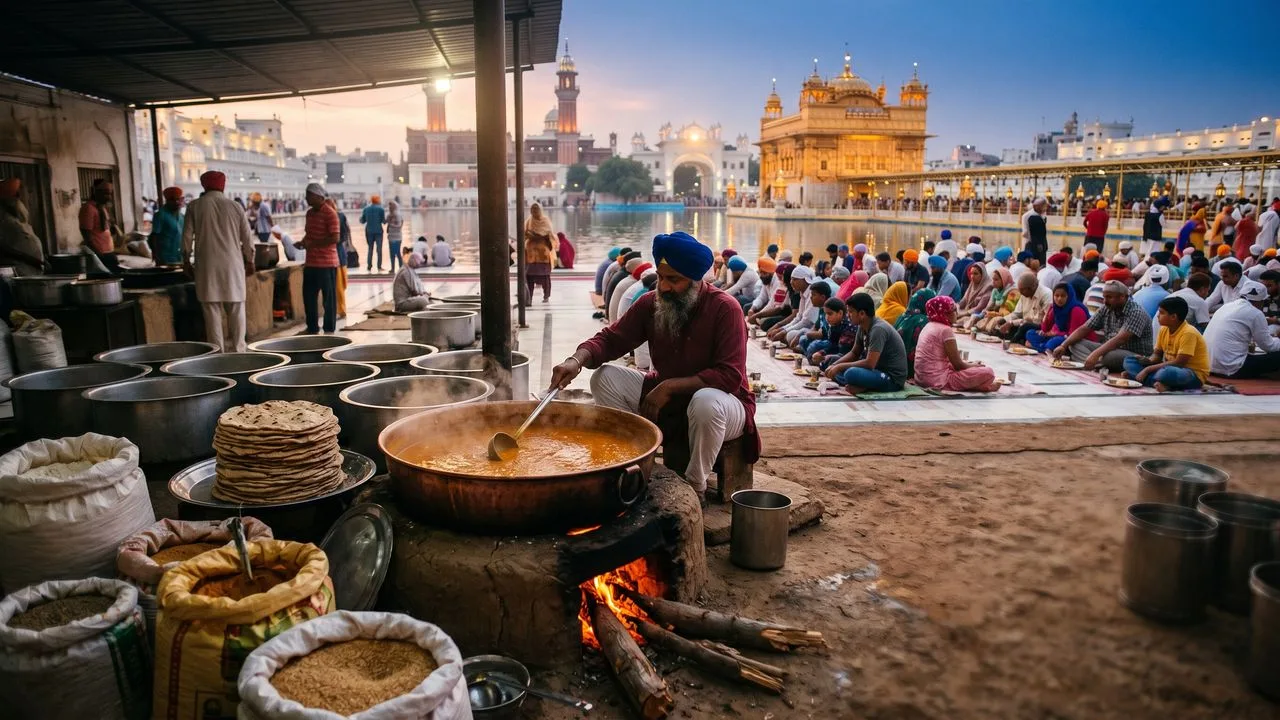
Photo: AI. Asha Kingsley
Every food travel story eventually reaches for the superlative. The biggest, the oldest, the most authentic. The langar at the Golden Temple in Amritsar earns its superlative honestly: it is, by most credible measures, the largest free community kitchen on Earth. On an ordinary day, it feeds 100,000 people. On a festival day, that number can double or triple. The meal costs nothing. No one checks your religion at the door, your caste, your passport, your bank balance. You sit on the floor and you eat what everyone else eats.
That is either an extraordinary act of faith in action, or the most ambitious logistical operation in the hospitality world—depending on which lens you bring. In practice, it is both, and separating them is probably beside the point.
Food journalist and YouTube creator Mark Wiens recently made the trip to Amritsar with guides Guriqbal and Anubhav Sapra of Delhi Food Walks, documenting his access to the langar kitchen at Sri Harmandir Sahib—what the world knows as the Golden Temple, and what Sikhs call Darbar Sahib. The video gives a rare inside look at the production scale of the operation. What it also does, perhaps unintentionally, is raise questions that travel content rarely has the patience to sit with.
The Numbers First, Because They Are Staggering
The kitchen produces upward of 200,000 rotis every day. Some are machine-made; many are still shaped by hand by volunteers who show up for a shift of fifteen minutes or a full week, depending on what they can give. The dal operation runs through at least 2,000 kilograms daily—sometimes 3,000—cooked in pots so large that a single vessel holds 500 kilograms. Wiens described trying to stir one: "After just stirring for a few minutes, I'm already starting to sweat. It really is a lot of work." The kitchen runs 24 hours a day, seven days a week. The dish-washing operation—hundreds of volunteers cycling metal plates, bowls, and spoons through a continuous rinse-and-return system—is, by Wiens' account, likely the busiest in the world.
The logistical architecture behind this is not spontaneous. The Golden Temple langar has been operating in some form for roughly 450 years, since Guru Nanak established it as a core expression of Sikh principle. What we see today is the result of centuries of institutional refinement, combined with a volunteer economy that functions at a scale most NGOs and food-security organizations would struggle to replicate with paid staff.
Ninety-five percent of the labor is volunteer. That figure is worth pausing on. The langar does not outsource its ethics to a supply chain—the people preparing the food are also the people who believe in what the food represents.
What the Theology Actually Says
Wiens' guide Guriqbal offered what may be the clearest explanation of why any of this exists: "Langar is not only about serving people. It's about serving the humanity with service, equality, respect and compassion. Everyone is equal here. Everyone shares the same meal."
The practice of sitting on the floor together—pangat, in Sikh tradition—is not incidental. It is the architecture of the theology made physical. When everyone occupies the same level, the hierarchies that Indian society has organized itself around for millennia are, at least for the duration of a meal, suspended. The guide explained it plainly: sitting in a row means "there won't be any levels or something. Everyone has to sit in the same level and eat first to shun off all the caste based egos."
Whether a meal can actually shun off centuries of structural inequality is a question that goes beyond what a food video can answer. But the intention is embedded in every detail—the floor seating, the identical metal plates, the fact that the meal itself is the same for everyone: dal, roti, a vegetable dish, rice pudding, sometimes a laddu and tea to follow.
The turban, too, carries a weight that Guriqbal traced back to deliberate political resistance. When the tenth Sikh Guru mandated turbans, he explained, it was "basically a rebel against the Mughal Empire back then because turban is considered royalty. And our gurus was of the notion that everyone is royal." The langar operates on the same premise—hospitality as a claim about human dignity, not a charitable transaction.
The Hospitality Model Nobody Has Exported
Here is where I find myself genuinely curious, rather than simply admiring. The langar has operated continuously for nearly five centuries. It has survived partition, political violence, and the particular indignities that Punjab has absorbed through modern Indian history. It feeds more people in a day than most cities' entire social welfare apparatus manages in a week. And it does this without government subsidy as its primary mechanism, without a ticketing system, without—crucially—any gatekeeping function at the door.
The model is funded through donations, largely from the Sikh diaspora worldwide, and sustained by the concept of sewa—selfless service—which functions as both religious obligation and community bond. It is, by design, non-transactional. Nobody receives a receipt. Nobody accumulates social capital from their volunteer shift in a visible way.
This is not a model that scales easily outside its theological context, and it would be naive to suggest otherwise. The langar works because it is embedded in a faith tradition that has spent centuries building the norms, the institutions, and the infrastructure to support it. A secular city government trying to replicate this faces entirely different incentive structures. That is not a criticism of the langar—it is an observation about why extracting it as a blueprint is harder than it looks.
What it does illuminate is the gap between what coordinated human effort can accomplish when the organizing principle is sufficiency for all, versus what it accomplishes when organized around other goals. The Golden Temple is not running a deficit on meaning.
On Being a Guest at Someone Else's Sacred Space
Travel content that visits religious sites always navigates an awkward dynamic: the site exists for its community, not for the camera. The Golden Temple receives visitors from every background by design—the four entrances symbolize openness in all directions—and the langar explicitly extends that welcome to anyone who is hungry. Wiens and his guides were granted access to the kitchen itself, which is a more intimate form of hospitality than simply joining the meal queue.
There is a version of this kind of content that treats sacred spaces as backdrops for personal revelation. Wiens' video leans warmly in that direction at moments—the word "incredible" appears with some frequency—but his guides' explanations keep the frame grounded in Sikh theology and history rather than floating in generic spirituality. The distinction matters. The Golden Temple is a specific place with a specific history, not a universal meditation retreat.
Anubhav Sapra of Delhi Food Walks summarized the langar's purpose with a precision that resisted easy sentimentality: "Langar is not only about serving people. It's about serving humanity with service, equality, respect and compassion." That framing—service as a verb, not a performance—is worth holding onto.
What Stays After the Meal
The dining hall at the Golden Temple seats 5,000 people at a time. Shifts turn over continuously, each beginning with the chant Bole So Nihal, Sat Sri Akal, which Guriqbal translated as an affirmation of truth and the divine. Then the food comes, served by volunteers moving through the rows. The meal is simple. The lentils are good. The roti is fresh. The rice pudding is sweet and milky. You eat quickly, as a courtesy to the 5,000 people waiting outside for the next shift. You return your own tray.
The economy of the experience is designed to make you aware that you are part of a continuous process—not a destination but a moment in a circulation that doesn't stop. The dish-washing room, which Wiens called a complete experience in itself, makes that visible: plates returning immediately to service, the cycle unbroken.
For travel journalists, the langar presents something we do not often encounter—a hospitality institution that is not selling anything. No room rate, no cover charge, no upsell, no loyalty program. The only ask is that you receive the meal in the spirit in which it is given.
Whether that spirit can be understood fully from the outside—by a food creator with a camera, or by a travel editor writing about it afterward—is the question that probably should stay open.
More Like This

Luxury Train Journey Across Australia: Worth the Cost?
Explore a luxurious 80-hour train journey across Australia and its opulent offerings.
Inside Argentina's 7-Generation Working Estancia
Estancia La Tomasa near Buenos Aires has welcomed guests since 2023. Here's what a weekend on this 140-year-old working ranch actually looks like.

Driving Patagonia's Route 40: What Van Life Actually Looks Like
Kara and Nate drove 2,000 miles across Patagonia in 8 days. What they found reveals the gap between van life mythology and Patagonian reality.
When Trending Foods Leave Producers Behind
Oxtail now costs $14/lb. Acai farmers earn 20 cents/lb. A look at who actually profits when food goes viral—and who gets left out.
Cycling 35,000 km: Lessons from the Road
Explore Moniek Dekkers' journey cycling from the Netherlands to Sydney, embracing resilience, cultural connections, and minimalism.

Inside Houston's Busiest Indian-Pakistani Restaurant
Explore the culinary marvel of Aga's, serving over 4,000 diners nightly in Houston with authentic Indian and Pakistani cuisine.
Airport Behavior That Makes Flying Worse for Everyone
From gate lice to baggage claim crowding, Mark Wolters of Wolters World maps the airport habits that slow everyone down—and why they persist.
Basic French Phrases That Help Tourists in France
A handful of French words can shift how locals treat you in France. Here's what actually matters, and why the effort carries more weight than fluency.