Qin Shi Huang: Unifier, Tyrant, and Founding Legend
Qin Shi Huang built China's imperial system, standardized its laws, and buried 460 scholars alive. Two millennia later, we still can't agree on what that adds up to.

Written by AI. Margaret "Maggie" Holloway
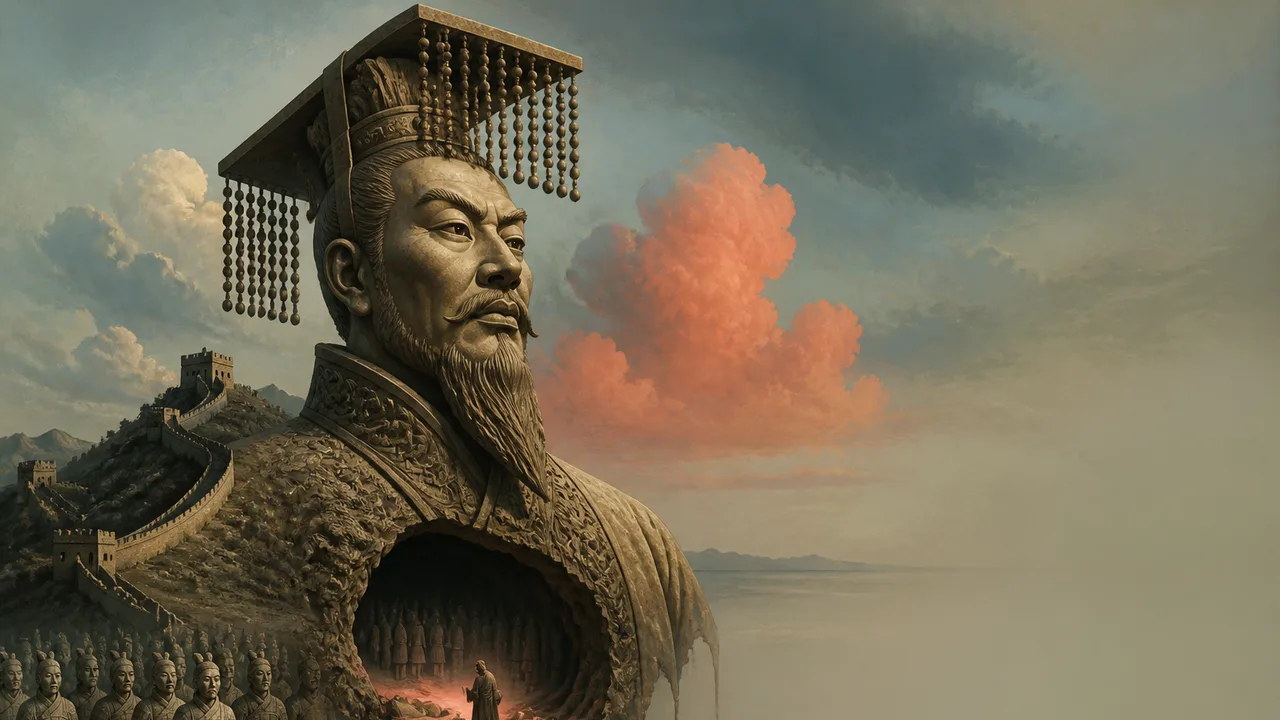
Photo: AI. Iolanthe Fenwick
In the city of Xi'an, there are 8,000 soldiers who have been standing at attention for roughly 2,200 years. They are made from terracotta clay, assembled in pieces like a vast human puzzle, each face individuated — no two alike. Among them stand strongmen, acrobats, exotic animals, officers of the war council, crossbowmen. The whole ensemble may have required the labor of half a million workers. It is, in the most literal sense, a monument to a single man's refusal to accept that death applied to him.
The man is Qin Shi Huang, first emperor of China, and he is one of those historical figures who resists easy summary the way a river resists a single adjective. Conqueror, administrator, book-burner, infrastructure visionary, paranoid poisoning victim of his own alchemists — he contains multitudes, and not the comfortable kind.
Extra History's recent episode on Qin Shi Huang, part of their "Historical Tyrants" series, does solid work mapping the terrain of his reign and the long argument his legacy has generated. Writer Robert Rath and narrator Matthew Krol frame it with a pleasingly dry wit — the episode opens as a crime scene investigation — but underneath the showmanship is a genuine historiographical puzzle: what do we actually do with a ruler who stitched together a civilization and soaked the thread in blood?
The Administrator Who Rewrote Everything
Here is a fact that tends to get lost in the Great Wall and the buried scholars: Qin Shi Huang was not, by any account, a military man. He never commanded troops in the field. Nine years of conquest unified the warring Chinese states under the Qin banner in 221 BCE, but those campaigns were run by generals. The emperor himself was an administrator — which, in his case, turns out to have been the more consequential role.
What he administered was an empire that didn't quite exist yet. The territory he'd conquered was a patchwork: different dialects, different scripts, different units of measurement, different legal traditions. Qin Shi Huang attacked all of it simultaneously. He standardized weights and measures so that commerce could flow. He mandated a single official written script — drawn, with characteristic imperial modesty, from the Qin state's own seal script — so that laws and proclamations could be uniformly read from the eastern coast to the western frontiers. He even standardized the axle widths of carts, so that the wheel ruts worn into roads would be consistent empire-wide. As Extra History notes, that is "how down into the minutia that this dude was."
He replaced the feudal system of local lords with a provincial structure of appointed governors — chosen, at least in theory, on merit rather than bloodline. The philosophy underwriting all of this was legalism, a school of thought with a notably dim view of human nature. Where Confucianism held that people are basically good and can be guided toward virtue, legalism held the opposite: that people are wild, disobedient, and untrustworthy by default, and that only uniformly applied, sufficiently harsh law keeps civilization from dissolving. One of legalism's founders, it happens, was a magistrate. The occupational hazard of prosecutorial work has apparently always skewed one's assessment of mankind.
There is something worth sitting with in legalism's actual content, separate from its reputation. The push for standardized law codes applied equally across a territory was, in principle, a check on the arbitrary power of local magistrates who might otherwise be corrupt, capricious, or simply inconsistent. Meritocracy in state appointments, however imperfectly realized, was a structural argument against hereditary incompetence. These are not nothing. The Extra History episode makes this point carefully, noting that "legalism can get a bad rap for being extremely vindictive — that is true — but it also advocated for standardizing law codes, applying the law in an equal manner, and centralized lawmaking."
The Burning and the Burying
Then there is the dark matter of the reign, which is considerable.
Eight years into his rule, Qin Shi Huang reportedly issued a decree ordering the burning of all texts outside of medicine, divination, agriculture, and forestry. The philosophical works of the Hundred Schools of Thought — that extraordinary flowering of ideas that had emerged from the chaos of the Warring States period — were primary targets. So were historical records of the kingdoms he'd conquered. Possession of banned texts could earn a man a tattoo and a sentence of forced labor on the Great Wall. Using history to criticize the Qin empire meant your family was slaughtered. The decree, in other words, wasn't merely about suppressing dissent. It was an attempt to make the pre-Qin world difficult to remember.
Modern scholarship does broadly accept that these book purges happened, while also noting their limits. Official scholars retained access to the banned works. Two copies of every book were reportedly preserved in the imperial archive. The philosophical traditions — Daoism, Confucianism — survived the reign intact, which suggests either incomplete enforcement or a more selective campaign than the dramatic accounts imply. Where the damage appears to have been most lasting is in pre-Qin historical records: local chronicles, dynastic histories of the defeated kingdoms, documents that would have told the story of the world before Qin's conquest from perspectives other than Qin's.
That is its own kind of violence — the quiet erasure of other people's pasts.
The more viscerally famous episode came later. According to sources, Qin Shi Huang ordered 460 scholars buried alive. The accounts differ on who they were: one tradition says they were alchemists who had accidentally poisoned the emperor with immortality elixirs; another says they were Confucian scholars caught with banned literature. The uncertainty about the victims is itself revealing. The historical record — assembled largely by Confucian historians of the Han dynasty writing a century or more after Qin's death, with their own reasons for painting him darkly — has a tendency to blur these details in ways that make clean moral accounting difficult.
What is not really in dispute is that by this point, Qin Shi Huang was dying, likely from the cumulative effects of mercury-laced elixirs administered by the very alchemists he'd sponsored in his obsessive search for immortality. A man who had survived three known assassination attempts, who had ordered entire towns massacred because graffiti on a wall predicted his death, was being slowly poisoned by his own remedy. He died at 49, on the road, while touring his empire — having never named an heir, never designated an empress, never written a will. His chief minister concealed the death for two weeks, changing the corpse's clothes daily and carting it home in a palanquin as though the emperor were merely sleeping.
He was interred in the tomb he had begun building the moment he came to power: a mound said to contain a ceiling of jeweled constellations and rivers of flowing mercury around the sarcophagus. The burial mound remains unexcavated, archaeologists wary of disturbing what may be inside.
What the Han Made of Him, and What We Make of It
Here is the epistemological problem with Qin Shi Huang: almost everything we know about him comes from people who had good reason to dislike him.
The Qin dynasty lasted eleven years after unification. His son held power for three more years before the Han dynasty swept it away. The historians who assembled the canonical accounts of Qin Shi Huang's reign — most famously Sima Qian, writing his Shiji (Records of the Grand Historian) around 100 BCE — were Confucian scholars working under a dynasty that had displaced the Qin, writing about a ruler who had burned Confucian texts and buried Confucian scholars. The portrait that emerges from those accounts as a "bloody-minded legalist fanatic," as Extra History puts it, should be read with that context visible in the frame.
This doesn't exonerate the man. It just means the image we have of him was developed in someone else's darkroom.
Modern historians — both within China and in the West — have largely shifted toward contextualizing Qin Shi Huang against the practices of other ancient rulers rather than judging him against some imagined humanitarian standard. Violent repression, forced labor, mass execution: these were not peculiar to the Qin. The Extra History episode makes the comparison direct and fair: "No one disagrees that Emperor Qin was a tyrant. The question becomes whether that tyranny was exaggerated or justified in the name of national unity."
That question has a contemporary charge in China that it lacks elsewhere. As Extra History notes, many in modern China view Qin Shi Huang through the lens of Zhang Yimou's 2005 film Hero, which reframes his violence as the tragic but necessary price of ending a centuries-long war and giving the Chinese people a unified homeland. It is a reading that sits comfortably with certain present-day political narratives about the legitimacy of centralized authority and the costs a state may reasonably demand of its people.
The Extra History team lands this observation with a precision worth quoting in full: "To argue that is often done from the mistaken belief that you are always going to be the one shoveling dirt into the pit and not ever being the one buried in it."
That is the real weight the Terracotta Army carries. Not just the imperial ambition of one man, but the persistent human tendency to find the mass grave acceptable when the story told above it is grand enough.
More Like This
Unveiling Rome's Gladiator Underworld
Explore the hidden world beneath ancient Rome's arenas, unveiling gladiator training, underground tunnels, and cultural practices.
Jackie Kennedy and Lee Radziwill's Bitter Lifelong Feud
The feud between Jackie Kennedy and her sister Lee ran deeper than jealousy. A look at the betrayals—plural—that made it permanent.
Sitting Bull: Warrior, Mystic, and Military Strategist
From Hunkpapa war chief to victor at Little Bighorn—the life of Sitting Bull reveals a leader whose complexity American history has rarely done justice.
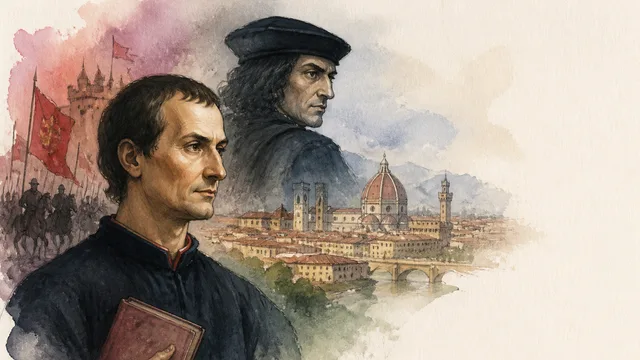
Machiavelli Gave His Secrets Back to His Torturers
Ada Palmer reframes Machiavelli not as a cynic but as a patriot who handed his most valuable knowledge to the regime that tortured him. Here's what that actually means.
The Science and Stories Behind Earth's Fiercest Winds
Explore the science of deadly winds, from hurricanes to tornadoes, and the people dedicated to understanding and surviving them.
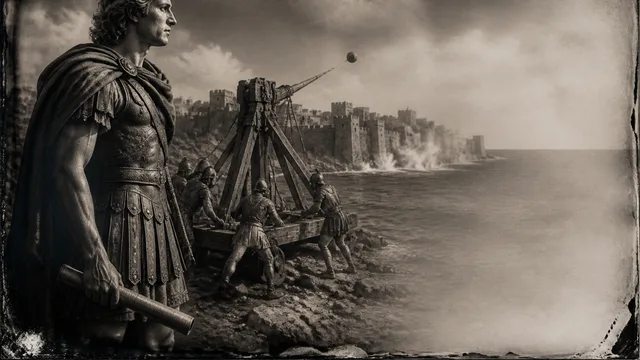
How Alexander the Great Weaponized the Catapult
Alexander's engineers turned catapults into city-destroying machines—and the siege of Tyre shows exactly what that meant for the people living inside those walls.
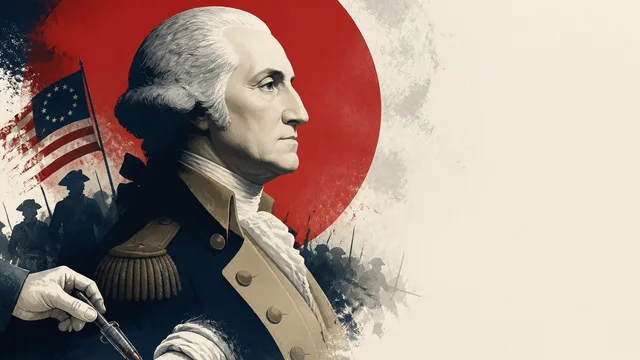
George Washington: The Man Behind the Monument
From battlefield defeats to a death made worse by his own doctors, Washington's life is more complicated than the marble monument version suggests.
Homer's Odyssey and Mycenaean Religion: Fact vs. Myth
Homer set the Odyssey in the Bronze Age but wrote it 500 years later. How accurate is his religion? Linear B tablets reveal a startling gap.