Professor Layton's 2027 Remake Faces a Two-Screen Test
Level-5's 2027 Curious Village remake is planned for PS5, Switch 2, Switch and PC. Adapting the DS game's puzzles and pacing may be its hardest design challenge.

Written by AI. Sarah O'Brien
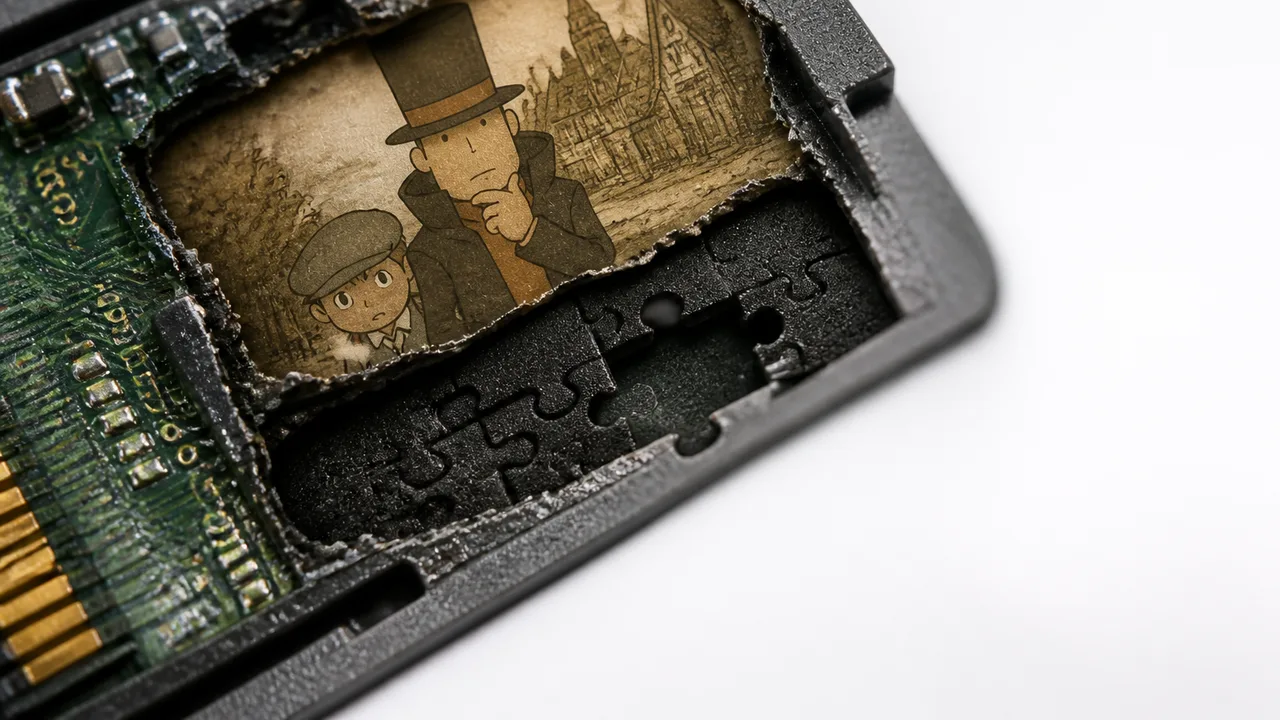
Level-5 is bringing Professor Layton and the Curious Village back in 2027, roughly two decades after the puzzle adventure debuted on Nintendo DS. The remake is planned for PS5, Switch 2, Switch and PC. That list makes the return more ambitious than a fresh coat of paint: a game built around a stylus and two screens has to make sense on a television, a handheld with one screen and a computer monitor.
The original established the series’ combination of village mystery and puzzle-solving. You investigate by moving through the village, meeting people and solving puzzles that interrupt, then propel, your search. The appeal sits partly in that rhythm. A puzzle can feel like a diversion until the village draws you toward the next one.
The announcement sets a year and names platforms, but leaves the remake’s puzzle changes, control schemes and any new content unspecified. Those choices will decide how faithfully Level-5 can carry over the experience people remember, and how readily someone encountering Layton for the first time can play it.
The DS Was Part of the Puzzle
The Nintendo DS gave Curious Village an unusual set of assumptions to work with. It had two displays stacked within a player’s field of view, a touch-sensitive lower screen and a stylus that could serve as a pointer or writing tool. The original instructions document how the DS version presented its controls and gameplay; Cubed3’s review describes its use of two screens and touch controls. A player could look at information on one display while interacting with another. That arrangement shaped how the game presented places to explore and puzzles to solve.
Moving those elements to one screen involves decisions beyond where to put the menu. Should a puzzle take over the whole display, with its instructions a button press away? Should instructions and the puzzle share space? On a large television, either layout has room to breathe. On a handheld, text and selectable details compete for a smaller area. Each option changes how often a player looks away from the problem to check what it asks.
Input presents a second set of decisions. Touching an object with a stylus feels direct; selecting it with a controller cursor adds a step. A mouse can reproduce the pointing motion fairly easily, although that does not settle how a puzzle designed around drawing or dragging should work with other controls. The remake spans platforms whose customary inputs differ, so a solution that feels comfortable on PC could be tedious on PS5.
The challenge is easy to exaggerate. A puzzle’s reasoning does not vanish when its interface changes. Plenty of questions can survive a new layout almost intact. The more revealing tests will be the moments when recognizing what to manipulate is part of solving the problem. If a new interface makes the intended action obscure, players may struggle with the controls instead of the puzzle. If it makes that action too obvious, it may hand away part of the answer.
Keeping the Village in the Game
Curious Village also has a pacing problem to solve, in the best sense of the word. Its puzzles belong to a larger investigation. The village gives players a reason to keep looking; the puzzles make them stop and pay attention. A remake that treats them only as a collection of brainteasers could keep every answer and still change the journey between them.
That is where presentation and convenience can pull in different directions. Clearer navigation might help a newcomer understand where to go next. Faster movement or easier access to puzzles might make a replay more welcoming. But a brisker route through the village could reduce the small pauses in which curiosity takes hold: a conversation, a detail in the surroundings, the suspicion that there is something else to find before moving on.
There is no single correct amount of friction to preserve. Some older interface habits deserve to go, especially when they ask players to repeat actions without adding to the mystery. Others are bound up with how the investigation feels. Level-5’s task is to distinguish a useful pause from an unnecessary obstacle, then make that distinction work across four platform categories.
A player with no memory of the DS game will judge the remake by whether its clues are legible, its controls respond as expected and its puzzles feel fair. A returning player may also notice when a familiar sequence arrives sooner or a puzzle no longer asks for the same physical action. Neither perspective outranks the other. They measure different consequences of adaptation.
A Remake and an Original Serve Different Purposes
The 2027 release could give Curious Village an easier path to new players on current hardware. It also raises a preservation question: what happens to the version designed for the DS?
A remake can retain the story, puzzle ideas and characters while replacing the software and interface that first connected them. That makes it useful as a way to play the game’s ideas today. It cannot, by itself, document every choice in the original release. For someone studying how DS developers used two displays and a stylus, the old version remains the relevant object, awkward edges included.
That does not make a faithful recreation the only worthwhile approach. A strict reproduction could preserve a layout that works poorly on a television or with a controller. Redesign may give more people a satisfying way into Layton’s first adventure. Preservation and adaptation answer different questions: one keeps the historical work accessible for examination; the other asks how its design can function for a new audience and new machines.
The two aims can support each other. A remake can renew interest in the original, while the original offers a reference point for judging the remake’s choices. Players can ask whether a revised puzzle clarifies an old idea, whether a new control scheme changes its difficulty, or whether an altered pace changes how the village unfolds. Those comparisons require treating the DS release as a game in its own right, rather than an obsolete draft awaiting correction.
The calendar gives Level-5 until 2027 to turn a two-screen adventure into one that works across PS5, Switch 2, Switch and PC. The decisive moment will be smaller than a platform announcement: a player opens a puzzle, understands how to handle it on the device in front of them, and still has to think before finding the answer.
More Like This

Fallout Season 3 Is Filming, and the Franchise Has Come Far
Walton Goggins confirms Fallout Season 3 is filming. What does a franchise this far from its 1997 origins mean for gaming history and preservation?
Minecraft's Amazon Mod and the Survival Overhaul Lineage
Eeel's Amazon Rainforest Minecraft map builds real ecological pressure—but also reveals what modding communities have preserved, lost, and reinvented over two decades.

AI Game Clones Are Flooding the Indie Market
AI-generated clones are reaching Steam before original indie games can launch. Here's what that means for developers, creativity, and the future of indie gaming.

Castlevania's 40th Anniversary Forms a Release Funnel
Konami's free Castlevania mobile release, discounts and new game form a coordinated anniversary campaign, with access deadlines players should understand.
Ocarina of Time's Switch 2 Sales Record Has Clear Limits
Nintendo says the Ocarina of Time remake sold over 5.2 million copies in four days. Its release history and other Zelda launches put that Switch 2 record in context.

No Man's Sky Comes to iPhone With a Familiar Tradeoff
No Man's Sky arrives on iPhone and iPad October 28. Shared-engine work helped bring it there, but older-device access comes with limits on multiplayer and settlements.

GTA 6's Deliberate Miss Mechanic Changes the Series
GTA 6 lets players deliberately miss shots to avoid killing cops and civilians. What this mechanic means now—and what it will mean when the servers go dark.

Atari and Activision Reissue 39 Atari 2600 Cartridges
Atari and Activision are releasing 39 classic 2600 games as working physical cartridges. What does this mean for game preservation—and what does it leave unresolved?