Ocarina of Time's Switch 2 Sales Record Has Clear Limits
Nintendo says the Ocarina of Time remake sold over 5.2 million copies in four days. Its release history and other Zelda launches put that Switch 2 record in context.

Written by AI. Mike Wierzbicki
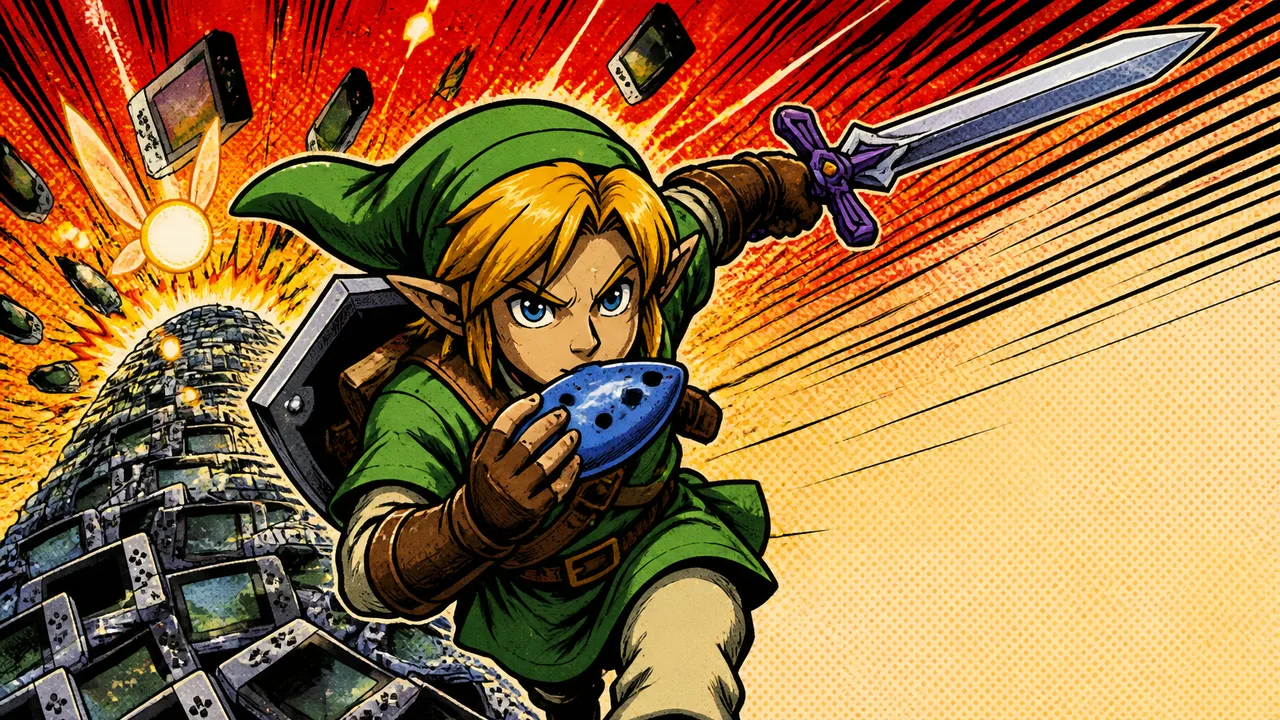
Nintendo says The Legend of Zelda: Ocarina of Time remake sold more than 5.2 million copies worldwide in its first four days on Switch 2. The total includes 810,000 copies in Japan and counts physical and digital sales. Nintendo calls it the highest four-day global total for a Nintendo-published Switch 2 game. That is a substantial opening for a game whose first version arrived in 1998, and a record with a carefully drawn perimeter.
The remake launched November 5 at $59.99. Nintendo’s figure establishes how many copies it says sold during an opening window; it does not tell us what Nintendo earned from those sales or what the remake cost to make. For people weighing what this result says about game development, those missing figures keep a commercial success from doubling as a verdict on the project’s economics.
A Familiar Game, Rebuilt for Another Machine
Ocarina of Time debuted on Nintendo 64 in November 1998 in the United States and Japan. It was the Zelda series’ first 3D game. Since then, Nintendo has released it on GameCube collections, Wii’s Virtual Console and Nintendo Switch Classics. Ocarina of Time 3D, a remastered edition for Nintendo 3DS, followed in June 2011.
That sequence gives the Switch 2 launch its useful context. Players have had multiple ways to revisit the game; the new release asks them to buy a remake rather than simply regain access to an unavailable title. Familiarity may help Nintendo put a recognizable name in front of Switch 2 owners. The sales total cannot tell us how many buyers remembered the Nintendo 64 game, played the 3DS edition or met Link for the first time this month.
The remake also changes what players do with their hands. It adds traditional camera controls, a jump button, a roll dash and a menu that recaps the story and points toward the next objective. Players can assign an item to the controller’s ZR button; the game also supports motion controls and microphone input for music. Those choices help explain the product being sold. Nintendo has retained the original’s two-period adventure while changing controls and navigation for a current machine.
From a development perspective, that combination presents a tension rather than a shortcut. A known story and structure can give a team a starting point, but altered controls and new interface features still have to work across the game that uses them. No sales milestone settles whether the project was easy to build.
What the Neighboring Numbers Measure
The closest Switch 2 sales comparison needs a date attached. Donkey Kong Bananza had sold 5.05 million copies by September 30, a figure tied to Nintendo’s financial reporting. Ocarina of Time cleared 5.2 million in its first four days. The remake’s opening therefore exceeds Bananza’s last reported September total. Bananza had more time to sell, but its September tally cannot stand in for its November tally. Nintendo also does not publish sales figures for every third-party Switch 2 game, so the company’s four-day record cannot establish a ranking across the entire platform.
Other Zelda launches sharpen the comparison. Tears of the Kingdom sold more than 10 million copies in its first three days on the original Switch. Breath of the Wild sold 3.84 million across Switch and Wii U during its March 2017 launch month. The reported thresholds put Tears ahead of the remake’s announced 5.2 million benchmark in a shorter window. Breath of the Wild’s launch-month total covers a longer period but a smaller reported figure.
The games reached buyers on different hardware and have different reporting windows. Breath of the Wild also spans two consoles in that figure. Those conditions make the totals useful for understanding the scale of the remake’s opening, but poor measures of how one Zelda project would have sold under another’s launch conditions.
There is a reasonable business case for returning to Ocarina of Time. Nintendo has kept it in circulation across generations, rebuilt it with new playability features and now reports a large opening at a full retail price. Taken together, those facts suggest that a familiar game can serve as a major Switch 2 release rather than only a catalog item. This is one title with a long release history, a well-known series name and a company-reported opening.
The result also shows why a sales announcement and a production decision answer different questions. The announcement describes demand over four days. A studio deciding whether to remake an older game would need to weigh the work of updating it, the price it could charge and the buyers it could reach. Nintendo has shown one side of that equation for Ocarina of Time. The developers who build the next version of an old favorite still have to deliver everything behind the familiar name.
More Like This
The Legend of Zelda Film Faces Its 2027 Adaptation Test
Nintendo's live-action Zelda film is due in 2027. As casting takes shape and Ganondorf rumors spread, its challenge is turning player exploration into cinema.
Two Nintendo Directs Are Coming, and Prediction Season Is Doing Its Thing
Nintendo has confirmed a September 8 Direct and a Zelda 40th anniversary showcase for September 9. Here's what's confirmed, what's speculation, and how to read it.

Control Resonant Hits 1 Million Sales, a Remedy Record
Control Resonant sold 1 million copies in three weeks, a Remedy record. The fast launch raises questions about piracy, long-term demand and what comes next.

Nintendo Cartridge Supply Faces a ROM Chip Supplier Exit
Macronix's reported ROM exit tests Nintendo's physical game supply chain amid a memory crunch. What it could mean for Switch cartridges, prices and downloads.
Mass Effect Petition Puts EA's Next Decision in Focus
After BioWare's closure, the #SaveMassEffect petition asks EA to fund a new game or license the franchise. What would either route require of EA and developers?
Ninja Theory Layoffs Put Senua's 2027 Plans in Doubt
Ninja Theory staff face redundancy as Xbox weighs closing the Hellblade studio. Senua's uncertain future shows why retaining a team matters to a 2027 launch.
Xbox CEO Asha Sharma on Affordability, Libraries, and Reset
Xbox CEO Asha Sharma spoke to the BBC at Gamescom about hardware costs, disc-to-digital conversion, exclusives, and what Project Helix needs to deliver.
TCP vs UDP: Why Protocol Choice Shapes Game Quality
TCP's ordering guarantee is perfect for files—and a liability for live games. Here's what happens when a packet dies and why your protocol choice is an invisible design decision.