Ninja Theory Layoffs Put Senua's 2027 Plans in Doubt
Ninja Theory staff face redundancy as Xbox weighs closing the Hellblade studio. Senua's uncertain future shows why retaining a team matters to a 2027 launch.

Written by AI. Mike Wierzbicki
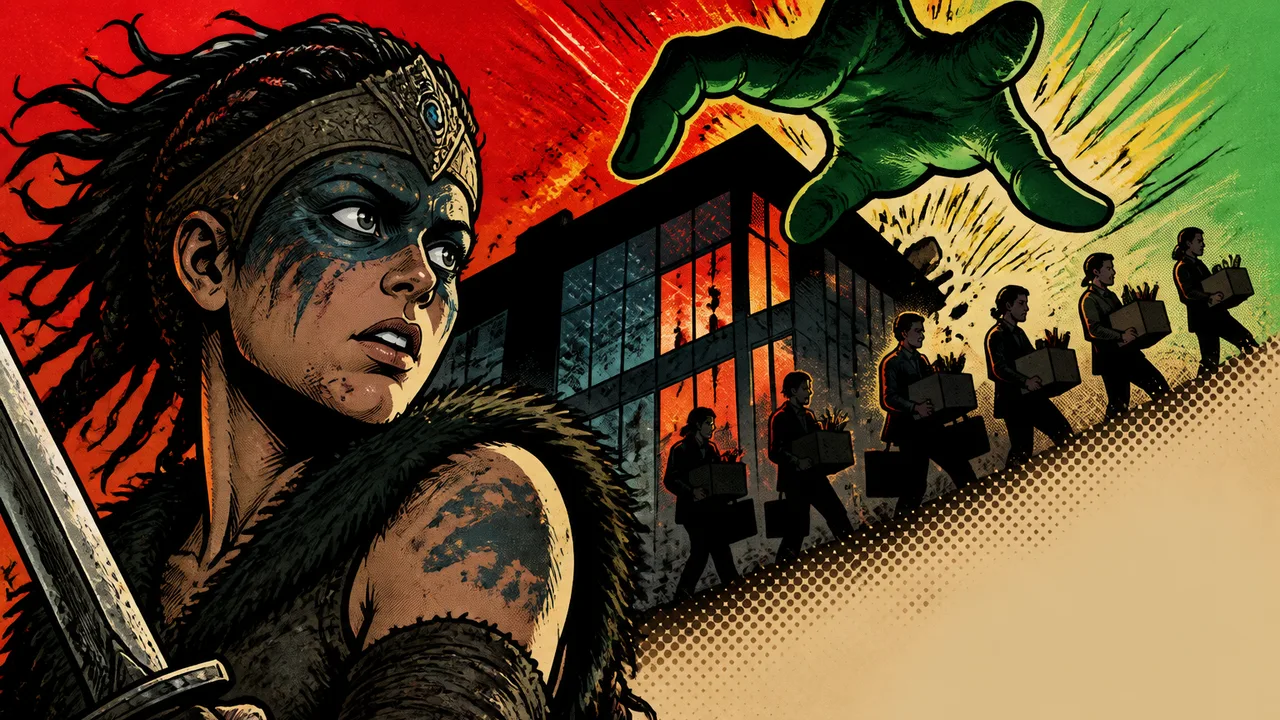
Ninja Theory developers are losing jobs or facing redundancy while Xbox considers closing the studio behind Hellblade. On October 5, employees publicly described positions at risk or already ended. In September, Xbox said two agreements involving the studio had fallen through and announced consultation on a proposed closure. Senua, the third Hellblade game, still has an announced 2027 release window. Xbox has not confirmed what will happen to the game.
The employees identified by Video Games Chronicle work across gameplay programming, sound, performance-capture technology, technical art, character art and technical direction. VGC said it verified posts first spotted by journalist Chris Kerr. Those posts show disruption across several disciplines, but they provide no studio-wide layoff total. Some employees say their jobs are at risk; others say their jobs have ended. Counting both groups as completed layoffs would erase the difference between a warning and a departure.
Principal sound designer Daniele Galante wrote that “my position is now at risk,” in a LinkedIn post quoted by Eurogamer. Gameplay programmer Katrin Mair wrote that she moved to the UK for Ninja Theory and began her games career there. Principal programmer Stefano Prosperi described facing redundancy after 13 years at the studio. Xbox may still find another route for the company. An employee deciding whether to look for work has to respond to the risk that exists now.
A Reveal Trailer and a Proposed Closure
Xbox’s wider business “reset” began in July, when Microsoft cut 1,600 jobs. A second wave in September brought a further 268 cuts, VGC reported. During that September round, Xbox executive Matt Booty said “two separate agreements for Ninja Theory fell through.” He said Xbox would begin consultation with employees on a proposed closure while continuing to explore other paths forward.
The October posts follow that September announcement. The word proposed leaves room for an alternative outcome; it does not suspend the employment decisions facing developers whose positions are at risk. Someone considering a new job cannot plan on a deal that has yet to happen. Equally, an employee’s public post cannot establish what happened to everyone else at the studio.
Xbox unveiled Senua at its June 2026 Games Showcase with a 2027 release window. Ninja Theory’s previous release, Senua’s Saga: Hellblade 2, arrived in 2024. Now the developer faces a closure consultation while its next game retains a public launch window. Whoever finishes that game will need people authorized and available to work on it, a budget for the remaining production and decisions about who controls the project. The reveal trailer answers none of those questions.
Game File reported in June that Microsoft was already considering selling or closing Ninja Theory when it revealed Senua, and that the trailer could attract buyers. That is Game File’s reported account of Xbox’s thinking, cited by VGC and Aftermath. Booty’s later statement establishes that two agreements fell through; it does not explain why Xbox chose to reveal the game in June.
What a Release Window Depends On
Mair wrote that it was “incredibly sad knowing that we won’t get to finish what we were working on,” in a post quoted by VGC. She was describing work she expected to leave unfinished. Her words do not identify that work as Senua or announce the game’s cancellation.
A 2027 release window is a production target. Gameplay changes need to survive integration with animation and presentation. Captured performances have to be processed and connected to characters and scenes; sound and technical art have to work in the same builds as the code that triggers them. When one part changes, another may need rework, testing and sign-off. The public posts identify people with skills in several of these disciplines, but do not establish that any named employee was assigned to Senua or tell us how far that game has progressed.
The practical question behind the release date is who retains knowledge of the build and who has time to finish, test and ship it. If staff depart during consultation and another owner or team later takes over, handover can consume production time. An asset directory can show where a captured scene lives; it may not explain which unfinished changes still need approval or why a tool behaves differently in the current build. A new owner could retain developers who know those answers. It could also choose a different schedule or scope. These are possible consequences of changing a production team, not a prediction that Senua will miss 2027.
Consultation creates a second clock for workers. Developers at risk may have to decide whether to wait for a potential deal or pursue another job while one is available. The longer ownership remains unresolved, the harder it may be for any successor to assume it will inherit the same team. A studio name can survive a transaction. The working knowledge behind a game stays with the people who built it, if they stay.
Other Xbox Studios Took Different Exits
The reset has produced other ownership arrangements. Double Fine and Compulsion Games became independent; Undead Labs became employee-owned in September, Aftermath reported. Compulsion gained publishing rights and ownership of South of Midnight. Aftermath also reported that Double Fine subsequently laid off 23 people and Undead Labs saw layoffs. A change of owner can preserve a studio or project without guaranteeing every employee a place in it.
Xbox sought to transfer Ninja Theory to another company, but the two agreements Booty described fell through. Double Fine and Compulsion demonstrate that studios in this reset have left Xbox. Their outcomes cannot establish that Ninja Theory had a viable offer on comparable terms. The terms of its two failed agreements, and the reasons they failed, have not been made public.
Xbox’s stated willingness to explore other paths leaves open the possibility of another arrangement. For developers, the useful question is what that arrangement would actually carry over: jobs, control of Senua and a production plan with time for the remaining work. Double Fine’s and Undead Labs’ layoffs show why a new ownership structure alone cannot answer the jobs question. A buyer keeping the project but losing the people who know its capture pipeline, tools and unfinished builds would also inherit the work of reconstructing their decisions.
More Like This
Microsoft's Ad Credit Patent Maps a Game Pass Future
Microsoft's ad credit patent application shows how Xbox could place ads at game pauses, and why cloud tests and Game Pass tier rumors matter for players.
Halo: Campaign Evolved Gets Mixed Reviews
Halo: Campaign Evolved's split reception isn't just a creative story — it's a studio story. What 343 Industries produced reflects the conditions it worked under.
Exploring Minecraft Capes and Player Engagement
A deep dive into Minecraft capes, their history, and how they shape player engagement and community culture.
Capcom, Jira, and the Question of Who Gets to Make Games
A former Capcom employee's critique of Jira-heavy Western studios has reopened an old argument about process, creative ownership, and who actually authors games.
Star Wars Zero Company's Titanfall Origins and Studio Furloughs
Star Wars Zero Company began as a Titanfall pitch. Then most of its developers were furloughed before launch. The full story is more complicated than either headline.
How to Pick the Right Art Style for Your Indie Game
Imphenzia's framework for choosing an indie game art style covers 15+ options and four must-pass tests. Here's what it gets right — and what it leaves open.
Enterprises Make AI Talk Like Cavemen to Cut Token Costs
Companies including Nvidia and GitHub are using a 'Caveman' plugin to slash AI output tokens by up to 75%. Here's what that actually tells us about enterprise AI economics.
Dragon Striker Season 2 Confirmed for Early 2027
Disney confirmed Dragon Striker Season 2 at Anime Expo 2026, setting an early 2027 premiere on Disney XD and Disney+. Here's what the renewal signals.