Microsoft's Ad Credit Patent Maps a Game Pass Future
Microsoft's ad credit patent application shows how Xbox could place ads at game pauses, and why cloud tests and Game Pass tier rumors matter for players.

Written by AI. Mike Wierzbicki
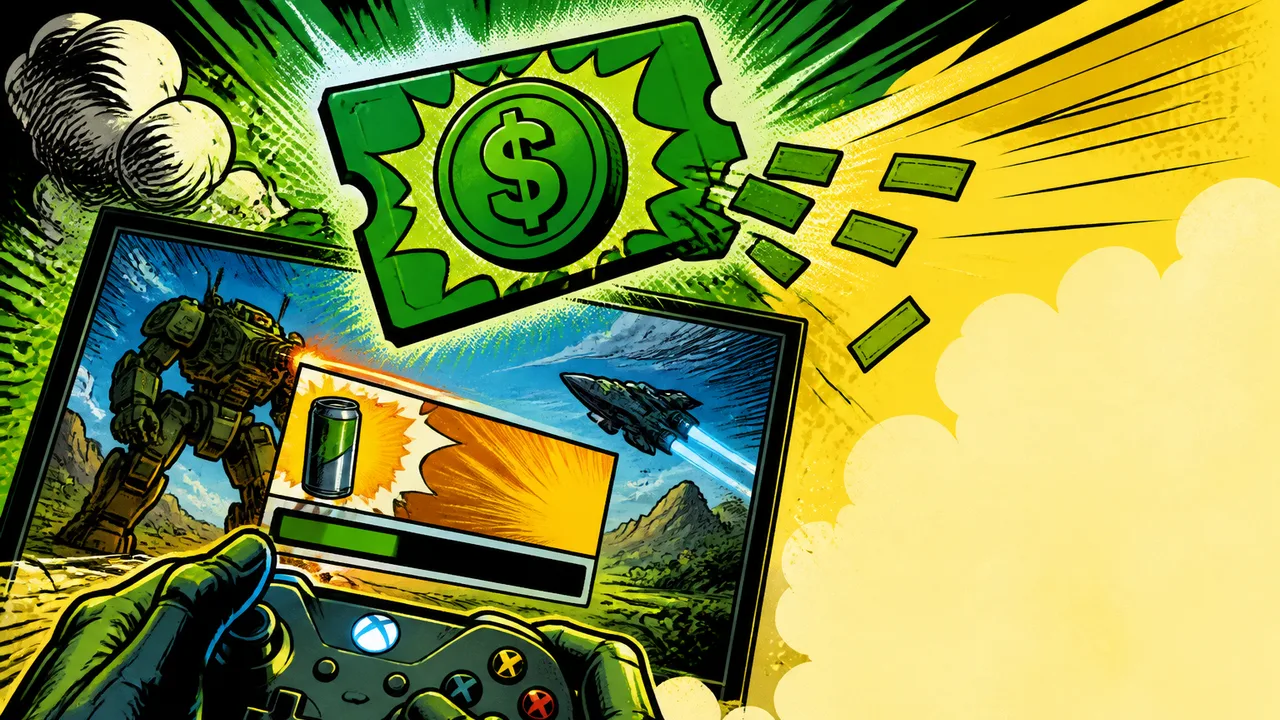
Microsoft Technology Licensing has published a US patent application for a system that suspends a game at selected stopping points, shows an advertisement, then grants the player another block of uninterrupted playtime.
The document is US 2026/0260258 A1, titled “Contextually Aware Management of Interactive Software Application Access,” according to the original discovery report from Respawn First. That filing describes the block of ad-free time as a “credit.” Examples include 30 minutes or the completion of a level.
The distinction around its status matters. This is a published patent application, and the available reporting provides no evidence that Microsoft has deployed it in a shipped game. Patent applications can preserve an option, block competitors or simply record an idea that never survives contact with production budgets. Microsoft has documented a monetization mechanism, not announced a product.
Even so, the mechanism deserves more attention than the usual patent fever dream because other parts of Xbox’s business are moving in the same direction.
How the Ad Credit System Would Work
The design joins two conditions. First, the player’s ad-free credit must expire. Second, the game must send a “promoted content trigger event” at an acceptable interruption point, such as a loading screen, menu, completed quest, finished boss fight or end of a cutscene.
Once both conditions are met, the system suspends player interaction, presents video or static promotional content, restores control and resets the credit. The reported control flow places the advertisement between game states rather than on an arbitrary timer in the middle of combat.
That is the strongest case for the design. If a free game already depends on advertising, scheduling an interruption after a round is less destructive than covering the screen during one. Tom’s Hardware’s reading of the application says the system could work with the game engine and use machine learning to choose an appropriate moment.
“Less disruptive” remains a narrow engineering description. A loading screen can hide asset streaming. A menu can be part of a speedrun route. The end of a cutscene can lead directly into a timed decision. Games do not share one universal definition of downtime, despite the advertising industry’s understandable wish that they did.
The application’s dependence on game-derived trigger events also implies development work. If Microsoft shipped this across multiple titles, designers would need to identify acceptable interruption states, engineers would need to expose those states to the content-management system, and quality-assurance teams would need to test what happens around checkpoints, multiplayer synchronization, suspend-resume behavior and failed ad delivery. A platform API could reduce that burden, but the reporting does not establish how much integration Microsoft envisions.
That labor would compete with feature work and bug fixing. An advertising system may arrive in a planning deck as a revenue feature. It reaches a development team as another state machine that can break.
The Game Pass Connection is Plausible, Not Proven
Microsoft has already started testing an ad-based tier of Xbox cloud gaming, according to Eurogamer’s report on the patent. That experiment supplies a useful comparison because it involves Microsoft lowering an access barrier while seeking advertising revenue from the resulting audience.
The patent could provide infrastructure for that model. A cloud service knows when a session begins and ends, while the proposed system lets the game communicate when an interruption would cause the least damage. Together, those layers could turn ads into a platform entitlement: watch this promotion, receive this much playtime.
That inference has limits. The application could remain confined to free-to-play games, where ad-funded access already has a familiar commercial logic. It could support cloud gaming without touching Game Pass. Microsoft could also shelve it. No inspected account identifies a product, participating game, launch date or final customer price.
The more combustible possibility comes from a separate Game Pass rumor. A ResetEra user named Slayven claimed Microsoft was considering three tiers, including a $13 monthly ad-supported option and a $20 ad-free option, for a possible February-to-April 2027 window. The same proposal reportedly removes day-one games from every tier and turns cloud streaming into a separate add-on.
Microsoft told Forbes reporter Paul Tassi that it regularly tests Game Pass offerings, but had no finalized changes to announce. The company also said previously announced Game Pass Ultimate releases would still arrive on day one. Eurogamer’s account of the rumored restructuring notes that some of Slayven’s earlier information proved accurate, while a 2025 claim that PC Game Pass would disappear did not.
That mixed record should control how much weight the rumor carries. It supplies a possible destination for the patent, not confirmation of one.
The broader chronology still makes the connection reasonable to investigate. Microsoft has tested ad-backed cloud access. Xbox CEO Asha Sharma said in April that the company would evolve Game Pass into a more flexible system and would need time to “test and learn.” A leak then described an ad-supported tier. Days later, attention landed on a patent application that manages game-aware ad breaks and playtime credits.
Each item can exist independently. Together, they describe the pieces required for a platform-level advertising tier: a cheaper access offer, an ad-delivery mechanism and a system for exchanging completed ads for continued play. The chain remains circumstantial because Microsoft has not connected those pieces publicly.
Mobile Games Provide the Closest Comparison
Free-to-play mobile games commonly place advertisements after rounds or after a period of play. Microsoft’s proposal shares that basic exchange: attention buys access. Its more ambitious element is coordination with game state, allowing the platform to wait for a trigger supplied by the software instead of firing solely from a timer.
The comparison also exposes the commercial tension. Ad-backed access can reduce the upfront cost for players who would otherwise skip a game or service. It can also change what publishers ask development teams to optimize. Once uninterrupted minutes become a metered credit, session pacing and ad inventory occupy the same design document.
Console and PC subscriptions impose a different expectation from free mobile games. A player entering a free title understands that some other transaction will finance it. A paying Game Pass subscriber could reasonably ask whether the monthly fee purchases access, fewer advertisements or merely a cheaper class of interruption. The answer would depend on pricing, ad frequency, data use and whether the ad-free tier becomes more expensive. None of those terms appears in the available patent reporting.
That is why the application alone cannot settle whether this would benefit players. A free cloud tier funded by restrained ads could expand access. Forced ads inside a full-price game would present a harsher bargain. The same machinery can serve either policy, and patents are notoriously indifferent to customer relations.
The useful signals will come from implementation rather than publication language. Watch whether Microsoft announces an ad-supported product, whether participation stays limited to free access, whether developers must integrate trigger events, and whether paying subscribers retain a fully ad-free option. Until then, US 2026/0260258 A1 is plumbing without a building, but Xbox is already testing several places where that plumbing could fit.
More Like This
Halo: Campaign Evolved Gets Mixed Reviews
Halo: Campaign Evolved's split reception isn't just a creative story — it's a studio story. What 343 Industries produced reflects the conditions it worked under.
Exploring Minecraft Capes and Player Engagement
A deep dive into Minecraft capes, their history, and how they shape player engagement and community culture.

Capcom, Jira, and the Question of Who Gets to Make Games
A former Capcom employee's critique of Jira-heavy Western studios has reopened an old argument about process, creative ownership, and who actually authors games.

Star Wars Zero Company's Titanfall Origins and Studio Furloughs
Star Wars Zero Company began as a Titanfall pitch. Then most of its developers were furloughed before launch. The full story is more complicated than either headline.
How to Pick the Right Art Style for Your Indie Game
Imphenzia's framework for choosing an indie game art style covers 15+ options and four must-pass tests. Here's what it gets right — and what it leaves open.
Can Unreal Engine 5 Run on a $500 MacBook? Sort Of.
Testing Unreal Engine 5.7 on the MacBook Neo reveals what happens when professional software meets budget hardware—and why friction matters.
WoW Gold-Making in Patch 12.0.7: Strategies and Trade-offs
ElonCS breaks down cross-realm flipping, crafting, and burnout management in WoW Midnight's Patch 12.0.7. Here's what actually works and what it costs you.

Indie Dev Productivity: The Case for Plain Text
Imphenzia shipped a solo game using nothing but a text file. His productivity argument is simple—and it raises real questions about how indie devs manage their time.