GTA 6 on Netflix and the Pressure It Creates for Everyone Else
GTA 6 hit 31.1 million Netflix views in four days. For indie and mid-size studios, the fallout is already showing up in pitch meetings.

Written by AI. Lily Tsai
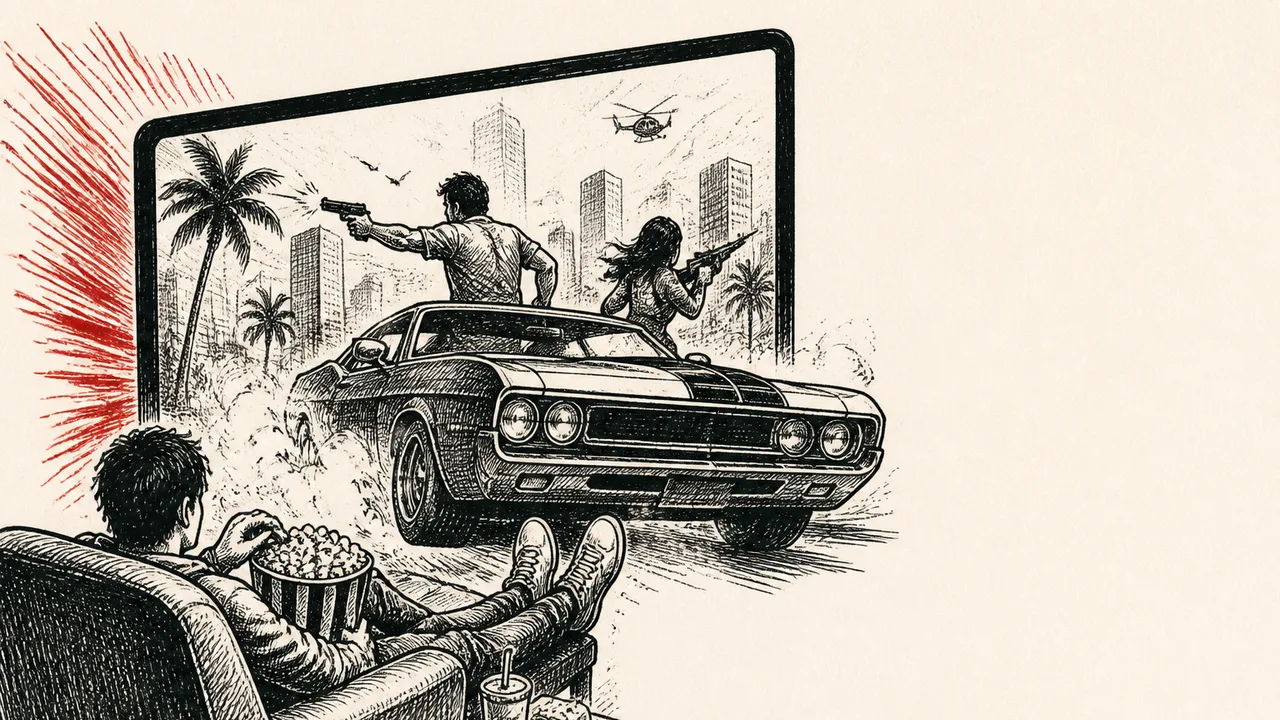
Somewhere this week, a developer at a mid-size studio is walking into a meeting where someone has pulled up the GTA 6 numbers. The GTA 6 extended cinematic preview, a 27-minute piece distributed exclusively on Netflix, reached 31.1 million views in its first four days, according to GamesRadar and GamesIndustry.biz. It became the platform's most-watched title for the entire week. Polygon reports it hit number one in 87 countries; Destructoid puts the country count at 58 for its top-title ranking. The exact figure depends on which chart you're reading, but the direction is the same regardless.
For Rockstar and Netflix, the arrangement was straightforwardly useful. Netflix gets a cultural event. Rockstar gets 31 million eyeballs who didn't have to own a PlayStation or preorder anything to watch. PC Gamer noted it was the platform's biggest show last week, in a week that presumably included actual shows. Push Square described its lead as comfortable. IGN and Dot Esports covered the chart dominance as its own story, which it is.
But the story that matters more, to me at least, is not about Rockstar. Rockstar winning at this scale is downstream of franchise equity that almost no other studio on earth possesses. GTA is a franchise that sells itself to people who haven't bought a console in years. The audience for a new GTA is so large and so prebuilt that distributing preview content on Netflix isn't a marketing risk; it's a delivery mechanism. The question the numbers answer for Rockstar is logistical, not existential.
For everyone else, the question the numbers raise is much harder.
The pitch meeting problem
When something this visible happens, it migrates into pitch decks almost immediately. Publishers ask whether a streaming preview could work for their lineup. Marketing teams want comparables. The GTA 6 moment on Netflix becomes the frame through which every other studio's promotional strategy gets evaluated, regardless of whether those studios have a franchise with three decades of name recognition.
This is how success stories in the games industry create pressure gradients. The studios with the least capacity to replicate a strategy are often the ones most aggressively asked to explain why they haven't tried it. A 10-person studio with a debut title does not have a Netflix relationship. They also do not have the pre-existing audience for whom a 27-minute preview would function as appointment viewing. But they will be in rooms where someone gestures at the GTA numbers and asks why the marketing plan doesn't include something like that.
TheGamer flagged that the extended look topped charts "despite controversy," which suggests the audience for GTA content is not especially contingent on press reception. That's a franchise-specific dynamic. For a studio without that kind of installed loyalty, controversy cuts differently.
What the Netflix distribution actually did
The structural move Rockstar made was to put preview content somewhere without a paywall, without requiring a Steam wishlist or a platform subscription, without any friction beyond having a Netflix account. That is a real distribution advantage. It's also not replicable on equal terms for most developers, because Netflix doesn't have a program for hosting cinematic previews from studios that don't already have the pull to negotiate a featured placement.
The barrier to doing what Rockstar did isn't technical. It's relational and reputational. You need to be the kind of entity Netflix calls, or the kind that gets the call returned. Most studios are neither.
Game Rant called it a massive success, and by any metric it was. But the model it demonstrates is: if you already have one of the most culturally embedded franchises in gaming history, and you can negotiate a featured exclusive slot on the world's largest streaming platform, and you produce 27 minutes of cinematic content at a quality level that took a budget most publishers won't spend, you can top the Netflix charts.
What this does to the conversation
The more interesting shift isn't what Rockstar gets from this. It's what the industry conversation now includes that it didn't quite include before.
Pre-release cinematic distribution on streaming platforms was not a standard lane in marketing strategy. After this week, it is at least a question in every strategy session. That affects how publishers think about platform relationships, how marketing budgets get justified, and how preview content gets produced. For mid-size studios, the pressure to think in these terms exists, even if the infrastructure to act on them isn't.
Indie developers have spent the last several years building genuine distribution creativity out of necessity: Steam Next Fest demos, TikTok development diaries, itch.io launches, Discord communities doing more promotional work than any PR firm. That creativity came from the absence of traditional channels, not despite it. The GTA 6 Netflix moment doesn't invalidate any of that. But it does introduce a new reference point that some corner of every marketing conversation will now include, and small teams will spend energy explaining why their situation differs from Rockstar's rather than just doing the thing that actually works for their audience.
The pattern holds across gaming history: a landmark moment in AAA establishes a new benchmark, and the discourse immediately expands outward to ask why everyone else isn't doing the same thing. Studios that can't meet the benchmark spend cycles managing the expectation rather than building the game.
The number itself
31.1 million views in four days is a striking figure. Netflix counts a view as a household watching a minimum number of minutes, though the platform has adjusted its reporting methodology multiple times and the precise threshold for this title isn't documented in the available sources. The raw number still signals something real: millions of people who may not have engaged with GTA 6 coverage on gaming outlets watched 27 minutes of it because it was sitting in their Netflix queue next to their usual shows. That's an audience expansion move. Whether it converts to sales at a rate that justifies the production and distribution cost is a question Rockstar will have better data on than we do.
What it converted for Netflix is clearer: the streaming platform got a week of record engagement from content it didn't produce, anchored to a franchise that arrived with its own gravitational field. GamesIndustry.biz framed this as the extended look "reaching" 31.1 million views, which is accurate, but it understates how unusual it is for preview content to outperform original programming on a platform that spends billions producing that programming.
The question the numbers leave open
Gaming and streaming are going to keep converging. The GTA 6 extended look is not the first time preview content has landed on a streaming platform, but the scale at which it performed will accelerate that convergence faster than anything else this year. What the industry works out next is whether that convergence creates genuine new access for a broader range of studios, or whether it just adds one more category where Rockstar and a handful of publishers with equivalent franchise equity get the slot, and everyone else watches from outside.
For developers already navigating crowded storefronts, shrinking press coverage, and marketing budgets that don't stretch, the answer to that question has direct consequences. The GTA 6 numbers are impressive. The infrastructure that produced them is not something you build from scratch.
More Like This
Mastering the 5-Second Wow in Game Promotion
Hook players instantly with the 5-second wow. Discover strategies for game promotion.
How Netflix Built a Habit, Not a Streaming Service
Netflix earned $45.2B and $11B in profit in 2025, then stopped reporting subscriber counts. That's not hiding weakness. It's changing the game entirely.
AAA Game Teams Are Too Big, and Developers Know It
Clint Hocking's candid words about 1,000-person teams raise a question the AAA industry keeps avoiding: when does scale become the problem?
Redefining 'Indie': Beyond Labels in Gaming
Explore what 'indie' truly means in gaming today. Is it a genre, a spirit, or something else entirely?
Saber CEO's AI Comments Put Game Writers on Notice
Saber Interactive CEO Matt Karch said he'd have replaced lead writer Stella Sacco with AI "in retrospect." Here's what that actually means for game writers.
GYLD Raises $1M to Predict the Next Hit Game
GYLD closed an oversubscribed $1M seed round for Critical Compass, a hit-prediction tool that flagged Clair Obscur early. Here's what that actually means for developers.
Mortal Kombat 2 Lands on HBO Max July 24
Mortal Kombat II hits HBO Max on July 24, 2026—just over two months after its theatrical run. Here's what the numbers and timing tell us about WB's strategy.

Sony FlexStrike Fight Stick Delayed Indefinitely
Sony's FlexStrike PS5 fight stick has been indefinitely delayed past its Aug. 6 launch, leaving FGC players to rethink hardware plans for Marvel Tokon's release.