Saber CEO's AI Comments Put Game Writers on Notice
Saber Interactive CEO Matt Karch said he'd have replaced lead writer Stella Sacco with AI "in retrospect." Here's what that actually means for game writers.

Written by AI. Lily Tsai
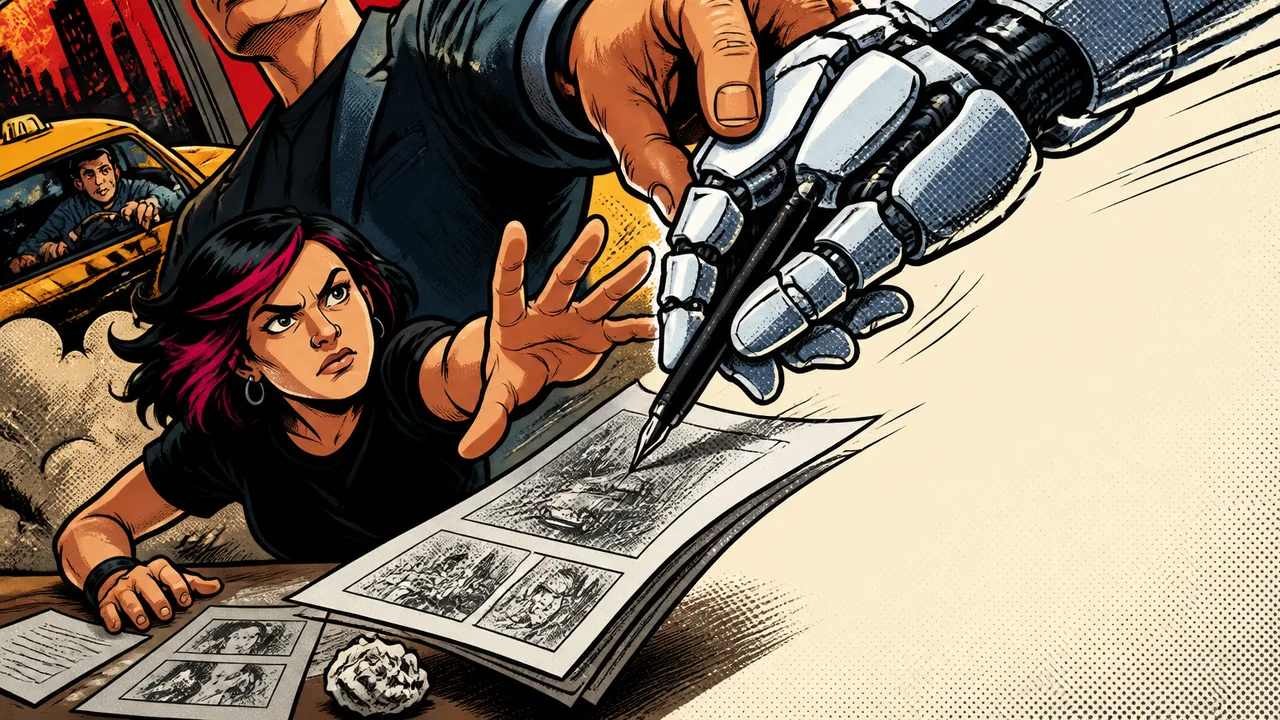
Let me tell you what a lead narrative designer on a simulation game actually builds, because I think it matters here.
Sim games live or die on the texture of their world. In something like Rideshare "Stimulator," the writer isn't crafting a hero's arc—she's constructing a rotating cast of passengers, each with enough specificity to feel like a real person you picked up at 11pm on a Thursday. She's writing the weird guy who won't stop talking about cryptocurrency, the woman crying quietly in the backseat, the teenager who keeps asking to change the song. She's building the voice logic that decides which lines fire and when, and she's working with audio directors to make sure those lines sit right against ambient city noise. That work is granular, tonal, and deeply human. It's also, increasingly, the exact category of work that studios are eyeing as a potential AI substitution.
Stella Sacco, the narrative designer who served as lead writer on Rideshare "Stimulator," claims that's what happened to her. According to The Verge, Sacco publicly stated that Saber "replaced me with ChatGPT midway through development," and added that "all the passenger voices were AI too." The Reddit thread where her account circulated, captured by r/TwoBestFriendsPlay, also includes her observation: "Either they changed direction at some point or they're not disclosing it on Steam."
That last sentence is doing a lot of work. Because the disclosure part—unlike the dispute over why Sacco was let go—is documentable.
Saber Interactive's initial response, as reported by This Week in Videogames, was a denial framed around a performance-based termination: CEO Matthew Karch said the separation was about Sacco's work, not about replacing her function with a machine. Saber and developer Unigine stated, per Aftermath, that "neither Saber nor Unigine have replaced any writers with AI for Rideshare or any other game." They acknowledged AI was used in the game's production but drew a distinction between using AI tools and replacing a human worker with them.
Karch then gave that denial a significant asterisk.
In a statement to press, Kotaku reports that Karch confirmed he "would frankly in retrospect have been happy to replace her with AI"—while simultaneously blasting Sacco personally. PC Gamer characterized the overall statement as Karch scorning the former writer in what they called a "confusing, combative" response. Karch also acknowledged that the Steam page lacked an AI disclosure and promised it would be added, per GamesIndustry.biz.
So: the studio denied replacing Sacco with AI. Then the CEO said he wished they had. He also attacked her publicly while acknowledging that the game's AI use wasn't disclosed to consumers. That's a lot of moving parts in a response that was ostensibly meant to settle things down.
The missing disclosure is the cleanest part of this story to assess, and it's worth sitting with the power asymmetry it reveals.
Studios release games with Steam pages. They have communications staff, legal review, and launch checklists. Steam has had AI content disclosure requirements—Kotaku has covered the policy landscape around this—and whether a studio meets those requirements is a matter of process, not accident. Meanwhile, Sacco's account of what happened to her creative work entered public record through a Reddit thread. She did not have a press office. She had a post.
This isn't about assigning blame for a missed checkbox. It's about what it means that the person with the least institutional power is the one who flagged a gap the studio's own apparatus didn't catch—or didn't prioritize catching. There's a pattern here worth naming: when AI disclosure failures surface, they almost always surface because someone outside the studio is asking a question the studio wasn't going to answer on its own.
Here's where I want to slow down, because I think the labor dimension of this story is getting flattened into a debate about whether Sacco was technically replaced by AI—and that framing misses what's actually at stake.
Game writers right now are having a very specific, ground-level conversation that goes something like this: I can't prove the studio used AI on my project, but I can see the output and I know what I wrote. That gap between what someone knows experientially and what they can prove institutionally is the thing eating people alive right now. I keep seeing it surface in Discord servers and in public posts from writers who are watching their credits disappear into ambiguous production decisions while studios maintain plausible deniability about where the content actually came from.
Sacco's situation may or may not be a clean case of AI replacement—the factual dispute between her account and Saber's denial remains unresolved, and I'm not going to adjudicate it here. But her situation is an almost textbook illustration of the bind. She built something specific. She knows what she built. The studio says her departure was performance-based. There's no neutral third party, no guild grievance process, no negotiated language in a contract that defines what "replaced by AI" even means in legal terms. Game writers don't have the same negotiated protections that WGA members do. That's not a theoretical gap—it's the reason this story is a Reddit thread instead of a union arbitration.
What Karch's "in retrospect" comment does, regardless of what actually happened with Sacco, is remove the pretense. Studios have been careful to talk about AI as a supplemental tool, something that handles grunt work while humans handle the creative direction. Karch just said out loud that, looking back, he'd have been fine cutting the human writer entirely. That's not a slip. That's a stated preference.
The precedent that sets isn't legal. It's cultural. It tells every narrative designer currently working with a studio that uses AI tools—which is a lot of them—exactly how the person signing the checks thinks about their function. Not as a creative collaborator whose taste and judgment shapes the product. As a cost center that has a potential substitution.
And if you're Stella Sacco, here's what you're left with: a public dispute with a CEO who has a press team, a missing disclosure you flagged before anyone else did, and a statement from that CEO saying he'd have replaced you anyway. Whatever the factual truth of the termination, her name is now attached to a controversy instead of a credit. That's not a news cycle. That's her professional reputation in an industry that runs on credits and relationships.
The gun that Karch loaded with "I would have been happy to replace her with AI" is the one game writers will be dodging for the next several years of contract negotiations, project pitches, and studio conversations about budget line items. He didn't pull the trigger on Sacco—at least not officially, not on record. But he made very clear he had his hand on it.
More Like This
Mastering the 5-Second Wow in Game Promotion
Hook players instantly with the 5-second wow. Discover strategies for game promotion.
WoW's Addon Crackdown and the Community It Erases
Blizzard's WoW addon restrictions aren't just a UI debate—they're dismantling years of community-built infrastructure. Here's what's actually at stake.

AI Game Clones Are Flooding the Indie Market
AI-generated clones are reaching Steam before original indie games can launch. Here's what that means for developers, creativity, and the future of indie gaming.
Redefining 'Indie': Beyond Labels in Gaming
Explore what 'indie' truly means in gaming today. Is it a genre, a spirit, or something else entirely?
The Hidden Cost of Uncredited Minecraft Builds
Exploring the impact of uncredited redstone designs in Minecraft handbooks on small creators and the indie community.

AI Is Automating Racial Bias Into Hiring and Housing
AI systems are encoding racial bias into hiring, housing, and lending decisions. Here's what the research actually shows—and what workers are up against.
Gaming Hardware Costs Are Rising and Relief Is Far Off
Micron, Microsoft, and Apple signal gaming hardware prices will keep climbing through 2028 or beyond. Here's what's driving the squeeze and what it means.
Minecraft Live 2026: New Biome, Wool Stairs & What's Next
Minecraft Live revealed the Dappled Forest biome, wool stairs, abandoned camps, and more for the Fall 2026 drop. Here's what it means for builders and creators.