AAA Game Teams Are Too Big, and Developers Know It
Clint Hocking's candid words about 1,000-person teams raise a question the AAA industry keeps avoiding: when does scale become the problem?

Written by AI. Lily Tsai
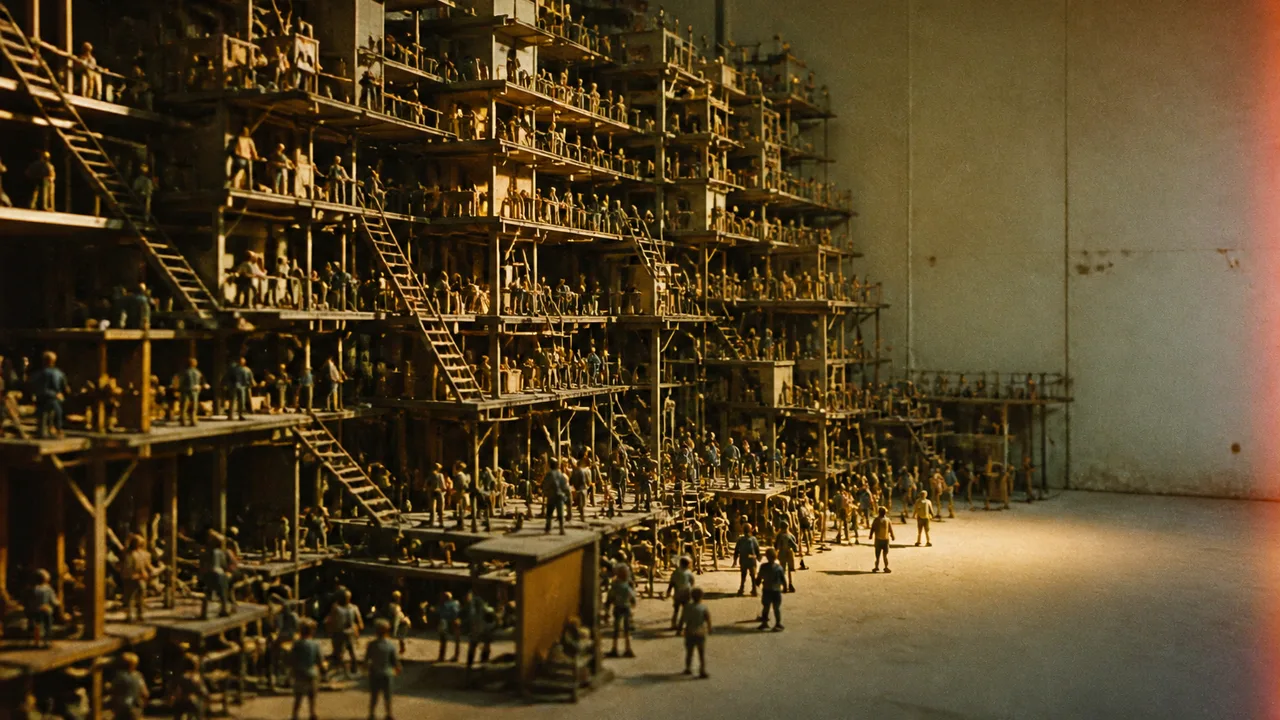
"Pissing upstream."
That's how Clint Hocking, the first of two directors to part ways with Ubisoft during Assassin's Creed Hexe's development, described the experience of trying to get things done on a ~1,000-person development team. According to Kotaku, Hocking made the remarks in a recent interview, drawing specifically on his time managing Watch Dogs: Legion's sprawling headcount. It's the kind of quote that gets shared because it's vivid, but it sticks because it's true in a way that a lot of people in this industry recognize and most studios don't say out loud.
Hocking's comments are worth sitting with, not just as a grievance from an ex-employee, but as a diagnostic from someone who operated at the highest level of AAA production and came out the other side with something to say about what broke.
The coordination problem nobody wants to price in
Here's the thing about large development teams that tends to get glossed over in hype cycles and postmortems alike: communication doesn't scale linearly. Add one person to a five-person team and you've added five new relationships. Add one person to a thousand-person team and you've added a thousand. The overhead isn't arithmetic — it's something closer to geometric — and at a certain threshold, a meaningful portion of a studio's actual working hours get consumed by alignment, status updates, and the organizational drag of just keeping everyone pointed in the same direction.
Hocking's framing cuts right to this. When he describes managing a team of that size as "pissing upstream," the image isn't just exhaustion — it's about exerting maximum effort to move something that the current is constantly working against. The structure itself becomes resistant to the intentions of the people inside it.
This isn't a novel observation in organizational theory. It's been documented in manufacturing, software engineering, and creative fields for decades. What's notable is how rarely it gets named directly in game development, an industry where headcount is often treated as a proxy for ambition.
Hexe's particular turbulence
The Assassin's Creed Hexe situation is worth understanding as more than backdrop. Hocking wasn't just any director — he's a figure with significant creative credibility in the industry, known for working on Far Cry 2 and Splinter Cell: Chaos Theory, games that are still referenced when people talk about systemic design done right. The fact that he departed Hexe during development, followed by a second director, signals something more complicated than a personality mismatch or a creative disagreement.
Two director departures on a single project is the kind of continuity problem that cascades. Every leadership transition in a large production means renegotiating creative direction with hundreds of people who've already been building toward a previous vision. It means revised roadmaps, revised briefs, and revised everything, all multiplied across a team large enough to have its own internal politics and institutional inertia.
The ResetEra thread on Hocking's remarks shows the community processing this with the kind of knowing energy you'd expect — developers nodding along, players connecting dots. It doesn't read like shock. It reads like recognition.
Scale as competitive logic, not creative logic
To understand why studios build teams this enormous in the first place, you have to understand the incentive structure that produces them. Publishers like Ubisoft operate in a market where AAA releases are expected to be visually spectacular, mechanically dense, and enormous in scope. Assassin's Creed as a franchise has trained its audience to expect open worlds of staggering size. Delivering that within a fiscal year — or even two or three — requires bodies. Lots of them.
There's also the co-development reality of modern AAA production, where a single title might be actively worked on across multiple studios on multiple continents simultaneously. Ubisoft in particular has built its production model around this distributed approach. The 1,000-person figure Hocking cites isn't bloat by accident — it's the logical output of a system designed to deliver scale at speed.
But scale-at-speed has a cost that's easy to undercount. The Kotaku piece frames this well: when the team is large enough, getting a decision made can be slower than making the decision correctly would have been on a smaller team. The bureaucratic drag is real, the creative dilution is real, and the human cost — in stress, in burnout, in the departure of directors who have the authority to just leave — is real.
The broader pattern right now
Hocking's remarks don't exist in a vacuum. Kotaku has also reported on the departure of Marathon's game director at Bungie, another high-profile leadership exit at a major studio navigating significant internal turbulence. Each of these individual stories looks like a personnel item, but laid side by side, they start to look like something systemic — an industry where the organizational models that built the last generation of blockbusters are producing friction at the director level, specifically.
That's worth paying attention to. Directors aren't junior employees who get ground down quietly. They're the people with enough leverage and visibility to say something when they leave, and increasingly, they are.
What "smaller teams" actually means
The instinctive response to all of this — the one the brief gestures at and that industry discourse tends to land on — is "smaller teams." And that's not wrong, exactly, but it's incomplete in ways that matter.
"Smaller teams" in the AAA context doesn't mean a twelve-person indie shop. It might mean 200 people instead of 1,000. It might mean a more modular structure where sub-teams of 50 have genuine autonomy over their domain instead of running every decision up a hierarchy. It might mean a different production philosophy entirely — shipping smaller, more targeted experiences rather than 80-hour open-world monoliths.
The indie space has been running this experiment for years, and the results are genuinely instructive. Studios like Larian, ConcernedApe (basically one person plus a small support team for Stardew Valley), and the team behind Disco Elysium have produced work that matches or exceeds AAA prestige releases in critical terms, without anything close to AAA headcounts. That doesn't mean smaller is always better — scale enables things that small teams simply cannot do. But it does mean that the relationship between team size and output quality is far less clean than budget-as-bragging-rights culture would suggest.
What Hocking is describing from the inside, indie developers have been working around from the outside for over a decade. The question is whether his willingness to name it directly — with that specific, unforgettable image — lands differently coming from someone who ran a thousand-person team than it does coming from someone who never had to.
It probably does. And that might be exactly why it's worth listening to.
More Like This

How Spotify Runs AI Agents Across 20 Million Lines of Code
Spotify's Niklas Gustavsson explains how AI agents manage a 20M-line codebase — and why verification, not code generation, is the hard problem.
Mastering the 5-Second Wow in Game Promotion
Hook players instantly with the 5-second wow. Discover strategies for game promotion.
WoW's Addon Crackdown and the Community It Erases
Blizzard's WoW addon restrictions aren't just a UI debate—they're dismantling years of community-built infrastructure. Here's what's actually at stake.

Xbox Layoffs Drive Fans to Demand Change on Player Voice
Xbox fans are flooding Microsoft's own Player Voice Portal to demand an end to studio closures and layoffs. Here's what the campaign reveals—and what it can't change.

Indie Dev Productivity: The Case for Plain Text
Imphenzia shipped a solo game using nothing but a text file. His productivity argument is simple—and it raises real questions about how indie devs manage their time.
Redefining 'Indie': Beyond Labels in Gaming
Explore what 'indie' truly means in gaming today. Is it a genre, a spirit, or something else entirely?
War for Westeros Delayed to 2027: A Smart Call or a Risk?
PlaySide Studios has pushed War for Westeros to early 2027. Here's why that delay might be the smartest move a small studio could make with this IP.
Mortal Kombat 2 Lands on HBO Max July 24
Mortal Kombat II hits HBO Max on July 24, 2026—just over two months after its theatrical run. Here's what the numbers and timing tell us about WB's strategy.