Two Nintendo Directs Are Coming, and Prediction Season Is Doing Its Thing
Nintendo has confirmed a September 8 Direct and a Zelda 40th anniversary showcase for September 9. Here's what's confirmed, what's speculation, and how to read it.

Written by AI. Lily Tsai
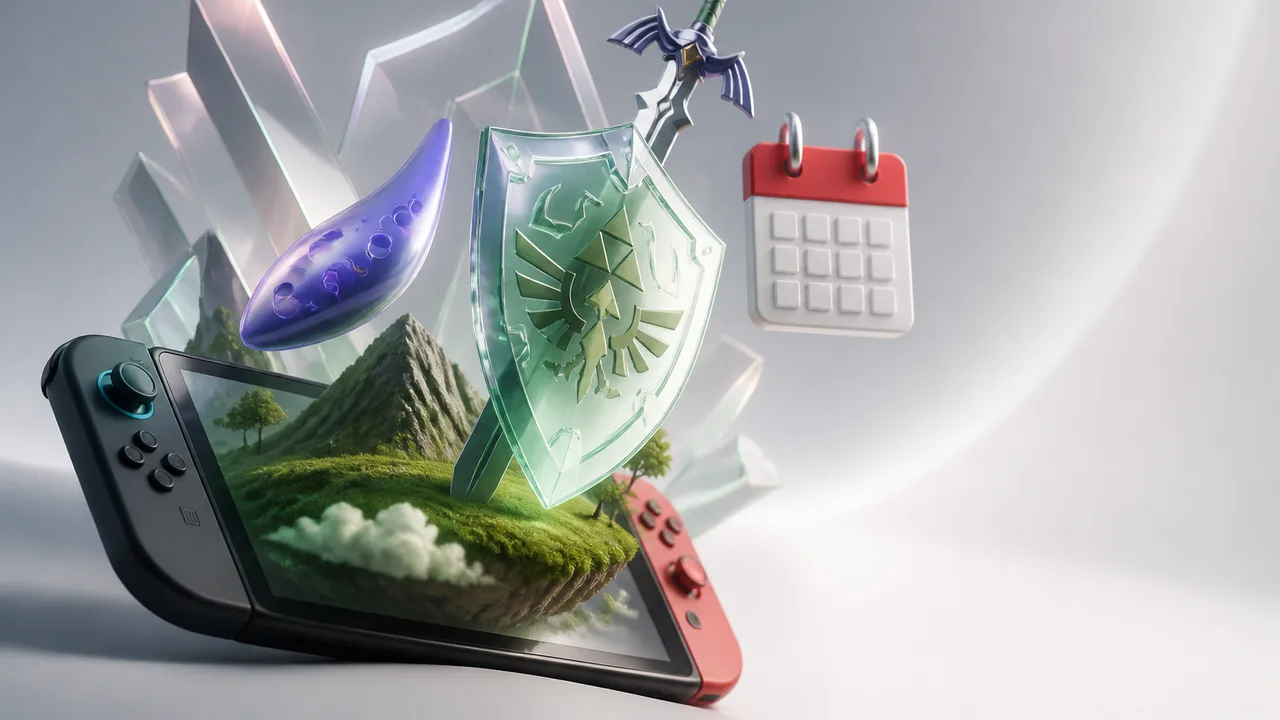
Nintendo has confirmed two back-to-back Nintendo Directs for next week: a roughly 45-minute general presentation on September 8, followed by a dedicated showcase celebrating The Legend of Zelda's 40th anniversary on September 9. According to Noisy Pixel, the general Direct runs 45 minutes, and Eurogamer reports this is the first time Nintendo has ever hosted two Directs back-to-back, with the first of the pair dedicated entirely to Zelda's anniversary. Kotaku flags the scheduling details, dates and times, in its coverage of the doubleheader kotaku.com, and Video Games Chronicle frames it the same way: two Directs confirmed, one of them Zelda's 40th videogameschronicle.com.
The Prediction Machine, Timestamped
Nintendo announced the Directs this week, and the prediction industry reached operational capacity within hours. IGN posted 14 predictions spanning both presentations ign.com. Game Rant went bigger, predicting the "MAJOR" Zelda and Switch 2 reveals at both Directs. Nintendo Everything published its own September 2026 predictions roundup nintendoeverything.com, and Nintendo Life took the community-survey route, asking readers directly what they hope to see nintendolife.com.
GamesRadar contributed the most honest headline of the bunch, noting that a dedicated Zelda anniversary stream makes "Ocarina of Time feels inevitable" gamesradar.com. TheGamer went further and put the words "Ocarina of Time remake" right in the URL of its announcement coverage thegamer.com, which is a curious editorial choice for a piece nominally about what Nintendo has confirmed. Nothing in Nintendo's announcement names an Ocarina remake. The headline bakes a rumor into the factual record's framing.
This is the standard mechanics of Direct week, and it's worth being precise about how it works, because it happens every cycle: Nintendo confirms an event. Outlets report the confirmation. Then prediction content arrives, structured as analysis but fueled by hope, and the distinction between the two erodes somewhere between the headline and the third paragraph. By the time the Direct actually airs, a reader who browsed casually has absorbed a set of assumed announcements that Nintendo never said.
Why This Doubleheader Carries More Weight than Usual
The stakes here aren't purely fan excitement. Destructoid argues the doubleheader "could solidify Switch 2 as the top console this generation" destructoid.com, framing the week as a hinge point for the hardware's software lineup. That's a claim about trajectory, not fact, but it reflects a real question: Nintendo has launched Switch 2 into a market where software cadence determines hardware momentum, and a 45-minute general Direct plus a Zelda showcase is a substantial commitment of stage time. Siliconera covers the scheduling of both the Switch 2-focused general Direct and the Zelda showcase under one roof siliconera.com.
The Zelda 40th anniversary framing raises the expectation ceiling further. Anniversary branding, historically, invites audiences to expect a retrospective, re-releases, or a headline reveal. Zelda specifically carries forty years of catalog pressure: fans have spent years asking for easier access to older entries, and a dedicated stream is exactly the venue where those requests converge. GamesRadar's "feels inevitable" line captures the dynamic; inevitability, in prediction culture, is a feeling doing the work of a source.
The Useful Divide: Reading the Calendar vs. Reading Wishes
The brief's most useful framing, echoed in IGN's piece, is the line between informed reading of Nintendo's release cadence and pure wish-list speculation. Informed reading looks like this: Nintendo has a Direct scheduled, Directs historically serve the next two quarters of releases, Switch 2 needs a strong second-half lineup, and a Zelda anniversary stream will contain Zelda content, presumably including some form of catalog or remaster news. Those are structural inferences, and they're reasonable.
Wish-list speculation looks like naming specific titles, specific remakes, specific dates, without leaks or filings behind them. The Ocarina of Time remake prediction is the current poster child: plausible, frequently repeated, and sourced to nothing but the shape of past anniversary celebrations. When TheGamer's announcement coverage already carries the remake in its URL, the prediction has effectively been laundered into common knowledge before anyone has confirmed a thing.
Neither mode is illegitimate. Prediction articles are fan service in the literal sense; Nintendo Life's community thread exists because people enjoy wondering together, and there's nothing wrong with that. But the two modes make different claims on your belief, and readers benefit from outlets labeling which one they're doing. A prediction grounded in Nintendo's historical cadence can be wrong and still be good analysis. A prediction grounded only in desire can be right and still be noise.
The Other Side of the Ledger
One counterweight deserves mention. Prediction culture also functions as a demand signal. When hundreds of thousands of readers click on "will we finally get an Ocarina remake," Nintendo's marketing apparatus can read the room as well as anyone. Anniversary Directs in the past have shaped their content partly around what the conversation was already loudest about. Speculation isn't just vapor before the facts; it's a public negotiation over what the facts should be, conducted in full view of the company that owns them.
The risk runs the other direction too. Nintendo is famously disciplined about controlling its own reveal schedule; IGN's piece notes the company's ability to keep plans tightly guarded until the moment it chooses. A fanbase that spends a week convincing itself an Ocarina remake is coming has handed Nintendo a hostage: whatever the Zelda Direct actually contains, a segment of the audience will measure it against a reveal that never existed. Nintendo doesn't owe anyone that remake. The audience built the expectation themselves, with help from headlines like TheGamer's.
What to Watch For
Judged soberly, the September 8 and 9 Directs will be evaluated on three axes. First, the Switch 2 software roadmap: does the general Direct clarify the console's near-term release strategy, or does it pad? Second, whether the Zelda anniversary showcase serves players, with accessible re-releases, preservation of the catalog, real news, or whether it mostly packages nostalgia, a museum exhibit with a buy button. Third, how the predictions held up, which will tell us something about whether the current prediction ecosystem reads Nintendo well or just reads itself.
My own guess, for what a guess is worth, is that the Zelda Direct contains at least one announcement nobody predicted, because Nintendo has a long record of using dedicated showcases for curveballs rather than the expected headliners. The community's most confident predictions have a way of being the ones Nintendo most enjoys subverting.
The facts arrive September 8 and 9. Until then, every headline you read about remakes and reveal slates is a bet, not a report. Read them like bets, and the week gets a lot more fun.
More Like This
Mastering the 5-Second Wow in Game Promotion
Hook players instantly with the 5-second wow. Discover strategies for game promotion.
Lollipop Chainsaw's New Game Debuts at TGS 2026
Dragami Games brings a new Lollipop Chainsaw title to Tokyo Game Show 2026, complete with a world premiere demo and a self-described DEI-free stance.
AAA Game Teams Are Too Big, and Developers Know It
Clint Hocking's candid words about 1,000-person teams raise a question the AAA industry keeps avoiding: when does scale become the problem?
Zelda Ocarina of Time Remake: Confirmed and Coming
Nintendo confirmed an Ocarina of Time remake for Switch 2 in 2026—but the rumor cycle that got us here reveals something about how gaming communities process hope.
Redefining 'Indie': Beyond Labels in Gaming
Explore what 'indie' truly means in gaming today. Is it a genre, a spirit, or something else entirely?
Anime NYC 2026: What the Convention Reveals
Anime NYC 2026 ran August 20–23 at the Javits Center. Here's what the announcements, rankings, and crowd energy actually tell us about where anime is headed.
War for Westeros Delayed to 2027: A Smart Call or a Risk?
PlaySide Studios has pushed War for Westeros to early 2027. Here's why that delay might be the smartest move a small studio could make with this IP.
Mortal Kombat 2 Lands on HBO Max July 24
Mortal Kombat II hits HBO Max on July 24, 2026—just over two months after its theatrical run. Here's what the numbers and timing tell us about WB's strategy.