Nintendo Cartridge Supply Faces a ROM Chip Supplier Exit
Macronix's reported ROM exit tests Nintendo's physical game supply chain amid a memory crunch. What it could mean for Switch cartridges, prices and downloads.

Written by AI. Mike Sullivan
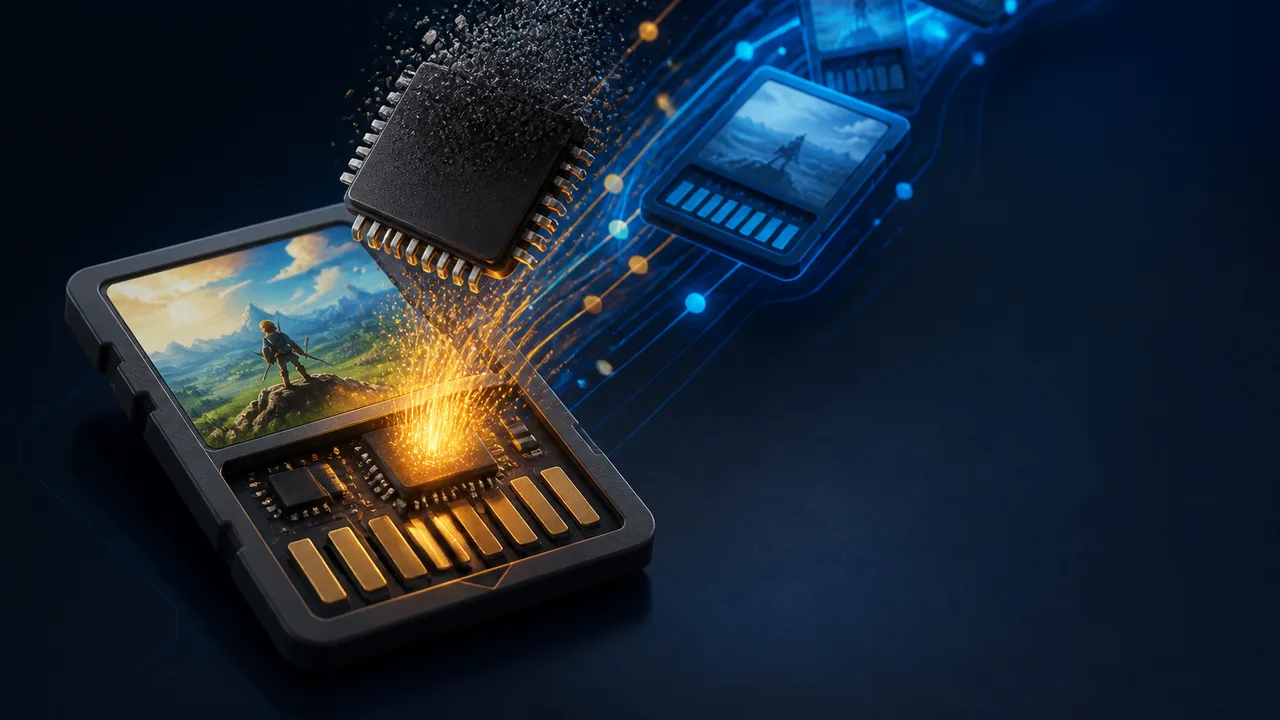
Macronix, Nintendo’s largest supplier of cartridge ROM chips, is reportedly leaving that business as a wider memory shortage puts pressure on game-cartridge supply. It is an awkward reminder that a physical game, however reassuringly solid it feels in your hand, depends on a component industry with other places to spend its money.
The immediate question is what happens to Nintendo’s supply of physical Switch games. The answer depends on more than the number of cartridges already on shelves: manufacturers need chip capacity for future production, and another supplier would need to take on work if Macronix stops making the relevant ROM chips. The timing of replacement capacity and any effect on retail prices remain unclear.
That leaves room for two outcomes that can sound contradictory until you look at the hardware. A supplier exit could squeeze some physical releases or raise costs. It could also leave much of the Switch 2 lineup untouched if those games rely on different suppliers or different ways of delivering game data. “Nintendo cartridges” is a useful label for shoppers, but a broad one for diagnosing a chip shortage.
The Chip Inside the Plastic
ROM holds the game data on a conventional cartridge. The shell and contacts are the visible parts; the memory chip is the reason inserting the thing does anything useful. A publisher ordering a physical release needs that chip, a suitable cartridge assembly and a production run timed to reach stores. Replacing one company in that chain involves more than finding another factory that makes something called memory.
Macronix’s exit concerns ROM manufacturing. The reported shift toward chips for AI data centers offers a plausible business explanation: suppliers have incentives to direct capacity and investment toward customers they expect to buy more profitable products. That does not mean a cartridge chip and an AI server chip are interchangeable. It means cartridge buyers compete for a manufacturer’s attention and resources. The plastic shell has never had to book a wafer fab.
This is where an old consumer-electronics lesson comes back around. Concentrated supply works smoothly while the favored supplier keeps producing the part everyone designed around. Once its priorities change, the customer must either find another source, change the design or accept a narrower supply. Those choices take time, even for a product that has been on store shelves for years.
The cartridge itself has been through a version of this argument before. In the 1990s, CDs gave console makers and publishers a different set of trade-offs from cartridges, including manufacturing costs and the amount of data a game could carry. Nintendo kept cartridges for the Switch because the format still offers useful qualities for a portable console: a compact physical product that stores game data locally. Old technology can remain useful long after an industry declares it passé. Its supply chain, however, does not receive a lifetime achievement award.
One Supplier Exit, Several Kinds of Physical Game
Macronix has made chips for Switch cartridges, and the exit raises questions for Switch and Switch 2 physical games. The phrase “physical game” now covers products that place different demands on storage chips. A cartridge carrying game data needs enough storage for that data. A game-key card instead serves as a physical means of accessing a download, reducing the amount of game content that must fit on the card.
That creates an economic trade-off. If large game-storage chips become harder or more expensive to source, a publisher might find a download-dependent physical product more attractive. It can still put a box on a retail shelf. It cannot give a player the same experience as a cartridge that holds the game. A collector thinking about long-term access, or a buyer with a slow connection, has a good reason to care which version is inside the box.
The case for limited disruption to Switch 2 games rests on the possibility that Macronix’s role in the older Switch supply chain does not translate directly to the newer console. That is a narrower and more useful claim than predicting either a cartridge collapse or business as usual across every physical release. Exposure can vary by console generation, cartridge type and the suppliers making each component.
Nor does a supplier’s departure turn every game already manufactured into a scarce collectible. Inventory on shelves and chips needed for the next production run are different things. The pressure, if it reaches consumers, would show up through decisions about future runs: how many physical copies to make, what form they take and what price can support them. A broad memory crunch gives manufacturers less slack to absorb a change in one corner of the market.
What Downloads Can and Cannot Replace
Digital distribution neatly sidesteps one part of the problem. A downloaded game does not need a game-data cartridge. For a publisher facing uncertainty over physical components, that makes digital sales a practical route to customers. It also gives Nintendo and publishers an existing alternative if a particular cartridge run becomes difficult to arrange.
For players, the substitution depends on what they wanted from the purchase. A download may be more convenient than finding a boxed copy. A retailer cannot stock it in the same way as a cartridge; a buyer who wants game data on physical media cannot get that from a download code or a game-key card. Those differences help explain why the fate of a ROM supplier remains relevant in an era when games routinely arrive over the internet.
Retailers have another stake in the format. Physical games give stores products to display, stock and sell to customers who did not arrive planning to browse an online storefront. Publishers, meanwhile, have to decide whether a boxed release will sell enough copies to justify its production costs. If chip costs rise, that calculation could change first for smaller runs rather than for every major release at once. That is a business possibility, not an announced change to Nintendo’s pricing or release plans.
The useful indicators now are practical ones: whether another manufacturer takes over the affected ROM work, whether physical release plans change, and whether publishers favor download-dependent cards when choosing a format. Each would reveal more about the pressure on cartridges than an empty shelf photographed months after the fact.
Nintendo’s cartridge has survived several rounds of predictions that physical media was finished. Its next challenge comes from a familiar direction: the company that makes a small part inside it has other customers to consider.
More Like This

Do You Really Need an $80 HDMI Cable? Maybe Not
Tech reviewer Adam tests a premium HDMI 2.1 cable. We examine what you're actually paying for and whether most users need it.

Atlas Can Lift a Fridge. Now What?
Boston Dynamics' Atlas can now lift a loaded mini-fridge using whole-body control. Here's what the demo actually tells us—and what it doesn't.
AMD EPYC 8005 Sorano: A Genuine Generational Leap
AMD's EPYC 8005 Sorano upgrades SP6 with Zen 5 cores, 84-core density, and 96 PCIe Gen 5 lanes—but the ecosystem remains niche and memory costs sting.

CircuitPython Turbo Speeds Python Code on Tiny Boards
Adafruit's CircuitPython Turbo compiles selected Python functions into native code, promising faster microcontrollers while preserving an accessible workflow.

Why RAM Prices Won't Come Down Anytime Soon
Luke from Linus Tech Tips explains the forces keeping memory prices high—and why the consumer market is becoming an afterthought for hardware makers.

Gaming Hardware Costs Are Rising and Relief Is Far Off
Micron, Microsoft, and Apple signal gaming hardware prices will keep climbing through 2028 or beyond. Here's what's driving the squeeze and what it means.

Meta Enters AI Coding with Muse Code Agent
Meta launches Muse Code, a terminal-based AI coding agent taking on Anthropic's Claude Code and OpenAI's Codex. Here's what it actually does and what it means.

Designing GUIs for AI Agents: An Unsolved Problem
AI agents need interfaces humans can actually understand and control. The design choices made now will shape whether AI goes mainstream or stays a developer toy.