Cavalry Armor Surfaces in Palace Moat During Film Research Dig
Actors rehearsing a treasure-hunt film at Pielaszkowice Palace uncovered 19th-century cavalry armor in the moat. What the find can and cannot tell us.

Written by AI. David Oyelaran
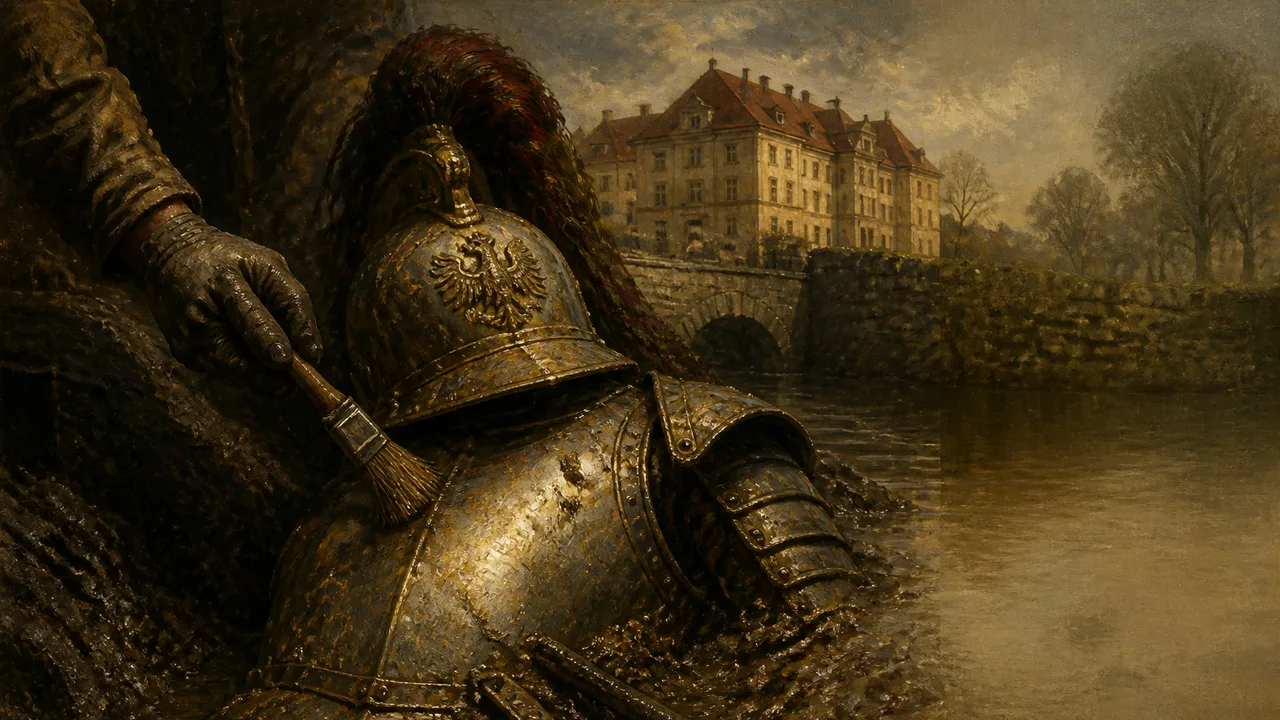
The actors came to Pielaszkowice Palace to rehearse. They left with an artifact.
According to reporting compiled by Europe Says and Bytes Europe, a group of actors preparing for an upcoming film about treasure hunting joined an archaeological dig in the muddy moat of a historic palace near Kostomłoty, in Poland's Lower Silesia region. It was research as preparation: stand where the characters would stand, hold the tools they would hold, feel the mud. Somewhere in that mud, the team uncovered a piece of nineteenth-century cavalry armor, described by All That's Interesting as intact and associated with the era of the Napoleonic Wars. Heritage Daily framed the find as an unexpected "encounter with history" during what it called a real-life treasure hunt at the palace moat.
The film crew went looking for a story and the moat handed them a source.
What the Armor Might Carry
An object like this is dense with information that no dramatic reconstruction can reproduce. Armor is manufactured in identifiable ways: the alloy composition, the shaping of the plates, the riveting patterns, and the maker's marks, if any survive, can point to a workshop, a decade, even a regiment's supply chain. Wear patterns record use. Repairs record poverty or desperation or attachment; a soldier who had a cuirass patched rather than replaced was telling you something about his circumstances, though the armor will not say what. Burial conditions record everything that happened after: whether the object was deposited carefully or thrown, whether the soil was waterlogged, whether it lay alone or beside other material.
All of that is contingent on what happens next. The sources available for this story are thin on the specifics: no named institution, no published conservation plan, no laboratory results. The reporting so far, from Heritage Daily and the aggregators that picked it up, establishes the find and its setting, and little more. That gap matters. In archaeology, the headline arrives months before the knowledge does.
The Moat as an Archive
Moats are good at preserving what they swallow. Waterlogged soil limits oxygen, which slows the decay of organic material and stabilizes metal in ways that dry, aerated ground does not. The mud that made the dig difficult is the same mud that may have kept a piece of armor intact for roughly two centuries. Lower Silesia adds its own layered history: the region shifted between Polish, Bohemian, Habsburg, Prussian, and German rule over the centuries, and the Napoleonic Wars swept armies across it in 1806 and 1807 and again in 1813, after the catastrophic retreat from Russia. Silesia saw campaigning, requisitioning, garrisoning, and the ordinary chaos of soldiers moving through farmland owned by aristocrats whose palaces, like Pielaszkowice, anchored the landscape.
That context makes several explanations plausible, and it is the archaeologist's job to narrow them, not the storyteller's. The armor could have been lost by a soldier, dumped with other scrap, hidden deliberately, or buried as part of building debris during later renovations of the palace and its grounds. A single object found near a palace does not establish who owned it or how it arrived there. Dating needs to come from the object itself and its find context, not from the romance of the Napoleonic association that every write-up reaches for first. The word "associated with the era" in the initial reporting is doing careful work: it describes a hypothesis, not a conclusion.
When Performance Meets Method
The odd and appealing thing about this story is the doubled role of the dig. It was a set-visit-style exercise for actors and, simultaneously, a real excavation, apparently supervised by archaeologists, in a moat that is a protected part of a heritage site. Those two purposes can sit comfortably together or they can grind against each other. Film research wants texture and anecdote; archaeology wants stratigraphy, context records, and patience. A find like this armor tests whether the production's curiosity can be disciplined by method: whether the object was left in situ for proper documentation, whether the find spot was recorded precisely, whether conservation began quickly enough to prevent a freshly excavated piece from deteriorating.
The evidence so far suggests the production worked with professionals rather than around them, and Heritage Daily's account treats the dig as a legitimate archaeological operation. If that holds, the episode is a small model for how historical films might actually engage the past they portray: not by consulting a historian for a fact-check pass, but by funding and joining fieldwork, and accepting that the past will occasionally hand them something they did not script.
There is also a public dimension. Discoveries like this one circulate widely precisely because they are legible: armor is visually dramatic, the treasure-hunt-for-a-treasure-film angle writes its own headline, and a palace moat sounds like folklore. Popular attention can fund and protect archaeology; it can also flatten it. By the time the story reaches international aggregators, the caveats have usually been stripped away, and "associated with the era of the Napoleonic Wars" becomes "Napoleonic armor" becomes, eventually, certainty that a French cuirassier died in the moat. Each step is a small fiction. None of them is needed to make the find remarkable.
What to Watch For
The next reliable signals will be institutional. A museum or conservation laboratory taking custody of the object, a published find report, a radiocarbon or metallurgical analysis, a statement from the regional heritage authority in Lower Silesia: any of these would move the story from anecdote to record. Until then, the honest description of the find is the one the initial reporting gave: an intact-looking piece of cavalry armor, recovered from a palace moat, provisionally dated to the nineteenth century, circumstance suggesting but not proving a connection to the Napoleonic period.
For the filmmakers, the discovery has already done the thing research trips are supposed to do, only more literally than anyone planned. They now know something the rest of us are still waiting to learn, and the moat knows more than both of them. The object in its mud held its information for two hundred years; the question is whether everyone involved, from the dig team to the production to the aggregators retelling the story, gives it the time and method it needs to keep talking.
More Like This

Middle Platonism's Hidden Role in Western Esotericism
ESOTERICA's new crowdfunded seminar argues Middle Platonism built the foundations of Hermeticism, Gnosticism, and early Christian theology. Here's what that means.
Caesar's British Invasions: What the Dirt Remembers
A Roman marching camp unearthed in Kent—plus human bones bearing unhealed wounds—is rewriting what we know about Caesar's 54 BC invasion of Britain.
An 11,000-Year-Old Statue of a Man Riding a Leopard
Archaeologists unearthed an 11,000-year-old statue at Karahan Tepe, Turkey, showing a man riding a leopard. What does it tell us about Neolithic power?
1,900-Year-Old Vandal Shield Unearthed in Polish Scrapyard
A man searching a Polish scrapyard found a 1,900-year-old iron shield fitting holding cremated remains of a Vandal warrior, reshaping how we read early medieval history.
Unveiling the Mayan Secrets of the Oldest American Book
Explore the Códice Maya de México and its astrological secrets tied to Venus, revealing Mayan culture's celestial insights.
Mexico's Radioactive Milk Scandal After Chernobyl
After Chernobyl, Mexico distributed Cesium-contaminated powdered milk to its poorest communities. The families who consumed it left almost no testimony behind.
Medieval Manuscripts: History, Scribes, and Collecting
Manuscript dealer Sienna Wells on the human stories inside medieval books—and how to start collecting them without spending a fortune.
Homer's Odyssey and What Mortality Means Today
Homer's Odyssey is more than epic adventure — it's a philosophical argument for why a finite life matters, and why immortality might be the real curse.