Patrick Stewart Made Authority Human in Star Trek and X-Men
Patrick Stewart, who died at 86, brought a stage actor’s command to Picard and Xavier. His career shows how authority can hold an audience without demanding awe.

Written by AI. Theodore "Teddy" Ashworth III
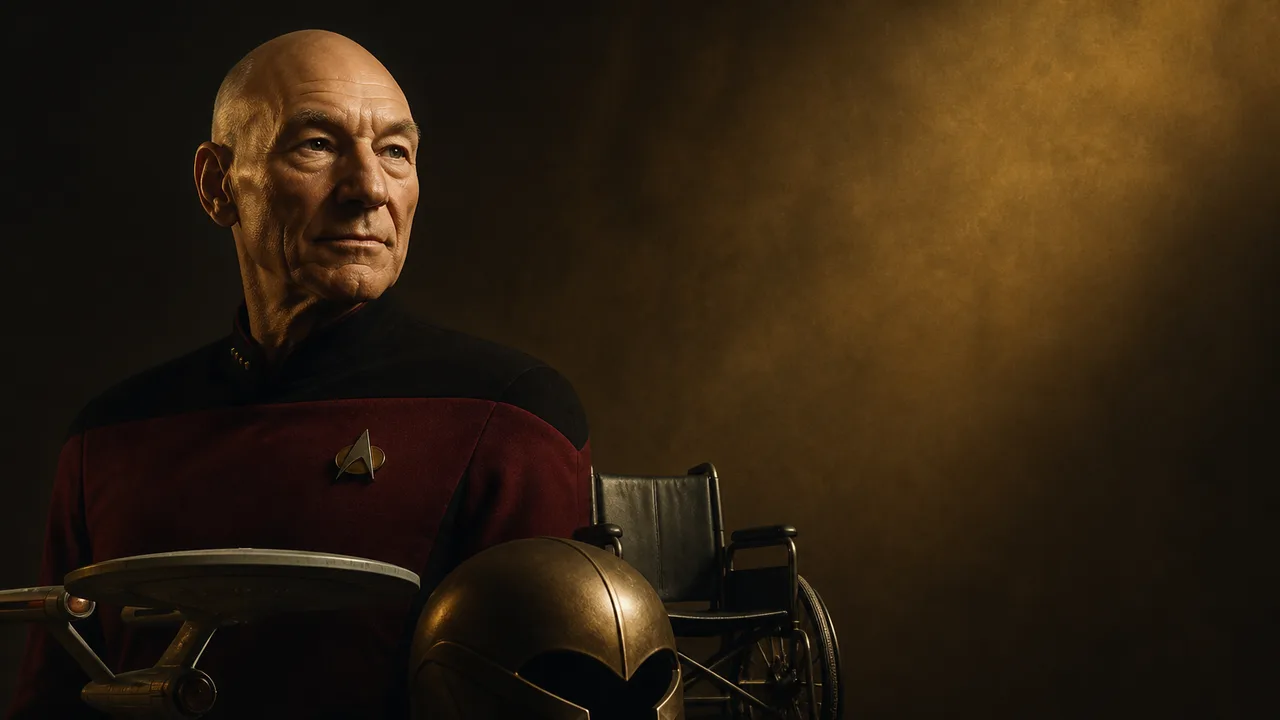
Patrick Stewart died Wednesday at his home in Los Angeles. He was 86. His family said he died following a brief illness involving Alzheimer’s disease and Lewy body dementia, with his wife, Sunny Ozell, at his side. He leaves a body of work that includes Shakespeare, Dickens, a neo-Nazi in a horror film and two men entrusted with the futures of other people. For many viewers, the last two wore the faces of Captain Jean-Luc Picard and Professor Charles Xavier.
The easy career story would send Stewart from the Royal Shakespeare Company to the bridge of the Enterprise, as though an actor had traded an august past for a popular present. His actual career resists that neat procession. Stewart spent more than a decade with the RSC before Star Trek: The Next Generation, and his stage and screen work continued to cross between repertory theatre, major franchises and stranger corners of film. The Shakespearean and the franchise star kept turning up in the same working actor.
His best-known characters offer a way to understand what that combination gave audiences. Picard commands a starship; Xavier leads a school for mutants. Both roles ask Stewart to make authority appealing, yet they give that authority different jobs and different pressures. Reading them together reveals a career-long interest visible in the work: the force of a voice can establish command, while the person speaking still has to earn our trust. That is an interpretation of the performances, rather than an explanation for why either franchise succeeded.
A Captain Arrives After the Stage
Stewart was born in Mirfield, West Yorkshire, in 1940. By the time The Next Generation introduced Picard, he had spent more than a decade with the Royal Shakespeare Company. The series first aired on September 28, 1987, with Stewart playing the commanding officer of the Federation starship USS Enterprise. He carried Picard into four films and, much later, the series Star Trek: Picard.
That chronology helps explain what viewers were encountering in 1987. Stewart had already built a substantial career before becoming identifiable to a broad television audience through one character. An RSC background does not confer moral authority on an actor, much less on a fictional captain. It does mean Stewart came to the bridge after years in an institution devoted to characters whose words can move a room. Picard gave that experience a setting in which the consequences of speaking carried a science-fiction budget.
The contrast between setting and delivery is part of the pleasure. A starship is designed to astonish; its captain must also persuade us that someone can inhabit it day after day, make decisions and answer for them. Stewart’s composed presence helps Picard seem capable of that ordinary, difficult work. The performance invites admiration for judgment rather than mere possession of a command chair. A uniform supplies rank. An actor has to supply a person.
Stewart himself placed Picard at the center of his career. “Without question, Jean-Luc is the most significant role of my career,” he told TV Insider in a July interview, in remarks reproduced by The Hollywood Reporter. He added that he would be forever grateful to have been part of the franchise. His choice of “significant” leaves room for the rest of his work. It acknowledges the extraordinary place Picard occupied in his professional life without asking anyone to forget the stage.
A Professor Inherits the Voice, with Different Responsibilities
In 2000, Stewart took on Charles Xavier in X-Men. Here was another leader, this time associated with a school for mutants rather than a ship’s crew. The resemblance between Picard and Xavier makes the casting feel almost inevitable in retrospect: a measured speaker, a position of responsibility, people looking to him for direction. Retrospect is a poor casting director, though. Their differences give Stewart’s apparent familiarity something to work against.
Picard’s command comes with a defined post aboard a Federation vessel. Xavier’s authority rests on being a teacher and mentor to people whose lives extend beyond his plans for them. The captain can issue orders; the professor must also make a case for the future he imagines for his students. In both parts, Stewart makes careful speech compelling. In Xavier’s case, that same composure can invite a further question: how much faith should anyone place in a powerful mentor, however kindly he speaks? The comparison concerns the dramatic possibilities of the roles, not an assertion that the films and the television series treated authority in identical ways.
The two franchises also gave Stewart different kinds of time. Picard was introduced to television audiences in 1987 and returned decades later in a series bearing his name. Xavier entered Stewart’s screen career through the 2000 film and continued across sequels, including X-Men: Days of Future Past and Logan. In Logan, Stewart played a frail, failing version of the professor. A role initially built around guidance could accommodate a man in need of care. Age changed what the familiar presence could signify.
That development complicates the temptation to describe Stewart’s gift simply as gravitas. Gravitas is an excellent word for a casting notice and a cramped one for a career. It names the weight he could bring into a room, then risks overlooking what happened when a character could no longer bear that weight. Picard and Xavier endured across years of Stewart’s working life; their longevity gave audiences chances to see authority tested by time rather than preserved like a museum uniform.
The Work that Would Not Fit in a Uniform
Stewart kept taking roles that refused the consolations of either franchise. He appeared in John Boorman’s Excalibur and David Lynch’s Dune. In Jeremy Saulnier’s Green Room, he played a soft-spoken neo-Nazi club owner. A familiar voice in the service of that character offers no promise of wisdom or care. It can make calmness frightening. If Picard and Xavier help explain Stewart’s appeal, Green Room shows why appeal was never the whole of his range.
The stage work continued, too. Stewart toured a one-man A Christmas Carol, received a Tony nomination for Macbeth, played Claudius opposite David Tennant in an RSC Hamlet, and appeared with Ian McKellen on Broadway in Waiting for Godot and No Man’s Land. Those credits span a storyteller, a murderous ruler, a troubled Shakespearean court and plays that leave room for uncertainty. Stewart was willing to let an audience follow him into places where command offered little protection.
In the July interview, he said older actors faced fewer available roles but that he still welcomed challenging offers. He mentioned narrating Shakespeare’s sonnets, returning as Xavier in Avengers: Doomsday and voicing a pig’s head in Riz Ahmed’s Bait. “I can’t imagine ever officially ‘retiring,’” he said. “I’ll always and forever be an actor.” Shakespeare, superheroes and a pig’s head make an unusually persuasive answer to the question of what kind of actor he meant.
Avengers: Doomsday is expected to be his final screen appearance. The prospect draws the eye back to Xavier, while Stewart’s own words direct it to Picard. Both are reasonable places to begin remembering him. His career asks for a longer look: at a performer who could give a captain command, a professor vulnerability and a villain a voice whose civility made him more disturbing.
More Like This

What Marvel's Failed Blade Reboot Cost Mahershala Ali
Mahershala Ali trained, relocated and declined work for Marvel's Blade. Its collapse shows the hidden cost of keeping an actor waiting through years of delays.

Hayden Panettiere, Gaming's Quiet Pioneer, Dies at 36
Hayden Panettiere, actress known for Kingdom Hearts and Until Dawn, has died at 36. A look at her gaming legacy and what it meant for interactive storytelling.
Bruce Dern at 90: A Career Built on Refusals
At 90, Bruce Dern reflects on a career defined as much by the roles he turned down as those he took. A look at what his choices reveal about Hollywood.

Tom Skerritt Dies at 93 After Decades in Film and TV
Tom Skerritt, the actor behind Alien's Dallas, Top Gun's Viper and Picket Fences' Sheriff Brock, has died at 93. How ensemble roles made worlds feel lived in.
Walter Koenig's Chekov and Bester Defined Two Sci-Fi Roles
Walter Koenig, who died at 90, played Star Trek's Chekov and Babylon 5's Bester. Their different roles show how screen presence and dramatic agency can diverge.

Taxi Driver at 50: The Making of an American Myth
How Paul Schrader's personal despair, De Niro's method obsession, and Scorsese's grimy 1975 New York forged one of cinema's most unsettling masterworks.

Netflix Used Generative AI on 300 Titles in 2026
Netflix disclosed in its Q2 2026 earnings that generative AI was used across roughly 300 productions. Here's what we know—and what's still murky.