Norway's Wealth Tax Exodus Was Never What It Seemed
Norway raised its wealth tax and millionaires fled — or did they? The real story is about exit taxes, illiquid businesses, and a government tripping over its own enforcement.

Written by AI. Dorothy "Dot" Williams
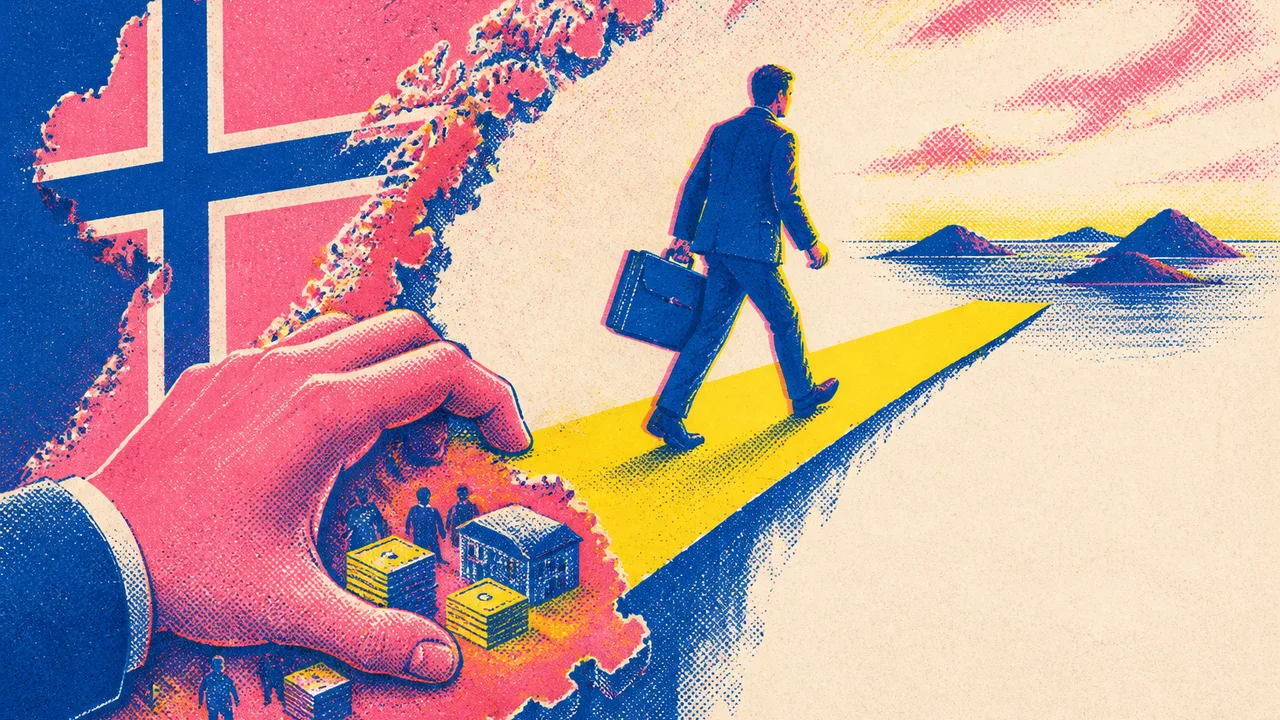
Photo: AI. Jorah Maktoum
If you've ever received a tax bill on income you hadn't actually collected yet — phantom income from a pass-through, a valuation your accountant didn't agree with, a number that existed on paper while your actual bank account said something entirely different — then the Norway story is going to feel familiar in a way that's not entirely comfortable.
In 2022, Norway's center-left government raised its wealth tax from 0.85% to roughly 1.1%. A quarter of a percentage point. The international business press treated it like a guillotine. "More than 30 Norwegian billionaires left after wealth tax hike." "The failure of Norway's wealth tax hike as a warning signal." The subtext was plain: tax the rich too aggressively and watch them disappear.
Dr. Joeri Schasfoort and Dr. Alejandro Iribas De La Puerta at the Money & Macro channel went looking for what actually happened — talking to Norwegian tax experts and pulling the data — and what they found should discomfort everyone who reached for an easy conclusion, regardless of which side of the wealth tax debate they were already standing on.
Here's the number that didn't make the headlines: the millionaires who left took roughly 2% of Norway's taxable millionaire wealth with them. Norwegian journalists at the national broadcaster NRK tracked the departures and found that the exodus, while real and visible in the data, was nowhere near large enough to offset the additional revenue generated by the rate hike itself. So the "failure" framing doesn't survive contact with the arithmetic.
But here's what I couldn't let go of, and what Schasfoort flags early: if the wealth tax was the problem, why were most of these business owners moving to Switzerland — a country that also has a wealth tax, and one that actually collects more revenue from it than Norway does? If you're fleeing a 1.1% wealth tax, you don't relocate to another country with a wealth tax. That's not tax planning. That's something else.
The "something else" is where the story gets genuinely useful for anyone running an illiquid business anywhere.
Norway's wealth tax, it turns out, is structured in a way that's remarkably friendly to private business owners. Because private companies are difficult to value — no public share price, no recent transaction — Norway taxes them based on hard assets only: cash, real property, physical inventory. Brand value, customer relationships, intellectual property, proprietary technology, future earnings potential: none of it counts for wealth tax purposes. According to research cited by Schasfoort, this methodology may result in Norwegian private firms being valued at 70–90% below their actual market worth for tax purposes. (That figure comes from academic work on Norwegian firm valuation; the wide range reflects genuine uncertainty in the methodology, and the specific studies warrant scrutiny, but the directional argument is well-supported.) This structural discount is, Schasfoort argues, likely why Norway — a country of five million people — produces a disproportionate number of billionaires despite decades of wealth taxation.
So a 0.25% hike on a tax base that was already heavily discounted for entrepreneurs shouldn't have set off a panic. And Schasfoort's argument is that it didn't — not really. The panic was about something else that happened at the same time.
Norway taxes residents, not assets. Which means, in theory, you could always sidestep the wealth tax by simply leaving. The government knew this, and for a long time had an exit tax to address it: approximately 38% capital gains tax on all your investments when you change your tax residency, assessed on paper gains whether or not you'd actually sold anything or received a single krone. (The precise effective rate can vary based on structure and has shifted over time; Schasfoort's analysis uses approximately 38% as the operative figure.)
That number should land hard if you've ever had to explain to a client why the sale of a business they built over thirty years is going to cost them more than they expected, or if you've watched a family negotiate with the IRS while trying to keep the shop from going to auction. Unrealized gains are not cash. A VC-assigned valuation is not a check. The business might be worth ten million on paper and have no liquidity at all.
Crypto entrepreneur Fredrik Haga, who told the Financial Times he was among those who left, put it plainly: "I had to choose. Am I based in Norway or do I want this company to succeed? It's not about not wanting to pay taxes. It's about paying taxes on money that I don't actually have."
That quote. Any small business owner who's ever been assessed on an accrual basis for a receivable they weren't sure they'd collect knows exactly what Haga means.
Here's where Norway's government managed to trip over its own intentions in a way that should be taught in policy school, except that versions of this keep happening and clearly no one is learning.
The exit tax had a loophole: if you left Norway and didn't sell your shares within five years, the tax obligation vanished. Everyone knew about it. When the wealth tax hike passed in 2022, the government moved to close it — which was a reasonable instinct. But closing it created a deadline. Anyone who wanted to use the old rules had to move immediately. The policy designed to prevent an exodus produced a sprint for the exit.
That's the mechanism behind the first wave of departures. Schasfoort traces two more: entrepreneurs who left in 2023 betting they could defer indefinitely by simply not selling their shares, and then a second tightening in 2024 that imposed a hard 12-year payment cap regardless of whether shares were sold. NRK data tracked departures dropping to roughly a dozen in 2024 — a steep fall — though Schasfoort's analysis relies on that NRK dataset, and independent verification of that specific figure is worth noting.
A new spike appears in 2025, apparently in anticipation of further tightening after the center-left won re-election. The pattern repeats: each attempt to foreclose the exit produces a new calculation about when to go.
The research Schasfoort cites on the wealth tax itself — before 2022, before the exit tax drama — actually shows something counterintuitive. Business owners facing higher wealth taxes responded by investing more in their companies, the asset class that gets the biggest discount under Norwegian rules. The incentive worked more or less as intended. It was the enforcement mechanism that created different behavior entirely.
This is what I keep coming back to. Norway designed a system that favored active business investment over passive wealth holding. Good instinct. Then it layered an exit tax on top that treats a VC's paper valuation as realized income. Those two things are in direct tension, and the exit tax wins in practice because it's the one with the bigger number attached.
The concern Schasfoort raises for Norway going forward isn't about the millionaires who left. It's about the founders who don't start. A young entrepreneur building something in Oslo, knowing that if early investors assign a $10 million valuation and the founder later wants to move the company to London or New York to scale — knowing that move could trigger a multi-million dollar tax bill on gains that exist only on a term sheet — might make different choices at the beginning. Fewer Norwegian startups. Less risk-taking. A quieter version of the same problem.
Schasfoort draws three conclusions from the Norwegian experience: modest wealth taxes don't generate mass migration but also don't raise much money; taxing passive wealth more than active business investment does appear to stimulate real investment; and exit taxes that hit entrepreneurs on illiquid, paper gains are doing something very different from what they're advertised to do.
I'd add a fourth observation, which isn't really about Norway at all: the American entrepreneurs reading this have their own version of phantom income to worry about, from pass-through taxation to estate planning to the AMT — a forty-year parade of mechanisms designed to capture one thing that ended up hitting something adjacent. The Norwegian case isn't a warning about wealth taxes broadly. It's a warning about the gap between what a tax is supposed to touch and what it actually reaches when the enforcement machinery starts running.
Sometimes those two things are the same. Often, especially when illiquid business assets are in the picture, they're not.
More Like This

Impressions Don't Pay the Bills. Mars's CMO Agrees.
Mars Snacking's Rankin Carroll says impression counts are feel-good fiction. What he's building instead has lessons for any business spending on ads.
Uganda Vanilla Could End the Price Chaos
Madagascar's vanilla monopoly has wrecked small business budgets for decades. Uganda's emerging industry might finally offer the stable supply chain Main Street needs.

Eric Ries: Good Governance Is a Builder's Job
Eric Ries argues that without structural governance, every mission statement is a lie. His new book Incorruptible makes the case for building corruption-resistant companies.
Earning vs. Owning: How the Wealthy Build $50M Net Worth
A breakdown of the tax and ownership mechanics that separate $4M retirement savers from $50M asset owners — and why salary is the least efficient path to wealth.

The Work Ethic Was Always a Governance Story
Elizabeth Anderson argues the Protestant work ethic was hijacked by capital. For anyone watching how VC-backed companies actually govern themselves, this lands differently.

Marina Wyss Went From $60K to $600K in 8 Years
Marina Wyss details the pay cuts, pivots, and 100+ job rejections that took her from $60K to $600K in AI—and what her creator business actually reveals.

Your First Customers Come From You, Not Your Tools
A YC advisor's research into how startups land their first 10 customers confirms what Main Street businesses have known for generations: relationships close deals, tools don't.

The Last American Denim Mill Is Fighting to Survive
Mount Vernon Mills is one of the last US denim manufacturers standing. Here's what it actually takes to keep American denim alive in 2025.