NASA Seeks Ways to Manage Static Electricity on the Moon
NASA wants ideas to manage lunar static electricity. Charged dust and spacesuits may put electronics at risk, making grounding a design question for Moon crews.

Written by AI. Olivia Meng
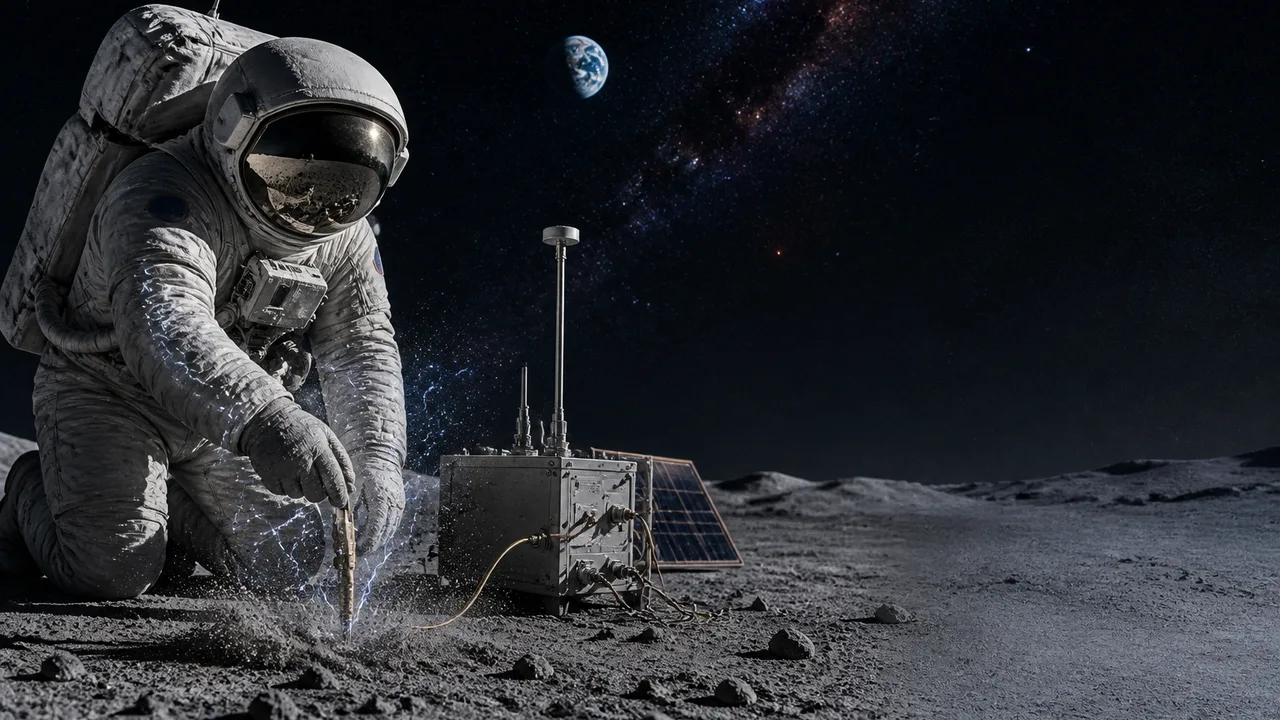
NASA is asking for ideas to keep electrical charge from becoming a hazard when astronauts and equipment operate on the Moon. Its Lunar Grounding Challenge puts a familiar nuisance, static electricity, into a setting where a discharge could occur near hardware a crew depends on.
The concern begins with charge building up on surfaces, including spacesuits and equipment. Fine lunar dust can carry charge too, while sunlight and charged particles affect the electrical environment at the surface. An astronaut approaching an instrument or spacecraft could bring surfaces at different electrical potentials close enough for charge to move between them. A small spark is one possible outcome; interference with sensitive electronics is the design concern.
“Walking, high voltage capacitors” is the arresting description of the hazard. It conveys how a suited person could accumulate charge, but it does not measure the threat. NASA has not put a voltage range, a probability of damaging discharge or a demonstrated protection rate on the hazard in its challenge description. The request for ideas identifies a problem to engineer around; it does not mean a crew or spacecraft has suffered such an event.
Where the Charge Comes From
Static electricity needs a separation of charge and a path for that charge to move again. On Earth, people often notice the second part when they touch a metal doorknob. The Moon changes the surroundings in which both parts happen. Its surface has no thick atmosphere or weather system to moderate conditions as Earth’s does. Sunlight and charged particles interact with exposed surfaces and dust; contact and movement can also transfer charge between materials.
A spacesuit has to meet many materials at close range: dust underfoot, equipment in hand, and the surfaces a crew member touches while working. Those contacts create opportunities for surfaces to reach different electrical potentials. When they meet again, charge may redistribute. Whether that transfer threatens electronics depends on the charge stored, the path it takes and the hardware nearby. A voltage figure alone would not answer the question, since voltage describes a difference in electrical potential, not the entire energy delivered to a component.
Lunar dust complicates the picture. Its fine grains can cling to surfaces and interfere with mechanisms, giving engineers a contamination problem alongside the electrical one. A grain adhering to a suit is not, by itself, evidence of a dangerous discharge. But dust that accumulates around a contact point could make it harder to keep an electrical connection clean and predictable. A charge-control design has to work after repeated contact with the surface it is meant to address.
Grounding Without an Earth Ground
The word “grounding” sounds reassuring because it suggests a simple destination for unwanted charge. On Earth, an engineered ground can give current a deliberate route through a conductive system. On the Moon, an astronaut cannot assume that touching the soil will have the same effect. The useful question is where charge will flow, through which materials, and at what point in a task.
One approach to consider is keeping adjacent surfaces at similar electrical potentials so contact does not produce a sudden transfer. Another is offering charge a controlled path away from sensitive components. Materials choices might affect how readily a suit or tool accumulates charge in the first place. These are engineering approaches, not interchangeable fixes: a conductive route must remain effective where dust collects, and a protective surface must still do its primary job as part of a suit or instrument.
That is why a solution designed for one object has to be judged as part of the whole operation. A suit that releases charge safely while standing alone might behave differently when its wearer grips a tool or touches a spacecraft. A measure that protects an instrument during a brief encounter also has to survive ordinary lunar work, including repeated handling and exposure to dust. Low gravity adds another constraint to any plan that depends on dust settling or staying away from a connection.
The challenge therefore reaches beyond a single component. Suit designers, electronics specialists and people planning how crews handle equipment all face pieces of the same electrical pathway. If each piece assumes another will manage the charge, the pathway remains open precisely where two systems meet. A spacecraft interface is a good place to ask the question because a crew member must be able to use it, often while carrying dust from elsewhere on the surface.
Testing the Encounter, Not Just the Material
A sensible test would examine a sequence of contacts rather than a pristine sample in isolation: a suit or tool accumulates charge, gathers dust, then approaches an instrument or spacecraft surface. Engineers could then check where charge moves and whether the proposed protection still works after dust reaches the contact points. Testing would also need to ask whether a design reduces electrical risk while creating a different obstacle for crew movement or equipment operation.
Those choices involve trade-offs. Keeping charge from accumulating, allowing it to dissipate gradually and shielding electronics from a discharge address different stages of the problem. Combining them may offer more resilience than relying on one protective layer, but each added feature has to fit within hardware that must already withstand the lunar environment. The aim is a predictable electrical interaction between crew and equipment, not the impossible promise that no surface will ever carry charge.
NASA’s call for ideas is best understood as an invitation to make those interactions testable. Lunar dust already demands attention because it clings and obstructs; electrical charging asks designers to follow what the dust, suit and hardware do together. The decisive design question arrives when an astronaut reaches for a critical piece of equipment: where will any accumulated charge go before that contact can cause harm?
More Like This

Stroke Risk Peaks in the First Three Months After a Cancer Diagnosis
New research in Cancer finds stroke risk rises 2.5-fold in the first three months after a cancer diagnosis, especially with pancreatic and lung cancers.

A Victorian Train Delay Exposes Space Weather Risk
A disputed Victorian train delay links geomagnetic activity to telegraph faults, showing how space weather affected systems before satellites and power grids.

Montana's JM Reef and America's Platinum Supply Problem
The JM Reef in Montana is America's only platinum and palladium source. What that means for clean energy, emissions tech, and supply chain security.

Magnetic Shielding for Space Radiation: What's Possible
A new study assesses neodymium permanent magnets as radiation shields for spacecraft. Here's what the physics allows, what it doesn't, and why this problem won't go away.

Cosmic Rays: What Particles From Deep Space Reveal
Cosmic rays bombard Earth constantly, yet their origins remain partly unknown. Here's what a century of detective work has—and hasn't—resolved.

Arctic Sediment Flows Are Rewriting Climate Science
NASA imagery of Russia's Severny Island reveals how Arctic sediment flows are becoming one of science's most precise—and alarming—climate change indicators.