NASA Research Targets More Predictable Airline Travel
NASA is studying tools to reduce airline delays and fuel waste, but deployment will depend on safety, human factors and performance during disruptions at scale.

Written by AI. Olivia Meng
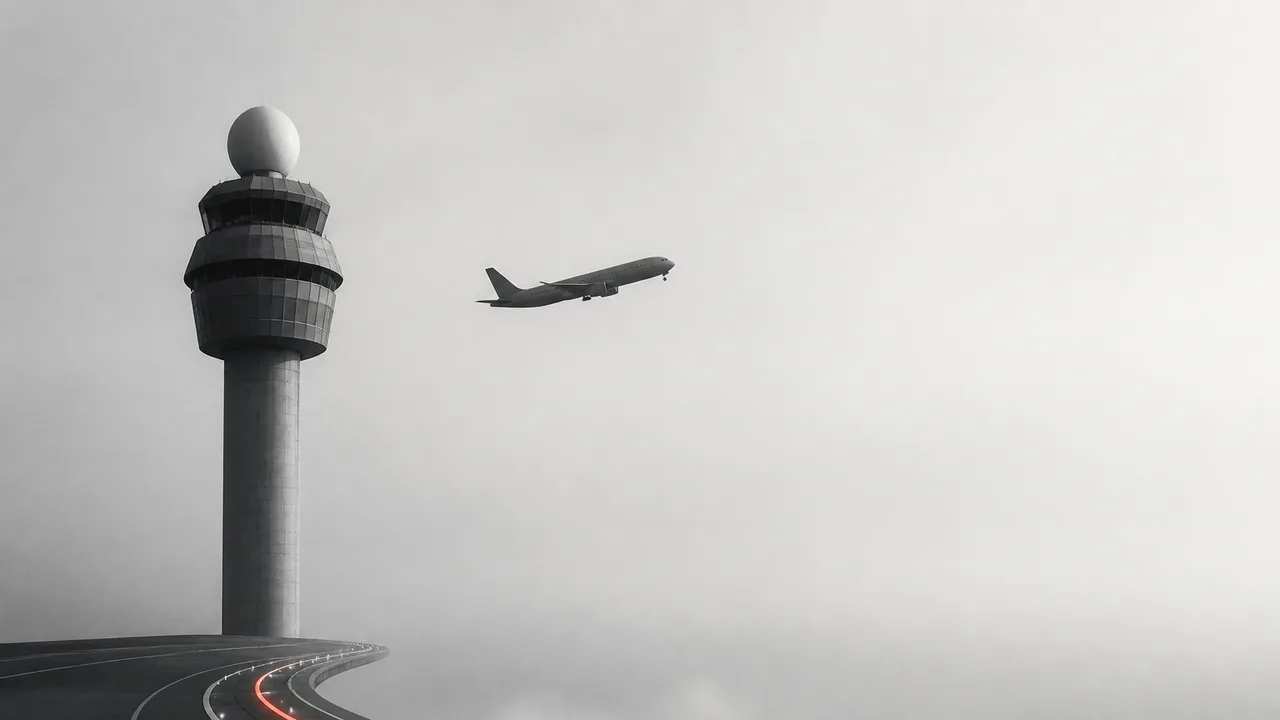
NASA researchers are examining how better forecasting and coordination could reduce the queues, holding patterns and circuitous routes that make airline operations slower and less predictable.
The work targets an old problem with newer computational tools. Airlines build schedules around expected demand, aircraft availability, crews, airport capacity and weather. Air traffic managers then regulate the flow of flights through a national system whose conditions can change by the minute. A thunderstorm, closed runway or overloaded arrival corridor can turn a workable plan into a sequence of conflicts.
NASA's description of the research places it at the intersection of air traffic management, computational forecasting and airline scheduling. The broad objective is to help aircraft spend less time waiting on taxiways or circling in holding patterns, while maintaining safety margins and respecting weather and capacity limits.
That objective is straightforward. Building a system that can achieve it across routine days and severe disruptions is considerably harder.
Where Delay Accumulates
Airline delay rarely has a single author. A late inbound aircraft can leave passengers, crews and gates out of position. Congestion at one airport can disrupt schedules at several others. Weather can close a route while the departure airport remains sunny, leaving travelers staring suspiciously through the terminal windows.
Each organization sees a different slice of the problem. An airline may focus on protecting connections, crew legality and aircraft rotations. A controller must maintain safe separation and manage traffic within the available airspace. An airport coordinates runways, gates and ground movement. Dispatchers monitor weather, fuel and route options. Decisions that improve one part of this network can transfer delay elsewhere.
A departure held at its gate, for example, might appear late before takeoff but avoid joining a long runway queue. A reroute may add distance to one flight while preventing a larger traffic jam. A system designed around total network performance could recommend choices that look inefficient when judged flight by flight.
Better prediction could give operators more time to make those choices. If a tool anticipates a capacity constraint early enough, an airline might adjust a departure time, route or sequence before aircraft begin accumulating in the wrong place. Earlier decisions can also preserve options that disappear once crews approach duty limits, gates fill and fuel plans become fixed.
Forecasts still carry uncertainty. Weather changes, passengers miss connections, equipment fails and airport capacity shifts. A planning tool that performs well when its inputs remain stable may become unreliable during the hours when operators need it most.
Research Capability Versus Operational Change
NASA's announcement describes a research direction, not evidence that a finished system has transformed commercial operations. The available public account does not provide a deployment timetable, quantified delay reductions or results from systemwide use. It also does not establish how any capability would be integrated into airline and air traffic control procedures.
Those gaps should shape how the project is assessed. An optimization model can produce an impressive result in a controlled simulation because the model defines the available information, objectives and constraints. Operational aviation adds missing data, delayed updates, competing priorities and people managing several tasks at once.
Realistic testing would need to expose a tool to ordinary congestion and irregular operations. The latter category includes severe weather, airport closures, equipment problems and cascading schedule failures. A system that shaves minutes from stable operations but becomes confusing during a disruption may deliver limited practical value.
Comparisons also require a credible baseline. Delay can vary with weather, demand and airport configuration, so a favorable day offers little proof by itself. Researchers would need to ask how operations performed against a comparable scenario using existing procedures, then examine where the benefits appeared and whether another airport or group of flights absorbed the cost.
Humans Remain Inside the System
Aviation automation succeeds when the people using it can understand what it recommends, recognize when its assumptions have failed and intervene without creating new hazards.
That requirement reaches beyond a clean interface. Controllers and flight crews need to know what information supports a recommendation and how rapidly it can change. Airline operations teams need enough visibility to judge effects on crews, gates and connecting passengers. If separate organizations receive incompatible recommendations, coordination may become slower rather than faster.
Workload deserves its own measure. A tool can reduce delay in a model while generating more alerts, negotiations or last-minute revisions for people. Frequent changes can also undermine trust. Operators may begin ignoring advice if recommendations arrive too late, fluctuate repeatedly or conflict with conditions visible from the tower or flight deck.
The opposite risk is excessive trust. A forecast presented with unwarranted precision can encourage users to defer to it even when incoming data are incomplete. Good decision support should communicate uncertainty and expose the constraints behind its output. A recommendation that cannot be interrogated may be difficult to use safely when events depart from the model.
Accountability remains an open institutional question. Airlines, airports and federal air traffic managers do not share one objective function. They also may value delay differently depending on where it occurs and whom it affects. Any operational framework would need rules for resolving those priorities rather than burying them inside software.
Measuring More than Minutes
Reduced delay is the most visible test, but an evaluation limited to average minutes would miss several consequences.
Fuel use provides another measure. Taxi queues, holding patterns and longer routes consume fuel without advancing the basic purpose of the flight. Reducing that waste can lower operating costs and emissions for a given trip. The result depends on the intervention, however. Holding an aircraft at the gate may save fuel compared with idling near a runway, even if its recorded departure delay grows.
Reliability may matter as much as the average. Passengers and airlines can sometimes plan around a consistently longer trip. Wide swings between normal operations and breakdown are harder to absorb because they disrupt connections, crew assignments and aircraft positioning. A system that narrows that variation could offer value even if the reduction in average delay looks modest.
Distribution also matters. A networkwide improvement can conceal worse outcomes for a regional airport, a time of day or a class of flights. Researchers should examine who receives priority when capacity becomes scarce, where delay moves and whether performance holds across airports with different layouts and traffic patterns.
Safety cannot be inferred from efficiency. Any change affecting traffic flow must preserve separation, workload limits and the ability to respond when assumptions fail. That calls for staged evaluation, beginning with simulation and progressing through controlled trials only when the evidence supports the next step.
The Climate Benefit Has Boundaries
More efficient operations can reduce avoidable fuel consumption, giving this research a climate dimension alongside its scheduling and passenger benefits. Aircraft burning less fuel while waiting or following an inefficient route generally produce fewer emissions for that flight.
Operational improvements do not settle aviation's larger climate problem. Total emissions also depend on traffic growth, aircraft efficiency, fuel composition and the pace of fleet change. If the number of flights rises, aggregate fuel use can increase even as each operation becomes more efficient. Efficiency can therefore contribute to emissions reduction without guaranteeing it.
That boundary cuts the other way too. The inability of operational tools to decarbonize aviation by themselves does not erase the fuel wasted in current procedures. Climate policy often becomes trapped between grand technological promises and the mistaken idea that incremental improvements have no value. The relevant questions are narrower: how much fuel does a tested change save, under what conditions, and does the benefit persist when the system is stressed?
What Evidence Would Change the Picture
The next persuasive step would be a public record of performance under realistic conditions. Useful evidence would include delay and fuel results, comparisons with current procedures, effects on controller and crew workload, and outcomes during disrupted operations. Reporting ranges rather than a single headline figure would show how performance changes across airports, weather and traffic levels.
Trials would also need to reveal failure modes. Researchers should know what happens when data arrive late, forecasts disagree or communications fail. A robust system should degrade predictably and return authority to human operators without forcing them to reconstruct the situation from scratch.
NASA's research points toward a more coordinated version of airline operations, one in which decisions occur earlier and reflect more of the network. Whether that vision survives contact with crowded taxiways, convective weather and incomplete information will determine if it becomes an operational improvement or remains an elegant result inside a simulation.
More Like This

Stroke Risk Peaks in the First Three Months After a Cancer Diagnosis
New research in Cancer finds stroke risk rises 2.5-fold in the first three months after a cancer diagnosis, especially with pancreatic and lung cancers.

A Victorian Train Delay Exposes Space Weather Risk
A disputed Victorian train delay links geomagnetic activity to telegraph faults, showing how space weather affected systems before satellites and power grids.

Montana's JM Reef and America's Platinum Supply Problem
The JM Reef in Montana is America's only platinum and palladium source. What that means for clean energy, emissions tech, and supply chain security.

Magnetic Shielding for Space Radiation: What's Possible
A new study assesses neodymium permanent magnets as radiation shields for spacecraft. Here's what the physics allows, what it doesn't, and why this problem won't go away.

Geothermal Energy's Promise and Its Real Barriers
Geothermal delivers 24/7 clean power with near-zero emissions. But drilling costs, financing gaps, and policy inertia stand between the technology and global scale.

How Air Pressure Works, From Barometers to Champagne
Neil deGrasse Tyson explains the physics of air pressure — and why understanding it matters beyond parlor tricks and party science.