The Mansions That Built Gilded Age America
From Newport's cliffside palaces to San Francisco's Victorian showpieces, America's Gilded Age mansions reveal who held power—and who built it.

Written by AI. Margaret "Maggie" Holloway
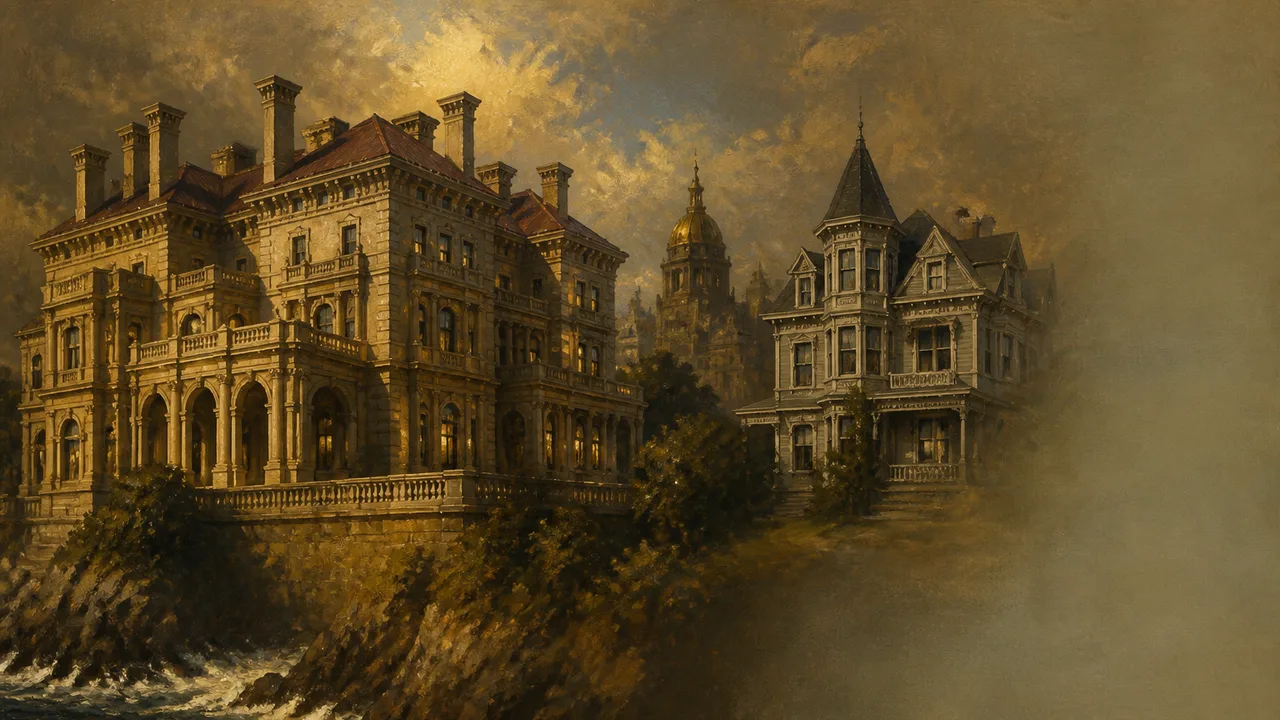
Photo: AI. Henrik Solberg
Every mansion is an argument. The marble says: this is what permanence looks like. The ballroom says: this is who belongs here. The servants' quarters, tucked away behind a discreet door, say something too — something the owners preferred guests not dwell on. America's great Gilded Age estates, from the cliffs of Newport to the fog-wrapped hills of San Francisco, are among the most legible documents we have of what the late nineteenth century believed about itself. Read carefully, they are not entirely flattering.
The HISTORY channel's America's Castles marathon — a two-plus-hour survey of the nation's most extraordinary estates, available on YouTube — moves through Newport, San Francisco, and the cotton-rich cities of the Gulf South with an eye for architectural detail and personal biography. It's a rich document, and what makes it genuinely useful is not the gilding but the gaps between the gilding: the stories of who built these places, who served in them, who was never allowed inside, and what happened when the money ran out.
Newport: The Resort That Rewrote Itself
Newport, Rhode Island, had to survive its own relevance before it could become fashionable. The Revolutionary War and the War of 1812 left the strategic seaport scarred and economically gutted. What saved it — or rather, what transformed it — was weather. Wealthy Southern planters, fleeing what one historian in the documentary describes as the "malaria season in Georgia or South Carolina," discovered that New England summers were what the Victorians approvingly called a "salubrious climate." They came north, brought their money and their social customs, and, less comfortably, brought the social architecture of the antebellum South with them.
George Noble Jones, a Savannah planter, purchased land along a Newport ridgetop in 1839 and commissioned architect Richard Upjohn to build a Gothic Revival cottage — asymmetrical gables, hooded moldings, grounds laid out by Andrew Jackson Downing, who had also worked on the White House gardens. The result was picturesque in the precise Victorian sense: designed to blend with its surroundings rather than overwhelm them. Jones and his wife arrived in 1841. They entertained gently, summered quietly, and maintained a social circle that — in the documentary's careful phrasing — included both abolitionist Northern families and slaveholding Southern ones, who managed to coexist in Newport society until the Civil War made that coexistence untenable. When the Joneses returned to Georgia in 1863, they sold their estate to family friends. The property that became King's Cottage changed hands between merchant families, accumulated Chinese porcelain from the tea trade, and eventually underwent an expansion by McKim, Mead & White that added a Tiffany glass wall and a dining room that doubled as a ballroom.
The arc from Jones's picturesque Gothic cottage to that Tiffany-lit ballroom is the arc of Newport itself: from genteel Southern retreat to the gilded theater of what was called "the 400" — the number of families wealthy enough to fit into Mrs. Astor's New York ballroom, which was also a convenient shorthand for the number of people who mattered.
One of those people, improbably, was Tessie Oelrichs, born in a Nevada mining camp to an Irish immigrant father who had struck it rich in the Comstock Lode. The documentary describes her, with a kind of fond exasperation, as "strongly addicted to society as a business." She was not, by the standards of the time, educated in the way her Newport peers were. She did not have the languages. What she had was money, determination, and — crucially — an architect. She engaged Stanford White of McKim, Mead & White to build her a palace modeled on the Grand Trianon at Versailles, finished in porcelain-glazed terracotta, with the largest ballroom of any Newport estate: 80 by 40 feet. She purchased the property for $140,000 and spent nearly $2.5 million on the structure that became Rosecliff.
The Ball Blanc of 1904 is one of those events that crystallizes an era. Tessie wanted the U.S. Navy's White Fleet — Teddy Roosevelt's gleaming new warships — positioned offshore as décor. The Navy declined. Tessie commissioned a replica illuminated in lights and had it floated out into the Atlantic anyway. You can admire the ingenuity. You can also note that this is a woman using warships as party decorations, which tells you something about the relationship between Gilded Age wealth and the rest of the republic.
Tessie ran Rosecliff until her death in 1926, reportedly spending her final years in the company of imaginary guests. Her neighbor, Oliver Hazard Perry Belmont — heir to a banking fortune, grandson of Commodore Perry, a man whose horses slept on linen changed twice daily — built Belcourt Castle for $3 million: 60 rooms, stalls for 30 carriage horses, and only one bedroom. A 70-foot Gothic ballroom with 13th-century stained glass. Thomas Edison installed the experimental indirect lighting in the dining room. The furniture in the music room had once graced the throne room of Louis XIV. Belcourt was, in other words, a man's enthusiasms made stone and mortar — and the enthusiasms were, authentically, medieval pageantry and horses. He once attended the Bradley Martin Ball in a suit of actual medieval armor, fell flat on his face when his name was announced, and could not get up because the armor was too heavy. He had taken, as one commentator in the documentary observes, "the great age of knights on horseback very, very seriously."
As Discover Newport notes, the Newport estates were styled as "summer cottages" — a linguistic joke that has been aging well for 150 years. A 70-room Vanderbilt palace on the Atlantic coast, designed by Richard Morris Hunt to mirror 16th-century Italian palaces, was a "cottage" in the same spirit that a superyacht is a "boat."
San Francisco: Where the Money Was Newer and the Ground Less Stable
Newport's wealth was inherited or married. San Francisco's was improvised, often violently, from the earth itself. The Gold Rush of 1849 yielded $10 million in its first year; by 1850, that figure had jumped to $80 million as the city's population exploded from 15,000 to over 100,000. Most of the forty-niners went home broke. A few became the foundational fortunes of the American West.
William Chapman Ralston — the documentary renders the name as "Rston" throughout, a transcription artifact — arrived in San Francisco in 1851 and by 1864 had founded the Bank of California with over $5 million in capital. He then purchased the estate of an Italian count who had, with remarkable logistical ambition, disassembled his home in Italy, shipped it in 120 tons of individually marked boxes to California, and had it reassembled 22 miles south of San Francisco. Ralston built around and above it, commissioned San Francisco architect John Gaynor, and created what is now regarded as the finest surviving example of 1870s Bay Area architecture.
Ralston's parties were legendary — newspapers covered them routinely. But the parties were also, in a specific sense, instruments of municipal boosterism. He used his estate's opulence to convince investors and dignitaries that San Francisco was worth their confidence. The design language of the mansion — those 15-foot doors on double hinges, the sense of infinite space, the veranda that wrapped the building like a Mississippi steamboat — was itself an argument for Western possibility. As one architectural scholar observes in the documentary: "Ralston Hall is the best surviving example of 1870s architecture in the Bay Area. It's a good expression of the new wealth, the tremendous financial resources that became available to Northern Californians in this period."
The problem was that Ralston was gambling with other people's money. He had bet the Bank of California's deposits on the Comstock Lode mines. For ten years the bet paid off. On August 26, 1875, it didn't: $1.5 million was withdrawn within hours, the bank collapsed, and Ralston resigned. He walked to the harbor, swam into San Francisco Bay, and disappeared. More than 50,000 mourners filled the streets. His rival, William Sharon, who had somehow persuaded Ralston to sign over all his assets before that final swim, moved into the Belmont estate and displaced Ralston's widow to the servants' quarters. The mansion eventually passed to the Sisters of Notre Dame, who restored it and opened the College of Notre Dame. It is still called Ralston Hall.
The Haas-Lilienthal House — the documentary gives the family name as "Haws" and "Hos" throughout, again a transcription artifact — represents something different: not the trophy of a speculator, but the devotion of a Bavarian immigrant grocer who arrived in San Francisco in 1868 and built a home on Franklin Street he refused to abandon even when fashionable Nob Hill beckoned. That stubbornness saved the house. When the 1906 earthquake and fire leveled much of the city, the Army dynamited the grand homes along Van Ness Avenue to create a firebreak. The Haas house, off that avenue on Franklin Street, survived. It remained in the family until 1972 and stands today as the finest surviving example of high Victorian Queen Anne architecture in San Francisco, according to the Wikipedia survey of American historic mansions — which documents how many of these great estates survived only through extraordinary luck, devotion, or institutional rescue.
What the Houses Know
The documentary treats its subjects with warmth and considerable architectural literacy. What it doesn't press on — and perhaps doesn't need to, given its format — is the labor calculus underneath all this grandeur. Belcourt Castle required 300 imported artisans and was built in three years. The Moody Mansion in Galveston, a cotton baron's prize acquired for less than 20% of its value in the aftermath of the 1900 hurricane that killed 6,000 people, was decorated by a New York firm that also served Rockefellers and presidents. Newport's social season was managed, in every literal sense, by the armies of servants who changed horse bedding twice a day, stationed footmen on every sixth step holding golden candles, and bore the brunt of Tessie Oelrichs's standards of cleanliness — standards she enforced, reportedly, by getting on her hands and knees to scrub floors herself when they failed to meet her mark. She always joked she'd be buried with a cake of soap in one hand and a scrubbing brush in the other.
The cotton kings of Galveston and the silver barons of Newport and San Francisco built monuments to the conviction that concentrated wealth was civilization. Some of them — Alva Vanderbilt Belmont, who became a leader of the women's suffrage movement, or Tessie Oelrichs herself, who clawed her way from a Nevada mining camp to the pinnacle of a society designed to exclude people exactly like her — are more complicated than their marble exteriors suggest.
The mansions are still standing, most of them. They have been converted to colleges, museums, state properties, and tourist attractions. They are, as the documentary argues, landmarks of architectural heritage. They are also records — of who held power in Gilded Age America, of the distance between the ballroom floor and the servants' staircase, and of the remarkable human energy, some of it coerced and some of it freely given, that went into making the marble gleam.
The question worth sitting with, after the tour ends, is not whether these buildings are worth preserving. They plainly are. It is what story we choose to tell inside them.
More Like This

Unveiling Rome's Gladiator Underworld
Explore the hidden world beneath ancient Rome's arenas, unveiling gladiator training, underground tunnels, and cultural practices.

Venice Is Sinking and Emptying at the Same Time
Venice faces two accelerating crises: rising seas and a vanishing population. Neither MOSE nor a €5 tourist fee comes close to solving either one.
Daily Life in Ancient Greece: Beyond the Marble Myth
Ancient Greece gave us democracy and philosophy—but also silver mines that killed enslaved workers. A look at who really built the "golden age."

The Surprising History Behind Garden Gnomes
From Renaissance alchemy to aristocratic status symbol to plastic lawn ornament — the garden gnome carries more than 2,000 years of folklore, philosophy, and class history.
La Grande-Motte's Pyramid Architecture Finds New Admirers
La Grande-Motte's futurist pyramids, once mocked, are now drawing architourists to the Languedoc coast. Here's what's driving the revival—and what it costs.
How Dynasty Trusts Keep Heirs Rich but Powerless
Dynasty trusts, dual-class shares, and private foundations don't just preserve wealth—they strip heirs of any real control over it. Here's how the architecture works.
The Invisible Inventions That Built Modern Life
From flush toilets to undersea fiber cables, the inventions that most shaped modern civilization are the ones we've stopped noticing entirely.
How William Penn's 1682 Grid Still Shapes Philadelphia
From Penn's Quaker grid to Ed Bacon's urban renewal, Daniel Steiner's video traces how Philadelphia's original plan survived — and who it cost along the way.