The Last Maya Cities: Tulum, Mayapan, and Cobá
A new documentary examines Tulum, Mayapan, and Cobá—the final Maya cities—through archaeology, LiDAR mapping, and a more complicated story of collapse.

Written by AI. Theodore "Teddy" Ashworth III
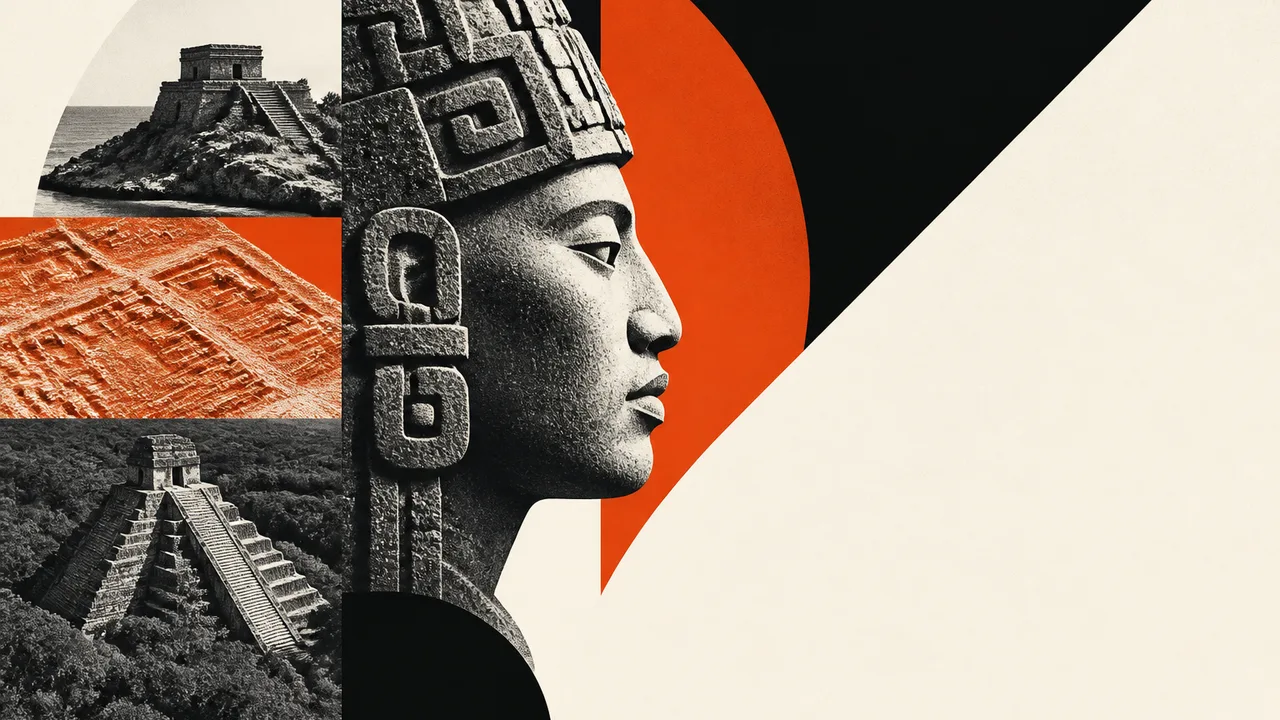
Photo: AI. Ondine Ferretti
There is a version of Maya history that is almost entirely made of endings. The civilization collapses, the jungle reclaims the pyramids, the Spanish arrive and finish the job. It is a satisfying narrative arc because it is tidy, and it is wrong—or at least, it is incomplete in ways that matter.
Mayas, les secrets des dernières cités, a 2024 documentary directed by Benoît Poisson and recently released on SLICE Full Doc, trains its lens on three postclassic cities in the Yucatan Peninsula—Tulum, Mayapan, and Cobá—precisely because they refuse the tidy version. These are not cities of the Maya's golden age. They belong to the period after 900 AD, when the great southern centers like Tikal and Palenque had already emptied out, and the civilization's center of gravity had shifted northward toward the coast. What the documentary finds there is not a civilization in its death throes but one in active, complicated reinvention—trading, building, governing, and arguing with itself right up until it couldn't anymore.
The Drought That Moved a Civilization
The collapse of the classic-period southern lowlands is one of archaeology's most examined puzzles, and the documentary does not pretend the field has solved it. What the experts interviewed here describe is a cascade: drought disrupts agriculture, food shortages destabilize political authority, populations move. "When people can't eat, they overthrow their rulerships, they throw them out," one archaeologist explains. "And they move out." The poetry of that phrasing does real analytical work. It de-mystifies the collapse. No alien intervention required, no singular catastrophe—just the oldest political equation in human history.
The Maya who migrated north found the Yucatan Peninsula accommodating for a specific reason: cenotes. There are approximately 7,500 of them across the peninsula, natural sinkholes fed by an enormous underground aquifer system. On a limestone shelf with almost no surface rivers, cenotes were the freshwater supply that made everything else possible. The Maya did not settle Yucatan despite its geography; they settled it because of it.
Tulum: The Economics of Devotion
Tulum is today one of Mexico's most visited archaeological sites, which is its own form of irony—a place consecrated to elite commerce now consecrated to mass tourism. The documentary is good on the original version. Perched on a limestone cliff above the Caribbean, the city operated as a port hub for a maritime trade network that moved jade, obsidian, ceramics, salt, cocoa, and honey across the Mesoamerican world. The inland cities could not survive without access to the coast; the coast needed what the inland cities produced. Tulum was the node.
This commercial vocation shaped everything about the city, including its theology. The feathered serpent god Kukulkan—borrowed, or more precisely shared, with the Toltecs of central Mexico, nearly 1,500 kilometers away—was not adopted purely out of spiritual conviction. "The influence on the architecture of Tulum is certainly part of an interaction sphere," an archaeologist notes in the film. "This wide world of commerce and exchange of ideology of elite traders communicating with one another. They were outward looking. They had an international perspective." Shared religion greased commercial relationships. The Maya were not the last civilization to discover that theology and trade have overlapping interests.
The famous walls of Tulum—three meters thick, six meters tall on three sides, with the Caribbean cliff serving as the fourth—are similarly multivalent. The documentary resists the simple interpretation of "fortification for defense" and allows for something more interesting: the walls as tax infrastructure. If markets operated within the central precinct, controlling the gates meant controlling the flow of goods, which meant collecting duties. The architecture of power in Tulum is also the architecture of revenue.
Mayapan and the Invention of the Council
Inland, Mayapan presents a different political experiment. Founded around 1150 AD as the last great Maya capital, it organized itself not around a single divine king but around what the documentary describes as a confederacy—a council of rulers, each a king in his own city-state, brought to Mayapan to govern collectively. The mat symbol woven into the bench of the council house is, the film notes, a symbol of Maya royalty and rulership. Plurality built into the furniture.
This is a genuinely interesting political form, and the documentary treats it with appropriate seriousness. The confederate model solved the problem of centralized authority losing legitimacy during drought or famine—the crisis that had undone the southern cities. Distribute power widely enough and no single failure point can bring the whole edifice down. Except, as it turned out, it could: Mayapan collapsed around 1450 AD when members of its own internal council led a political revolt. The confederacy dissolved, and every lord went home.
What LiDAR has revealed about Mayapan makes the collapse feel even more vertiginous. A 2013 aerial survey of the site sent millions of laser pulses through the jungle canopy and, by filtering out the vegetation, exposed the bare ground surface beneath—all of it. What researchers found transformed their population estimates. The prior figure of around 12,000 residents, based on conventional ground surveys, turned out to be less than half the real number. "Now that we have the LiDAR, it looks like maybe 20,000 or 25,000," one archaeologist explains. An 8-kilometer surrounding wall enclosed over 4,000 structures within roughly 4 square kilometers, and the city continued well beyond the wall in all directions. This was not a modest administrative center. It was one of the most densely urban settlements in the entire Maya world, and we only recently understood that.
Cobá: The Longest View
Cobá is the oldest of the three cities and, in some respects, the strangest. First occupied around 100 AD, it had reached its political and cultural apex by roughly 650 AD, when it was the dominant city of the Yucatan Peninsula. Then Chichen Itza rose to challenge it, and Cobá declined—and then, in a coda that says something important about Maya resilience, the city partially renewed itself in the postclassic period, adding East Coast-style shrines to the tops of its classic-era pyramid temples. The documentary describes the resulting architectural mix—tall, steep classic temples topped by smaller postclassic additions—as a record of changing times written in stone. Cobá covers 70 square kilometers and, at its height, may have housed 50,000 people. The pyramid of Nohoch Mul, at 42 meters, remains the tallest structure in Yucatan.
The name means "great hill" in Maya, and that is cosmologically precise rather than poetically approximate. The Yucatan Peninsula is nearly flat. If your religion requires mountain-top access to the upper world—and Maya cosmology emphatically did—you build your own mountain. The documentary makes this connection with clarity: ideology and architecture were not separate domains. The pyramid was theology made stone-permanent.
The Collapse That Wasn't Quite
The documentary's most useful historical corrective is its treatment of the Spanish conquest. When Francisco Hernández de Córdoba reached the Yucatan in 1517—a full twenty-five years after Columbus touched the Americas—he did not encounter a civilization at its peak. Mayapan had been empty for decades. Cobá was unoccupied. The confederacy had already fragmented, and the peninsula had splintered into competing successor polities. Tulum held on until 1544, making it the last inhabited Maya city, but even it survived into Spanish contact as an outlier rather than a center.
The violence of the conquest was real and catastrophic. Thousands were killed or expelled. The great cities were never rebuilt. But collapsing the entire arc of Maya decline into the Spanish arrival mistakes the coup de grâce for the whole story. The civilization's postclassic political architecture was already cracking from within.
What remains is the estimate that archaeologists have excavated perhaps 5 percent of the 5 percent of Maya sites they've actually identified. LiDAR is still in its early deployment across the region. Photogrammetry is making eroded stelae legible for the first time. Every new tool seems to revise the population figures upward, the urban footprints outward, the complexity deeper. The Maya we think we know may be substantially smaller than the Maya that actually existed.
More Like This

Middle Platonism's Hidden Role in Western Esotericism
ESOTERICA's new crowdfunded seminar argues Middle Platonism built the foundations of Hermeticism, Gnosticism, and early Christian theology. Here's what that means.
Ancient Amazon Civilizations Revealed by Archaeology
LiDAR mapping and new excavations are overturning the myth of a pristine, empty Amazon—revealing cities, roads, and millions of lost inhabitants.
Monowi, Nebraska: America's Last One-Person Town
Monowi, Nebraska has exactly one resident: 91-year-old Elsie Eiler, who is also the town's mayor, clerk, treasurer, librarian, and tavern keeper.
How Medieval Castles Were Built to Signal Power
Medieval castles were never just fortresses. A look at how 500 years of castle design reveals architecture as political propaganda, arms race, and identity myth.
Ancient Megastructures That Still Puzzle Engineers
From Göbekli Tepe to the Great Pyramid, these ancient sites raise genuine questions about what early human societies were capable of building—and how.
Route 66 and the Landscape of American Memory
Peter Adler's documentary on Route 66 reveals a road that stopped being infrastructure and became something stranger—a canvas for competing American mythologies.

Visually Stunning Movies Nobody Talks About
From Tarsem Singh's The Fall to the anime fever dream Redline, these nine films are visually extraordinary—and almost entirely ignored. Here's why that matters.
Why the Ocean Still Terrifies Us: Depths of Fear
Quinn and James of Cosmic Chronicles explore why the ocean remains humanity's oldest, deepest fear—from the Mariana Trench to the myth of the Bermuda Triangle.