Keeping Organs Alive Outside the Body
New perfusion technologies are extending how long donor organs survive outside the body—freezing, supercooling, and nutrient-pumping techniques that could reshape transplantation.

Written by AI. Priya Sharma
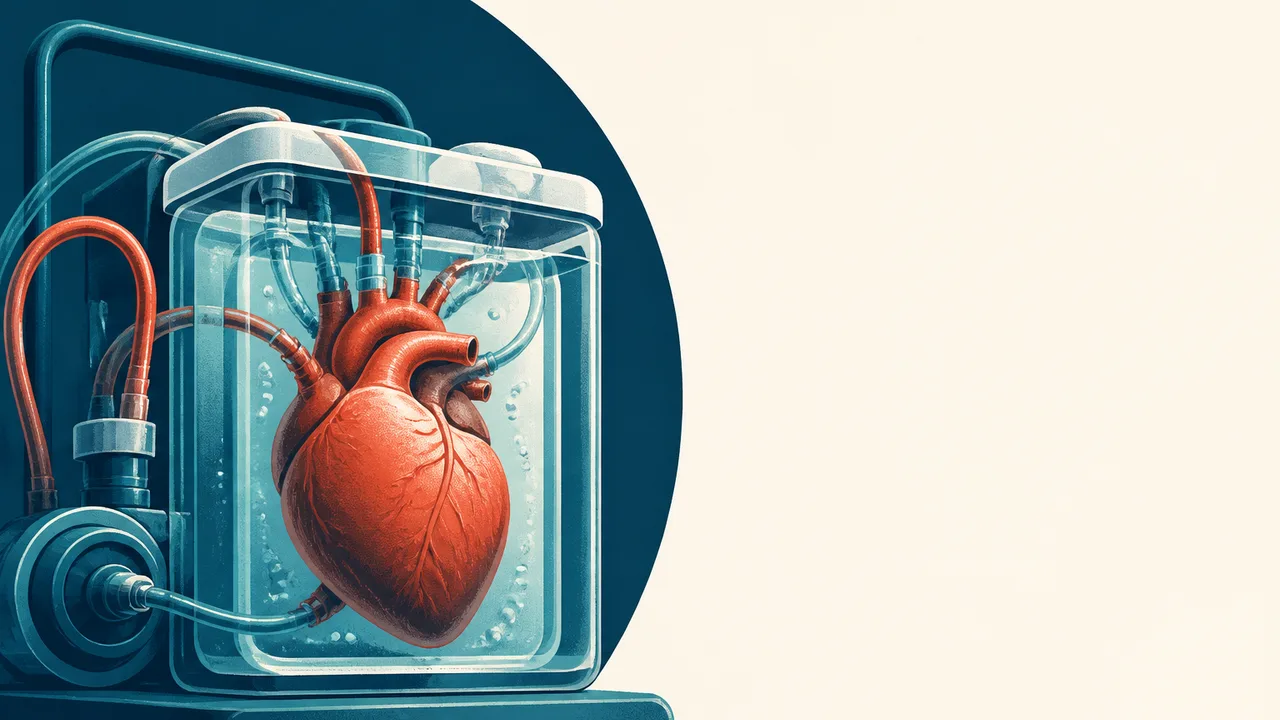
The donated heart has, on average, four to six hours to reach a recipient before its usefulness ends. The liver is more generous—perhaps twelve hours under cold storage. The kidney offers a wider window, but not an infinite one. These numbers are not administrative trivia; they are the geometry of a system that decides who lives. Every organ that degrades in transit, every transplant center too geographically remote to receive a fragile package in time, represents a person who did not get what was waiting for them.
That geometry may be about to change.
Researchers are now pursuing a cluster of approaches—freezing organs, pumping oxygenated nutrients through them, or supercooling them to slow metabolism without forming the ice crystals that damage tissue—to extend organ viability well beyond current limits, according to MIT Technology Review. The field has a long, strange, and occasionally grim history. What's emerging now is something more systematic: the convergence of engineering precision, biomedical insight, and a frank reckoning with how inadequate our current tools have always been.
A Horrible, Productive History
The modern era of organ preservation did not begin cleanly. It began, as The Conversation documents, with surgeon Alexis Carrel working in the early 1900s to keep whole organs functional outside the body. His equipment, by all accounts, was crude. It was crude enough that when aviator and engineer Charles Lindbergh encountered Carrel's work, he was reportedly "so surprised by the crudeness of the equipment being used that he offered to build a new apparatus," according to a paper published in PMC (Enabling out-of-body experiences for living organs). The Carrel-Lindbergh perfusion pump—a series of glass chambers capable of preserving organs at both normal and low temperatures—was the result, as noted by both The Conversation and The Independent.
The underlying logic of that pump—perfuse the organ, keep it fed, keep it alive—remains the conceptual spine of the most promising work being done today. What has changed is the sophistication of execution and the range of options available.
What Perfusion Actually Means
Cold storage—the dominant preservation method for decades—works by slowing cellular metabolism enough to buy time. Pack the organ in ice, ship it fast, hope the recipient is ready. The problem is that "slow" is not "stopped." Cells continue to consume resources and accumulate damage even at low temperatures. Ischemia—the injury that results from inadequate oxygen supply—accrues quietly and shapes outcomes on the operating table.
Warm perfusion takes a different approach. Rather than slowing the organ down, it keeps it functionally alive by connecting it to an artificial circulatory system that delivers warm, oxygenated blood and nutrients. VA researchers, working with the company TransMedics, Inc., developed warm perfusion systems designed to keep donor hearts and other organs viable until transplantation, according to VA Research. The organ, in this model, does not merely survive transit—it continues to function. That matters for assessment: a beating heart can be evaluated in ways a cold, inert one cannot.
The third approach—supercooling—attempts to split the difference. Bring the organ's temperature below freezing, but use protective agents to prevent ice crystal formation. The organ's metabolism drops dramatically without the structural damage that ice causes. MIT Technology Review flags supercooling alongside freezing and nutrient perfusion as active areas of current research, though the sources available do not specify which organ types are furthest along in each technique.
Beyond Preservation: Predicting and Repairing
What is genuinely new in the current generation of research is not just the attempt to extend viability windows, but to use the preservation period productively. Researchers are now studying how to predict organ function before transplantation and repair existing injuries during that window, according to Frontiers for Young Minds.
That second point deserves emphasis. The organ transplant system currently has a binary quality to it: an organ is either good enough to use or it is not. Organs from donors who died of cardiac arrest—so-called "donation after circulatory death" organs—are often passed over because the ischemic injury sustained before procurement makes their quality uncertain. If perfusion systems can not only preserve but actively rehabilitate injured organs, the pool of usable donations expands in a way that cold storage alone never could.
The implications, as Frontiers for Young Minds puts it, are that these advances "could help to increase the number of transplantable organs, giving every precious donated [organ] a better chance." That framing is accurate but slightly optimistic in register—the gap between laboratory demonstration and clinical routine is real and often long. What the research shows clearly is direction, not yet destination.
The Logistics Problem
Here is a tension the press-release version of this story tends to skip: better preservation technology does not automatically solve the allocation problem. It reshapes it.
If an organ can survive outside the body for significantly longer, the geographic radius within which it can be matched and transported expands. That is unambiguously useful. But it also creates new decisions: if a kidney can now last 36 hours instead of 12, does that mean waiting longer for a better immunological match? Does it mean the organ can travel further to reach a historically underserved transplant center? These are not self-resolving questions. They require updated allocation frameworks, and the medical community has not always been quick to update those frameworks in step with technology.
The ethical surface area grows, too. If organs can be stored longer and assessed more rigorously during perfusion, the criteria for accepting or declining a marginal organ become sharper—and more consequential. Who makes that call, under what guidelines, with what accountability, are questions that will need answers before any technology fully delivers on its promise.
How Far Are We?
Warm perfusion via TransMedics devices is already in clinical use for some organ types—the VA's involvement suggests meaningful adoption beyond the experimental stage. Supercooling and reversible freezing remain more experimental, and the sources consulted here do not specify which techniques have cleared which regulatory hurdles for which organs. MIT Technology Review's framing of the field as an active "quest" suggests that the most ambitious preservation windows remain a research target rather than a clinical reality.
That is honest positioning. Transplant medicine has a history of technologies that seemed transformative in the lab and delivered more modest—though still meaningful—gains in practice. The original perfusion pump from Carrel and Lindbergh was a genuine conceptual breakthrough that still took decades to become clinically relevant. The current generation of machines is more sophisticated, the biological understanding deeper, and the clinical infrastructure more developed. But the distance between "researchers are breaking new ground" and "patients are measurably benefiting at scale" is the distance this field still needs to travel.
The organ shortage is not primarily a preservation problem—it is a donation problem, a distribution problem, a socioeconomic access problem. Better perfusion technology addresses one real constraint without touching the others. That is worth saying plainly, not to diminish the work, but because overselling a partial solution can obscure the full shape of what remains unsolved.
Still: a donated organ that would have been discarded as too marginal, kept alive and assessed and repaired during a longer perfusion window, and then successfully transplanted into a patient who had run out of other options—that is not a small thing. The question is how often that scenario can be made routine.
More Like This

Can Unreal Engine 5 Run on a $500 MacBook? Sort Of.
Testing Unreal Engine 5.7 on the MacBook Neo reveals what happens when professional software meets budget hardware—and why friction matters.
Ovaries Age Before Menopause, Mouse Study Finds
A new mouse study shows ovaries undergo major aging changes well before menopause—raising questions about fertility, timing, and how little we've studied this organ.

FFmpeg's Twitter Drama Was Actually Good for Open Source
The FFmpeg account's X drama raised donations and awareness for grassroots open source. But is performative conflict a sustainable outreach strategy?

Cancer Treatment Using Light: Why PDT Isn't Everywhere Yet
PDT uses light to kill cancer cells with less toxicity than chemo. So why isn't it standard care? Stephen Bown's Royal Institution talk raises the question.

The Hard Ceiling on Human Lifespan, Explained
Can science push humans past 115? From longevity clinics to cellular reprogramming, here's what the evidence actually says—and what it doesn't.

When Walmart Sells Last-Gen GPUs Cheaper Than Amazon
A PC build experiment reveals an uncomfortable truth about 2026 hardware markets: sometimes the discount bin beats the cutting edge.

Adam Riess on the Hubble Tension and Cosmic Expansion
Nobel laureate Adam Riess explains why two precise measurements of the universe's expansion rate keep disagreeing—and what that could mean for cosmology.

How Volcanoes Work: Formation, Types, and Real Risk
From shield volcanoes to supervolcanoes, here's what geology actually tells us about how volcanoes form, erupt, and how dangerous they really are.