Cancer Treatment Using Light: Why PDT Isn't Everywhere Yet
PDT uses light to kill cancer cells with less toxicity than chemo. So why isn't it standard care? Stephen Bown's Royal Institution talk raises the question.

Written by AI. Mei Zhang
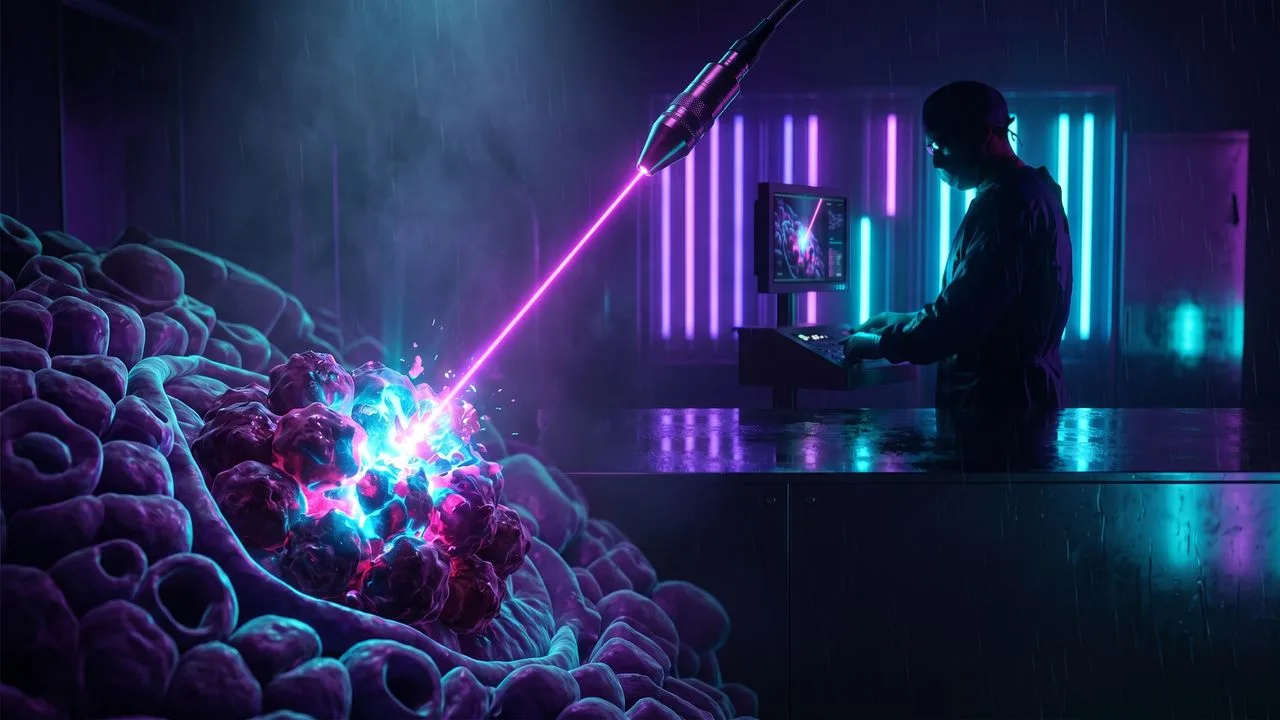
Photo: AI. Quinn Adler
There's a cancer treatment that's been around in some form for over a century. It's less toxic than chemotherapy. It doesn't accumulate damage in your body the way radiation does. It can be repeated at the same site. And for many patients who've exhausted every other option, it's bought years of good-quality life.
So — honest question — why haven't you heard of it?
Stephen Bown, founder of the National Medical Laser Centre at UCL, sat down with the Royal Institution ahead of his May Discourse to walk through photodynamic therapy (PDT): what it is, what it can do, and why it's still fighting for its seat at the oncology table. Bown has spent decades — literally, his first RI Discourse was 45 years ago — developing and applying this technology. What he describes is genuinely compelling. What the conversation doesn't address is equally telling.
Light as medicine: the actual mechanism
PDT works through a two-ingredient system. First, a photosensitizer — essentially a drug that mostly just sits there, inert — is introduced into the body. It can be a cream for skin conditions, swallowed, or injected. Crucially, most photosensitizers are preferentially absorbed by cancerous tissue. They have a targeting instinct, even if imperfect.
Then comes the light. Red wavelengths — roughly 630 to 690 nanometers — penetrate tissue better than other colors, which is why PDT uses them. When that light hits the photosensitizer in the presence of oxygen, it triggers a reaction that produces what Bown calls "singlet oxygen" — a highly reactive molecule that kills cells.
Here's the elegant part: the light doesn't torch everything in its path. PDT destroys living cells, but leaves the structural scaffolding — the connective tissue that holds organs together — largely intact. That means the treated area can regenerate with healthy tissue, rather than scarring the way heat-based treatments do.
"PDT is a gentle way of treating nasty bits of tissue without upsetting all the nice bits," Bown says. It sounds almost too simple, but it's mechanistically specific: the selectivity is real, and it's one of PDT's most significant clinical advantages.
The physics problem that explains everything
Now for why this isn't already standard care everywhere, and why I think it's the most underrated constraint in modern oncology 🧬
Light doesn't travel well through flesh. The further it gets from the source, the weaker it becomes — rapidly. According to Bown, PDT can achieve tissue necrosis up to roughly 10–15mm from the light source under typical conditions, though that's an approximation that varies by tissue type, photosensitizer used, and how the light is delivered — not a hard ceiling. For superficial cancers on skin or lining the inside of hollow organs like the esophagus, bladder, or lungs? Endoscopes can get a laser fiber right to the surface. Problem mostly solvable.
For solid tumors buried inside the pancreas or prostate? You're threading laser fibers through needles inserted under imaging guidance, trying to cover a three-dimensional volume of tissue where every point needs to receive enough light energy. Miss a spot and you miss the cancer.
That's the physics wall. Every variable — how deeply the photosensitizer penetrates, how much oxygen is available, how the light scatters through that specific tissue — has to be right simultaneously. It's less like a recipe and more like trying to evenly bake a loaf of bread from the inside out with a single heating wire. The precision required is genuinely brutal.
"Getting enough light to every part of the target tissue is the most difficult part," Bown acknowledges plainly.
This constraint is real — and it's a major reason PDT has developed faster in some cancer types than others. Clinical progress in pancreatic and prostate cancers has been slower, Bown says, precisely because of light delivery challenges. The biology is there. The physics is the bottleneck.
Wait — a cancer treatment that might vaccinate you against your own cancer?
Okay, I need to stop here because this part genuinely broke my brain a little, and I refuse to write past it like it's a footnote.
In animal studies, after a tumor is treated with PDT, the cellular debris left behind appears to act as an immune stimulant. The dying cancer cells essentially wave a flag to the immune system saying hey, this is what the enemy looks like. The immune system, which had apparently been ignoring the tumor before treatment, suddenly wakes up.
In one rat experiment Bown describes: a small cancer was treated with PDT. After healing, researchers transplanted the same tumor type back into the same animal. It didn't grow. The animal had been effectively immunized against its own cancer by the PDT treatment.
I cannot stress enough how wild that is. This is not how cancer normally works. Cancer famously evades the immune system — that's kind of its whole thing. The idea that PDT's aftermath could reverse that evasion, turning dead tumor cells into a personalized cancer vaccine, is the kind of finding that makes you sit up straight. Bown is careful to flag it's still largely experimental, and yes, rodent-to-human translation is never guaranteed. But he's not alone in pursuing it — research centers around the world are now actively investigating PDT as an immunotherapy primer.
"The tissue left after treatment can act as an immune stimulant, as though the cancer was effectively vaccinating its own host against the cancer itself," Bown says. The experimental evidence is building. Whether it translates at clinical scale is the question that will define PDT's next chapter.
Beyond cancer: diabetes, infections, and a nasal swab
Bown also sketches out some stranger frontiers. There's early-stage thinking (and he's honest that it's still largely ideas rather than data) about using PDT-style ablation of the duodenum's lining to control type 2 diabetes — inspired by observations from bariatric surgery that the same effect could theoretically be achieved without the surgery itself. Intriguing, very preliminary.
More concretely: PDT for bacterial infections. Bacteria take up photosensitizers even faster than cancer cells, and they're killed with lower light doses. Bown points to work on nasal decolonization — using a photosensitizer swab and a simple light device to eliminate the bacteria we all carry harmlessly in our noses, which can become dangerous when they migrate during major surgery, particularly joint replacements. Bown references research suggesting this approach has reduced post-surgical infection rates, though he doesn't name a specific trial or institution — so treat that claim as directionally interesting but unverified until the literature is cited.
The question Bown doesn't answer — but you're probably asking
PDT has genuine advantages over chemo and radiation in certain contexts. Less collateral damage. No cumulative toxicity. Repeatable. So why is it still the treatment most people have never heard of?
Bown doesn't address this directly — and that absence is worth sitting with. Cancer treatments that require specialized equipment, trained physicists working alongside clinicians, and highly individualized parameters for each patient and tumor type are harder to standardize and scale than a drug infusion. They're also, frankly, harder to monetize through the pharmaceutical pipeline. PDT isn't a pill you patent and market globally. It's a procedure that depends on institutional infrastructure, specialist training, and interdisciplinary teams.
Who builds that infrastructure? Who funds the clinical trials needed to establish it as standard of care? Bown spent decades benefiting from charity-funded research — the Imperial Cancer Research Fund, later absorbed into Cancer Research UK — that gave him the rare luxury of splitting time equally between lab and clinic. That model isn't common. Most clinicians don't have that latitude, and most institutions don't build laser centers without a commercial rationale.
Bown describes a patient who'd exhausted radiotherapy, chemotherapy, and surgical options — and credits PDT with giving him six additional years of good-quality life. That's one case, recounted as a lived anecdote rather than clinical data, and can't be independently verified from this conversation alone. But it points to PDT's specific niche as a "last resort" option for patients who've run out of road elsewhere.
The question isn't whether PDT works — there's enough evidence to take it seriously. The question is why it remains a specialist niche rather than a standard option, and who gets access to it when it isn't.
Bown has been working on this for 45 years. The physics constraints are real, the clinical complexity is real, and the translation from mouse to human is never automatic. But "this is complicated" and "this is deliberately underinvested in" are not the same explanation — and right now, we mostly hear the first one.
More Like This
Mapping the Invisible Paths of Knowledge Transfer
Explore the dynamics of knowledge transfer and its principles, from Silicon Valley success to forgotten technologies.
ALS Gene Therapy Hits Multiple Targets At Once—Finally
UC San Diego researchers developed a gene therapy that can target up to nine disease pathways simultaneously in ALS, solving a problem that's plagued the field.
Subcritical Reactors: Nuclear Power's Safety Fix?
A new generation of subcritical reactors promises to make nuclear meltdowns physically impossible. But can they deliver on cost, scale, and timeline?
Loneliness Is Wrecking Your Biology, Not Just Your Mood
Dr. Molly Maloof joins Dave Asprey to explain how isolation damages your cells, why connection is medicine, and what peptides may support longevity.

Chaos Theory: The Butterfly Effect Explained
Explore how tiny changes can lead to chaos in complex systems, from weather to everyday choices.
Ultrasound's New Role in Engineering Safety
Explore how ultrasound tech uncovers hidden structural flaws, preventing disasters in engineering.
Space Stations Beyond the ISS: A Forgotten History
From a Cold War spy base to a Soviet ice rescue to China's chicken-wing oven in orbit — the real history of space stations is wilder than you think.

Curiosity at Sol 4948: Reading Mars Like a Genome
Curiosity Rover hit Sol 4948 in Gale Crater. What its mineralogy tells us about Mars' chemical autobiography—and why that question is getting urgent.