How Medical Equipment Is Made: From MRI to Bandages
A detailed look at how MRI scanners, prosthetics, surgical templates, pills, and bandages are manufactured—and what the process reveals about modern medicine.

Written by AI. Priya Sharma
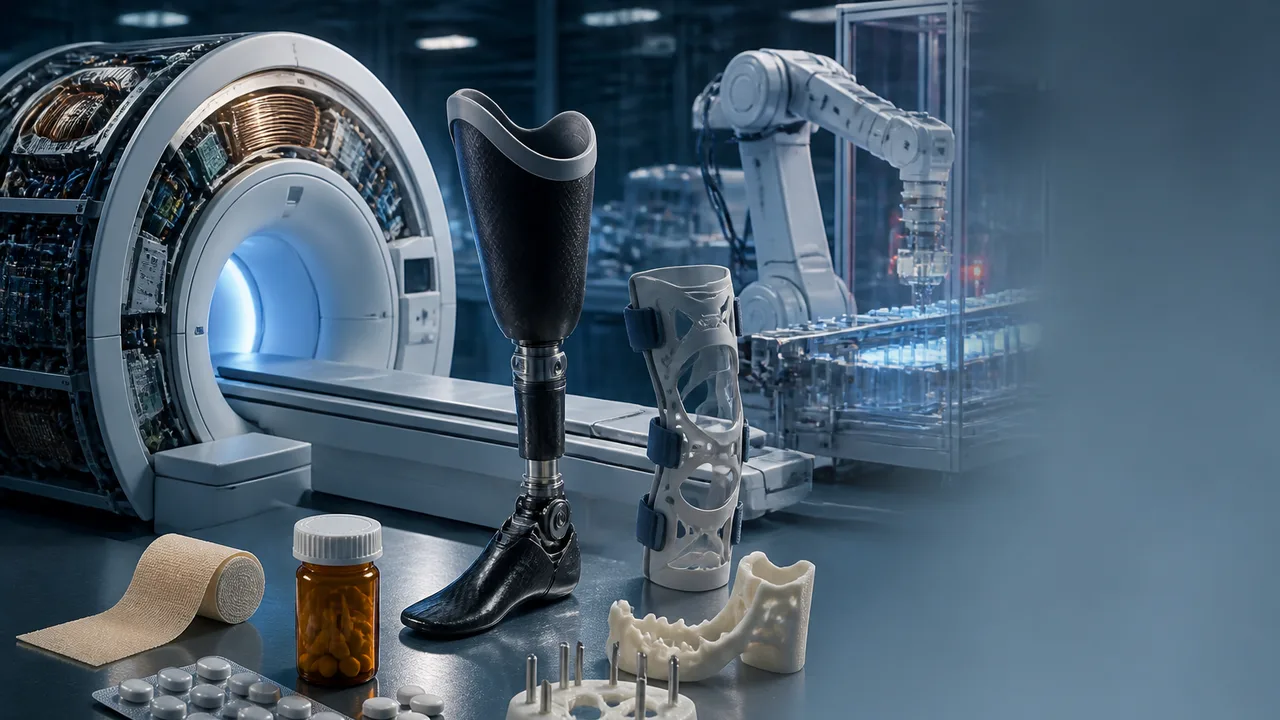
Photo: AI. Castor Belov
There is a particular kind of vertigo that comes from tracing the full arc of a medical device—from raw material to the moment it touches a patient. A bandage is just fabric and glue until it is not. An MRI scanner is just aluminum and copper and liquid helium until a radiologist loads the images and finds what they were looking for, or what they were dreading.
A recent episode of the Science Channel's How It's Made works through the manufacturing processes of a wide range of medical equipment—MRI scanners, custom knee braces, prosthetic eyes and ears, surgical templates for knee replacements, endoscopes, anatomical models, pills, pharmaceutical blister packs, and adhesive bandages. The hour-long program is, on its surface, a procedural: here is how the thing is made, step by step. But follow those steps closely enough and something more interesting comes into focus.
Cold Physics and the Diagnostic Machine
The MRI scanner is a reasonable place to begin because its manufacturing process is almost comically demanding. The magnet at its core must be cooled to -452°F—four degrees above absolute zero—using liquid helium. That temperature is maintained by a refrigeration unit called a cold head, without which the helium would simply vaporize. The magnet, exposed to this cold, loses all electrical resistance and becomes a superconductor. The result is a magnetic field up to 30,000 times stronger than Earth's own.
"The magnet is incredibly powerful," the program notes. "It's up to 30,000 times stronger than the Earth's magnetic field."
The insulation strategy is layered and almost paranoid in its thoroughness: a second aluminum tube, an aluminized Mylar blanket originally developed for space suits, a vacuum vessel with air pulled from the space between the shell and the magnet. The gradient coil—which controls image orientation through electrical pulses—is wound with copper wire into epoxy-filled grooves, sealed again in epoxy, wrapped in Teflon cloth, and fitted with cooling lines to manage heat. The radio frequency coil, which sends and receives signals from the body, is pressure-tested by pumping air in and spraying the exterior with soapy water to watch for bubbles.
All of this before a single patient lies down inside it.
What the manufacturing process illuminates is the gap between what a diagnostic machine does (produces images) and what it is (an extraordinarily fragile arrangement of superconducting physics held together by careful engineering). The MRI works because nothing goes wrong with dozens of components simultaneously. Worth keeping in mind when hospital infrastructure discussions arise.
The Customization Problem
Several segments of the program deal with a recurring tension in medical device manufacturing: the human body resists standardization.
Custom knee braces, for instance, begin with a 3D scanner passed above and below the knee, generating anatomical blueprints that guide a carving machine to produce a foam replica of the patient's leg. The brace is built around that replica—aluminum bars bent to follow the leg's specific contours, copper-riveted hinges, silicone padding at pressure points. The medial hinge, when the knee is extended, lengthens the brace by approximately three-quarters of an inch, creating what clinicians call a "distraction"—a slight separation of the femur and tibia to reduce joint stress.
The customized surgical template for knee replacement takes this further. Standard knee implants are designed to fit a range of patients, but every patient's bone geometry is different. The solution described here involves using a patient's MRI scan to build 3D models of their femur and tibia, running virtual surgery on those models, and then 3D-printing plastic templates that let the surgeon replicate the pre-calculated bone cuts in the operating room. One print run produces templates for up to 50 patients simultaneously; each one is laser-inscribed with the patient's name and identification code.
The program notes the tangible clinical payoff: "The operation takes less time and requires half as many instruments to set up and clean up. And because the surgeon no longer has to drill a hole in the bone to check the knee implant's alignment, the patient experiences less pain and bleeding and a smaller chance of developing complications."
That claim is presented matter-of-factly, as industry practice rather than contested finding. Whether patient-specific templates consistently produce better outcomes than conventional alignment techniques is a live question in orthopedic literature—the evidence base has been mixed, with some randomized trials showing comparable results. The manufacturing segment doesn't engage with that debate, which is fair; it is a program about how things are made, not whether they should be made this way. But readers weighing these procedures should know the debate exists.
Craft at the Boundary of Medicine and Art
The prosthetics segments are where the program's subject matter becomes most obviously strange. Building an artificial eye requires an ocularist who hand-paints a curved acrylic disc with artist's oil paints, attaches silk threads to simulate veins, and matches the coloring to the patient's remaining eye in real time. Building an ear prosthesis requires an anaplastologist who sculpts a wax prototype—a process that can take an entire day—adjusts it across multiple appointments with the patient present, and then injects medical-grade silicone into a three-part plaster mold while mixing pigment colors by eye, with no formula, against the patient's skin.
"There's no exact formula for doing this," the program explains of the silicone coloring process. "It requires an artist's eye."
These are not assembly-line processes. They sit somewhere between clinical care and portraiture. The titanium fixtures surgically implanted into the bone around the ear, the solid gold bar custom-fitted to the abutment replicas by an outside laboratory, the snap-on acrylic plate—all of this is structural scaffolding for what is ultimately a sculpture of a face.
The regenerative medicine segment gestures toward a future where the customization problem is solved from a different direction entirely: instead of building a prosthesis that resembles a biological part, grow the biological part. The program describes laboratory techniques involving cartilage cells extracted and multiplied in incubators, then seeded onto polymer scaffolds shaped like ears and fingers. For blood vessels, stem cells extracted from human blood are converted to endothelial cells and grown on collagen-polymer molds; fluid is pumped through to condition the cells to behave like a vessel. For heart valves, a pig valve is stripped of its cells, leaving only the structural scaffold, which is then repopulated with human cells. "Laboratory-engineered bladders have already been successfully implanted in humans," the program states.
That last point is accurate—pioneering work by Anthony Atala and colleagues at Wake Forest was published in The Lancet in 2006. What the program does not say is how far that work remains from routine clinical application. The field is real and progressing; it is not yet a delivery mechanism.
Volume and Vigilance at the Other End
Against all of this customization and craft, the program's segments on pills and bandages present a different kind of manufacturing logic entirely: enormous scale held together by constant quality monitoring.
A single pharmaceutical press runs at 5,000 pills per minute. Quality testing occurs on five pills every 15 minutes, checking hardness to tolerances between 0.3 and 3 PSI. Pills are coated in a drum holding 350 pounds at a time, sprayed for 40 minutes to prevent crumbling and sticking. Blister pack seals are tested by submerging packs in blue dye under vacuum—any penetration indicates a breach.
A bandage facility produces 4 billion bandages annually across 65 different models. A single 6,000-foot roll of the base fabric—ETS, elastic in one direction only—yields 1.8 million small bandages. Packaging speed runs between 300 and 1,500 bandages per minute depending on the product.
The scale is almost impossible to picture alongside the single ocularist hand-polishing an acrylic eye to a shine with a cotton wheel. And yet both are medical manufacturing. Both serve patients. The differences in what they demand—customization versus throughput, artisanal judgment versus automated vigilance—reflect the underlying biology: eyes are singular, injuries are not.
What the full span of this program ultimately shows is that "medical equipment" is not one kind of thing. It is a category that contains multitudes: superconducting physics, sculpted silicone, centrifuged stem cells, and perforated fabric. The question of how any of it is made turns out to be inseparable from the question of what the human body actually requires—which is, depending on the person and the moment, precision engineering, or a very good painter.
More Like This

Crafting Supercars: The Science Behind Speed and Style
Explore how supercars like Alfa Romeo 4C and Aston Martin Vanquish are meticulously crafted using cutting-edge materials and precision engineering.

AI and 3D Printing: Is the Barrier Really Gone?
AI tools like Claude Code are changing who can 3D print. A beginner's experience with the Elegoo Centauri Carbon 2 reveals what's actually changed—and what hasn't.

Cosmic Threats to Earth: Asteroids, Solar Storms & Black Holes
From city-destroying asteroids to solar storms that could kill the internet, scientists are mapping the universe's most destructive forces—and our readiness is uneven.

Medicine's Strangest History, Explained
Medical historian Richard Barnett unpacks lobotomies, Typhoid Mary, penicillin, and why the history of medicine is a mirror for the present.

Why Vertical AI Is an Org Problem, Not a Model Problem
Chris Lovejoy's oracle-evaluator-architect framework reframes vertical AI failure as an organizational design problem. Here's what that means in practice.

Mars, Enceladus, and the Search for Life
From Mars's vanishing water to Enceladus's hidden ocean, planetary science is reshaping our understanding of where life might exist.

Primordial Black Holes as Dark Matter Candidates
After decades of failed WIMP searches, physicists are turning to primordial black holes as a serious dark matter candidate. Here's what the evidence actually shows.

Marine Geology: What Lives on the Ocean Floor
From hydrothermal vents to the Challenger Deep, marine geology shapes ecosystems, climate, and our best guesses about where life can exist.