How the Twenty-One Quiz Show Scandal Shook TV Trust
Charles Van Doren's rigged Twenty-One victories exposed television's bargain with viewers and helped drive 1960 legislation against fixing broadcast contests.

Written by AI. James Morrison
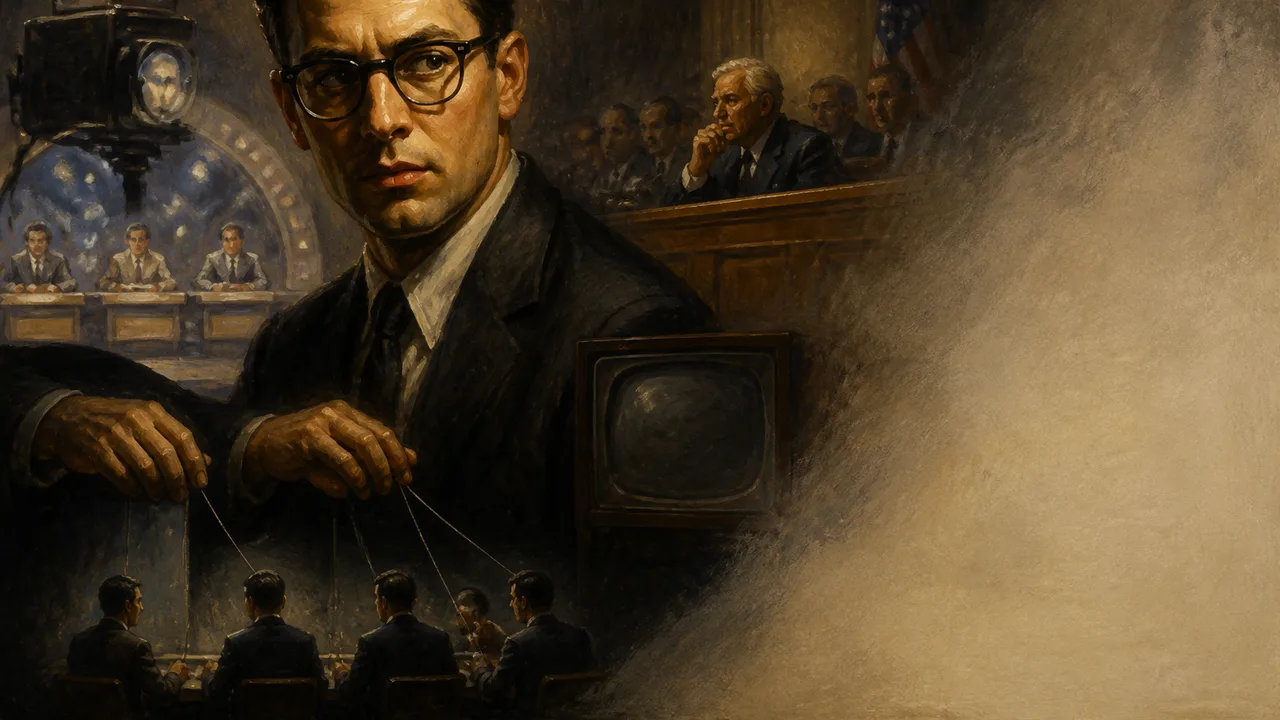
Charles Van Doren’s winning streak on Twenty-One earned him a reported $129,000 in 1957 and gave television a champion viewers could admire. He appeared to win by answering difficult questions under pressure, in a contest whose result nobody knew in advance. The money was substantial. The claim of an unscripted victory was the show’s greater asset.
By mid-January 1957, Van Doren had won $90,000, and the show’s ratings were rising. Viewers were watching a man succeed at something television could make unusually compelling: thinking in public. A correct answer carried suspense because a wrong one seemed possible. Each win made the next appearance more valuable to the programme, and the apparent risk made the streak worth following.
That arrangement collapsed when a former opponent alleged that Twenty-One had been rigged and that producers had supplied answers to shape the drama. An allegation alone might have remained a dispute between contestants. In 1959, Van Doren told a congressional inquiry that producers had given him correct answers. His admission turned suspicion about one show into a question about what television had promised its audience.
The Prize Behind the Prize
A quiz show can control almost everything surrounding a contest. Producers choose contestants and questions. They decide how to present the stakes and where to place the camera. Those choices are part of making television; audiences can recognize the production and still believe the answers and outcomes are uncertain.
Twenty-One crossed that boundary when people responsible for presenting the contest also supplied a contestant with answers. A viewer could see the question, the hesitation and the eventual response. A viewer could not see the prior arrangement that changed what those moments meant. Suspense survived on screen after uncertainty had been removed behind it.
Van Doren’s appeal made the deception more effective. He was a clean-cut champion, and each victory seemed to confirm that learning and composure could command a mass audience. His success offered viewers an agreeable proposition: intelligence could be exciting without any help from a script. Producers had every reason to preserve that image once ratings rose. The public had no way to examine the bargain sustaining it.
The reported $129,000 total also helps explain why the scandal could not be dismissed as harmless stagecraft. Prize money gave the questions consequences for contestants. More importantly, it told viewers that the jeopardy was part of the event, rather than an effect added for their benefit. If a show secretly determines who knows the answers, its advertised test of knowledge becomes a performance by selected participants.
Entertainment has always made room for performance. A viewer who watches a drama accepts that an actor knows the ending. Twenty-One asked viewers to accept the opposite premise. That was the product. The reveal injured the show because it exposed the gap between the contest television sold and the one its producers had arranged.
Responsibility Beyond the Champion
Van Doren had agency. He accepted answers and later admitted doing so. His public role gave the arrangement a face: he stood before the questions, collected the winnings and received the admiration. His admission established responsibility that cannot be assigned entirely to people off camera.
It also did not make him the sole architect. Producers controlled the conditions under which contestants appeared and could turn a winning streak into a continuing attraction. The former opponent’s allegation pointed to that production decision, and Van Doren’s testimony confirmed that answers reached him from producers. A contestant could deceive an audience once; a show could make the deception repeatable.
The network’s responsibility raises a separate question. Broadcasting a contest gives it reach and an institutional setting that viewers may take as assurance of legitimacy. That does not, by itself, establish what network executives knew about the answer-supplying at the time. It does establish why a network cannot treat the integrity of a contest as a private matter between producers and performers. The audience encountered the programme as a broadcast product, not as a collection of separate contracts.
The aftermath reached beyond Van Doren. Almost all of the quiz-show producers lost their jobs and were unofficially blacklisted for years. Their fate shows that the scandal carried consequences for people behind the camera as well as for its public champion. It does not settle the broader question of whether each person who profited from the programme bore a proportionate share of blame.
For other contestants, a secretly arranged result undermined the very measure by which a win or loss was supposed to count. For viewers, the injury was different. They had invested attention and judgment in a contest presented as open. When the answer was known beforehand, they had been asked to evaluate a performance while being told it was a test.
What a Law Could Protect
Congressional scrutiny helped spur federal legislation in 1960 against fixing broadcast contests. The law addressed an identifiable practice: arranging a purported contest to deceive the people watching or listening. It made clear that a producer’s wish to improve a programme did not excuse secretly determining its result.
A prohibition can reach an arranged contest. It cannot, on its own, make every unscripted claim credible. Viewers rarely know how a programme selected its participants, shaped its questions or edited what they saw. Some decisions will be routine production; others could compromise a contest’s fairness. The public needs a truthful account of the rules, and the people making the show need to keep those rules separate from their preferred outcome.
The strongest defense of producers’ latitude is practical. Television has to hold an audience. A fair contest with poor pacing may lose viewers before anyone reaches the decisive question. Choosing engaging participants and building a clear programme are legitimate work. The scandal’s lesson is narrower and firmer: once producers supply answers, they have stopped presenting the contest they invited viewers to judge.
Modern media offers far more places to watch people compete, demonstrate skill or claim expertise. It also offers more ways to turn a performance into an apparently spontaneous event. The comparison does not require treating every produced moment as fraud. It requires asking what the audience has been promised and who can alter the result without the audience knowing.
Van Doren’s victories looked convincing because the questions were visible and his preparation was not. That remained true until his testimony put the hidden preparation on the public record. A trustworthy contest needs more than a difficult question under bright lights. It needs rules that still hold when the answer would make better television.
More Like This
The KGB's Cyanide Newspaper Gun That Almost Worked
How a KGB poison weapon hidden in a rolled newspaper killed Ukrainian nationalist Stepan Bandera in 1957—and why one mistake unraveled the whole operation.

LIDAR Is Rewriting What We Know of Ancient Cities
Anthropologist Luke Caverns is planning the largest LIDAR scan ever done in the Amazon. What the technology finds may force a rewrite of ancient history.

Bodmin Moor's Bronze Age Village and Its Neolithic Cairn
Archaeologists confirm a Bronze Age village on Bodmin Moor—and find a 6,000-year-old cairn that may have outlasted the community that built it.
The Medici and the Borgia: Power, Banking, and Renaissance Italy
The Medici-Borgia rivalry was no simple feud. A look at how banking, papal power, marriage, and armies shaped Renaissance Italy's contested politics.

Audie Murphy: Soldier, Icon, and Haunted Man
Audie Murphy was America's most decorated WWII soldier. His battlefield heroism and Hollywood fame masked a man deeply scarred by combat and survivor's guilt.

The Crusades: Two Centuries of Holy War Explained
From Pope Urban II's 1095 call to arms to the fall of Acre in 1291, the Crusades reshaped Christianity, Islam, and the medieval world permanently.