How Television Was Invented, Line by Line
From Nipkow's spinning disc to Farnsworth's electron beam, the invention of television was also, quietly, the invention of a medium that forgot its own past.

Written by AI. Sarah O'Brien
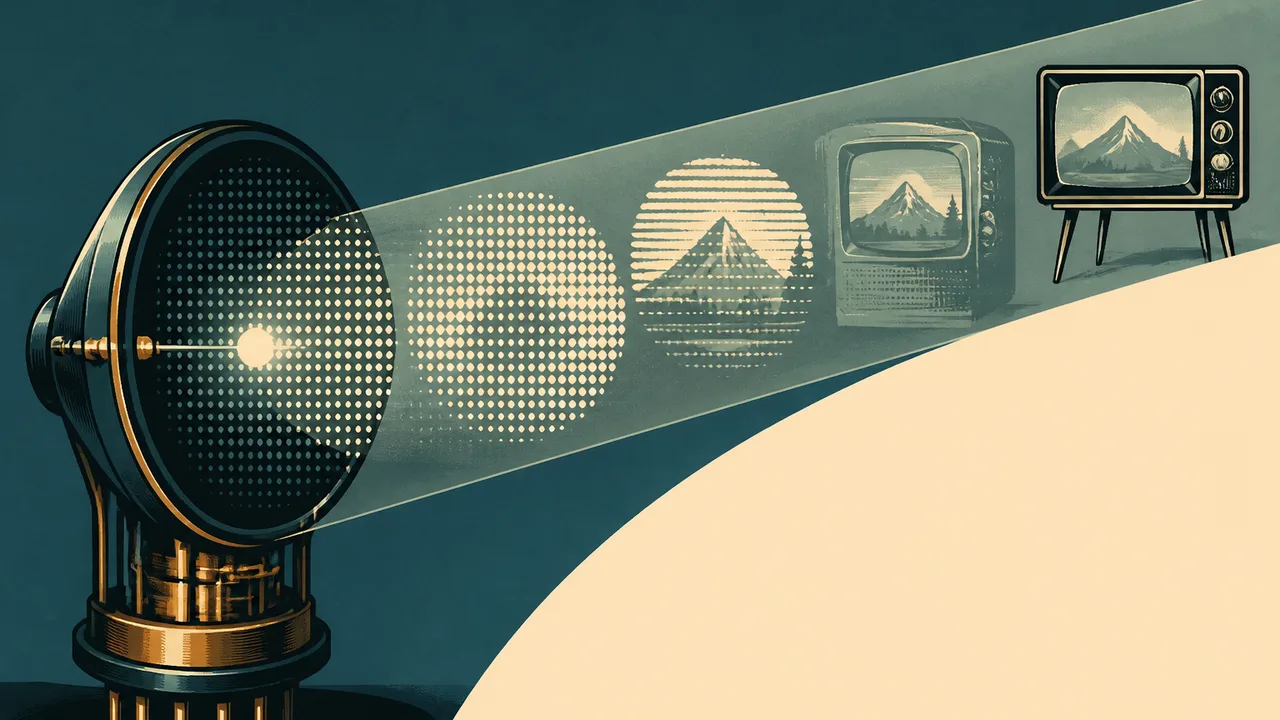
Photo: AI. Mika Sørensen
The picture on an old television screen never truly existed all at once. That's not a metaphor. When your family gathered around the set on a Saturday night, you weren't looking at a complete image. You were looking at a single dot of light racing across the glass, one line after another, dozens of times every second — and your brain was doing the rest.
I grew up close enough to the screen that my parents kept telling me to back up. From that distance, you could see the scan lines. A face resolved into something more like a venetian blind effect if you pressed your nose to the glass. The set itself ran warm — genuinely warm, the kind of heat that reminded you there was a lot of physics happening inside that cabinet. When the sync drifted, the picture would roll, slipping down the screen like a window shade. You'd reach for the vertical hold knob and coax it back. That was the technology making itself visible. It was asking you to pay attention.
Secrets of Everyday Things has produced a solid walkthrough of television's origin story, and it's worth your time — particularly if you've never stopped to interrogate the actual mechanism behind what you were watching all those years. The central insight the video builds toward is this: "There was only a point of light moving too quickly for the human eye to follow, while the brain assembled its fading traces into a living world." That's a precise description of something most people experienced for decades without ever examining.
The logic of the line
The fundamental problem television had to solve wasn't engineering — it was philosophical. A picture contains an enormous number of simultaneous points of light and darkness. A wire, or a radio wave, can carry only one changing value at a time. You cannot send a whole face. You have to decide to stop trying, break the face into a sequence of pieces, transmit each piece in order, and trust the receiving end to reconstruct them fast enough to fool the eye.
Paul Nipkow worked this out theoretically in 1884, building a metal disc with holes punched in a spiral. As the disc rotated, each hole swept across a different horizontal strip of the image. It was the correct idea housed in the wrong machine — too slow, too crude, too mechanically fragile to produce a usable picture.
John Logie Baird took Nipkow's principle and made it actually function in the mid-1920s, combining spinning discs, lenses, and photoelectric cells to analyze light and reproduce it at the receiving end. He demonstrated moving images publicly in London in 1926. What audiences saw that day was limited — Baird's mechanical system was approaching the ceiling of what spinning metal could achieve. To get a sharper picture, you needed more holes in the disc and faster rotation. But faster rotation meant more vibration, more manufacturing difficulty, and genuinely more danger. The spinning disk had to go.
A farm field in Idaho
The replacement idea came from Philo Farnsworth, who was fourteen years old and driving a plow when it arrived. He looked at the parallel rows of soil stretching across the field and understood, in that moment, that a picture could be scanned the same way — one row at a time, left to right, drop down, repeat, until the entire frame was covered. Then reassemble those rows at the other end in the same order.
The difference was the mechanism. Instead of a spinning metal disc, Farnsworth wanted to use an invisible beam of electrons.
Inside a cathode ray tube television, the inner surface of the glass screen was coated with phosphor — a material that glows when struck by electrons. A beam fired from the back of the set was steered by magnetic fields, sweeping left to right across the screen, dropping one line, sweeping again. The intensity of the beam varied continuously: stronger beam, brighter phosphor; weaker beam, darker point. The video describes this well: "At any single moment, only one point on the screen was being drawn. An entire face was not glowing at the same time. There was only one dot of light racing furiously across one line after another."
That dot was moving fast enough that persistence of vision did the rest. Your eye held each flash for a fraction of a second while the next line was being drawn. The brain stitched it all together into something coherent.
Farnsworth demonstrated the first complete electronic television system in 1927, at twenty-one years old. The first image he transmitted was a straight line. It's worth sitting with that for a moment — not because it's romantic, but because it's accurate. The entire edifice of twentieth-century broadcasting started with a straight line on a screen.
The patent war that almost erased him
Vladimir Zworykin, working first for Westinghouse and later for RCA, developed the iconoscope — a camera tube that was the other half of the system. Inside it, a mosaic of microscopic light-sensitive elements stored electrical charges proportional to the brightness of each part of the image. An electron beam scanned the mosaic line by line, reading those charges and converting them into a continuous signal. The camera took the picture apart. The television put it back together. Both ends had to scan in exact synchronization, or the image would distort, roll, or disappear entirely.
RCA — one of the most powerful communications corporations in the country — decided it wanted ownership of the foundational patents behind all of this. Farnsworth was a young inventor without institutional backing. What followed was a prolonged legal fight over who actually invented electronic television.
Patent proceedings across the 1930s ultimately supported Farnsworth's priority claims — a 1935 interference decision credited him with priority for the image dissector, according to documentation reviewed by Grokipedia — and by 1939, RCA had agreed to pay him licensing fees. The farm boy had forced a corporation to recognize what he'd figured out in a field.
The memory that television almost didn't have
The BBC launched regular high-definition television broadcasting from Alexandra Palace in 1936, using a Marconi-EMI system that scanned 405 lines per frame. That sounds laughable now. At the time, it was a revelation — not just because the image was sharper than anything mechanical television had produced, but because it came with a schedule. Television became something you could anticipate.
In the United States, the FCC established a common standard for black-and-white television in 1941, defining the scanning lines and frame rate that all broadcasters and manufacturers would use. Boring-sounding, critical in practice: standardization is what let people spend money on receivers with confidence. Then the war came, and the whole project paused.
When it resumed after 1945, television entered millions of living rooms rapidly. And here is where I always stop and feel the weight of what was lost, because most of what those families watched in the late 1940s and early 1950s is simply gone.
Before magnetic videotape arrived in the late 1950s, television had no memory. Programs were broadcast live. If something went wrong, it was gone. If something went right — a brilliant performance, a historic broadcast, an early experiment in the medium's possibilities — it was also gone. Kinescope recordings existed, filmed directly off a monitor screen, but they were expensive, rarely made, and often discarded when no one thought they had future value. The first decade of American network television exists now only in fragments. Historians piece together what early television looked like from production notes, still photographs, and the occasional surviving kinescope, the same way archaeologists work from potsherds.
The video notes that tape gave television "a medium with a memory." What it doesn't dwell on is the corollary: everything before that memory is a hole. And the industry has never been particularly interested in confronting the size of that hole.
The dot that survived the flat screen
In 1953, the NTSC color television standard was approved. Its engineering achievement was compatibility — color information was layered into the existing signal in a way that let black-and-white sets still display a usable picture. According to historyofinformation.com, NBC broadcast the Tournament of Roses Parade on New Year's Day 1954 as a major early demonstration of the new color standard. People with color sets saw one thing; people with black-and-white sets saw the same broadcast without being locked out. That's a design decision that deserves more credit than it gets — the alternative was fracturing the entire market and forcing an overnight hardware replacement that most households couldn't afford.
Cable and satellite extended television's reach through the 1970s and 1980s. Digital conversion replaced continuously varying analog waves with binary data — zeros and ones — which could be compressed, transmitted more reliably, and packed more efficiently into available spectrum. Flat panel displays pushed the cathode ray tube into history.
And this is the part I find genuinely striking: the electron beam is gone, but Farnsworth's core logic survived the transition intact. A flat panel screen doesn't have a racing dot. It has millions of pixels arranged in a fixed grid, each one individually addressable, each one changing brightness and color according to the signal it receives. The scanning is gone. The sequential reconstruction is gone. But the image is still divided into a grid of discrete points, still encoded as a sequence of values, still reconstructed into something the human eye reads as continuous.
The plow rows are still there. They're just not moving anymore.
What that means for preservation is a different and unresolved question. The physical formats that stored twentieth-century television — two-inch quad tape, one-inch tape, Betacam, even early digital formats — are degrading. The machines that can play them are becoming harder to find and harder to maintain. The industry's institutional memory is fragmentary and its archival priorities are frequently driven by copyright concerns rather than cultural ones. We saved more of television's past than we did of its first decade — but "more than almost nothing" is a low bar, and we haven't cleared it by as much as we'd like to think.
Every screen around you right now — the phone in your pocket, the monitor you're reading this on, the billboard you passed this morning — runs on a principle worked out by a fourteen-year-old looking at furrows in Idaho soil. That's the part of the story that lands cleanest.
The part that keeps me up is simpler: we built a medium that reshaped culture, and we almost didn't bother to keep any of it.
More Like This
How Times Square Became a Billboard for Itself
Times Square's wall-to-wall advertising wasn't inevitable. It was built by specific people, specific decisions, and one very consequential zoning law.

California's Channel Islands Hold 13,000 Years of History
From pygmy mammoths to the Lone Woman of San Nicolas, California's Channel Islands preserve one of North America's deepest human records — if we bother to look.

Digging for King John's Palace at Clipstone
Time Team excavates Clipstone, Nottinghamshire, hunting for King John's lost royal palace on the edge of Sherwood Forest. Here's what they found.
Inside the Smartphone: 120 Years of Hidden Engineering
Professor Hannah Fry tears apart a modern smartphone to trace 120 years of engineering history — from Marconi's radio waves to a 200-million-pixel camera sensor.

Rolls-Royce: Craft, Class, and a Century of Decline
How Rolls-Royce built the world's finest cars on bespoke craftsmanship — and what was really lost when that tradition could no longer survive.
Scotland's Carved Stone Balls: A Neolithic Mystery
Nearly 500 carved stone balls have been found across Scotland. Archaeologists still don't know what they were for. Here's where the theories stand.
Netflix Is Making a Live-Action Persona Series
Netflix is developing a live-action Persona series with Sega and Atlus. Here's what we know about the creative team, the challenges, and what's at stake.

July 2026 Game Releases: Remakes and New IP
Halo remade again, Black Flag re-engineered, and a packed July of new releases arriving in GTA 6's shadow. What this month reveals about how the industry treats its catalog.