How Ring Jousting Became Maryland's Official State Sport
Maryland named jousting its state sport in 1962. Today's ring tournaments turn a medieval martial tradition into a test of skill, community and public memory.

Written by AI. Sofia Ramirez
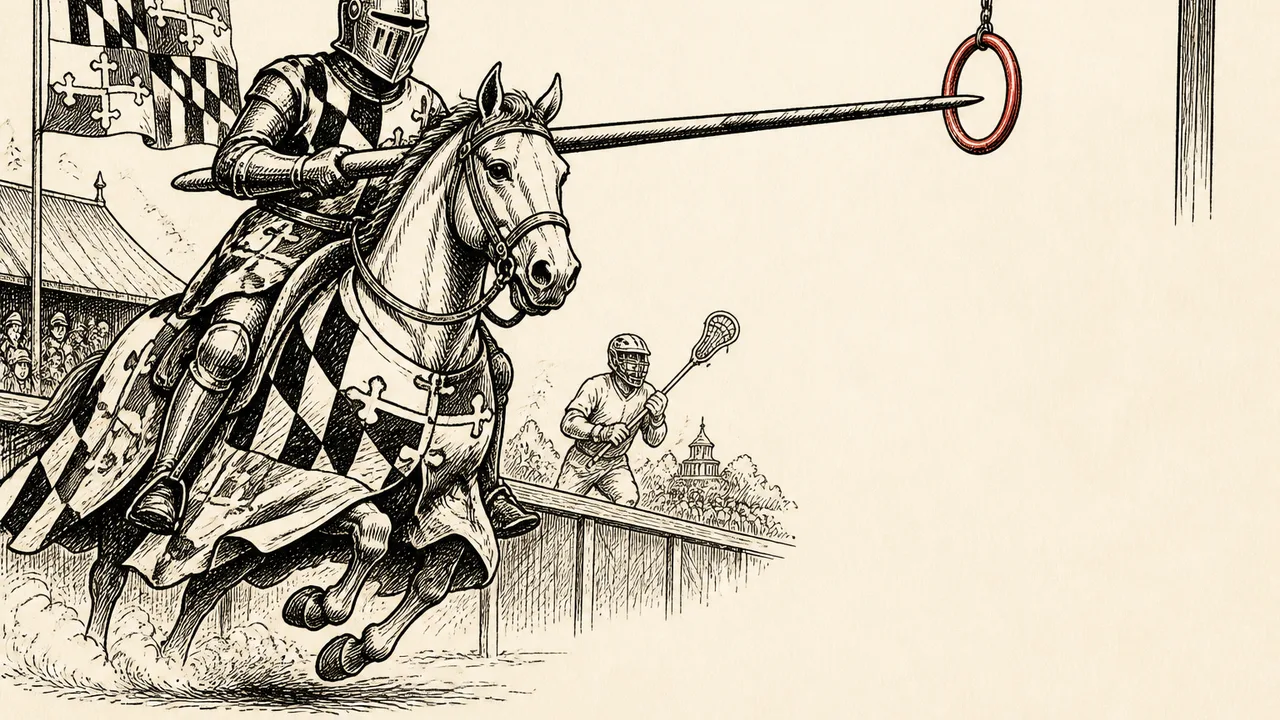
Maryland's official state sport asks a rider to guide a lance through a small ring suspended above a course. A horse is moving underneath. The target stays put. Accuracy, timing and control decide whether the rider makes the catch.
That is ring jousting as practiced in Maryland. The armored collision many people picture when they hear jousting belongs to a different version of the contest. Both draw on the medieval tournament, but the distinction changes what spectators watch: a rider's precision rather than the force of one opponent striking another.
Maryland made jousting its official state sport in 1962. The designation can sound like an eccentric entry in a list of state symbols. Follow the sport back through colonial-era tournaments and medieval military culture, though, and a larger question appears. When people carry an old practice into a new century, which parts do they keep, and who gets to decide what the practice represents?
What Crossed the Atlantic
Jousting's European history begins with mounted combat and military training. Medieval tournaments gave knights a place to demonstrate skill and status before powerful audiences. They also turned the abilities associated with warfare into something people could watch. The relationship between fighting and display was there long before Maryland put the sport in a statute.
That history can easily swallow everyone outside the armor. Kings, queens and knights dominate accounts of medieval tournament display because rank was part of what the events advertised. But a tournament was also an organized public occasion. Its survival as a recognizable form depended on people finding reasons to stage and attend contests after mounted warfare ceased to be their purpose.
Maryland jousting tournaments date to colonial times. Calling the sport a Maryland tradition therefore points to a long local history, although that history alone cannot establish an unbroken line of participants or identical rules across the centuries. European settlers brought a practice to a place with histories of its own. The colonial setting belongs in the account alongside the medieval origin.
The event people recognize today under the name jousting also comes in more than one form. A staged clash between armored riders recalls the combat spectacle. Maryland's ring contest keeps the horse, the lance and the demand for skilled riding, while giving competitors a small suspended target. The change makes an inherited practice usable as a repeatable test of precision. It also leaves room for the ceremony and pageantry that make a tournament more than a series of attempts at a ring.
How the State Chose a Sport
Maryland's 1962 designation gave an existing activity a new public role. During the legislative push, jousters called it “the only true Maryland sport,”. The claim is revealing as an argument made by advocates, rather than a definition every Marylander had to accept. It tied the sport's local tournament history to a bid for official recognition.
Supporters had a case they could make without claiming that jousting began in Maryland. A practice carried across the Atlantic had acquired enough local life for participants to seek a place for it in the state's civic identity. In that sense, the law recognized something people were already doing. The designation also gave them a way to explain the activity to anyone who knew the word jousting only from images of colliding knights.
Official titles simplify. One sport gets a line in a law; the reasons people play, watch or ignore it are harder to fit there. Maryland's state sports listing also recognizes lacrosse as its official team sport. Lacrosse's Indigenous roots bring another history into view when the state describes itself through sport. The two designations do not require residents to choose one game as the single account of Maryland. They do invite a closer look at how a state honors traditions with different origins and different communities behind them.
A state symbol can give a practice visibility, but it cannot supply the work of holding a tournament. Someone still has to ride, prepare a horse, set a course and organize a gathering. Those practical tasks explain how an old sport remains present rather than becoming a label people encounter only in a government directory. The state gives jousting a title. Participants give it occasions on which the title means something.
A Tradition that Still Has a Calendar
The Maryland state sports listing includes an Annual National Jousting Championship Tournament at Petersville Farmers Woods in Knoxville, scheduled for October 10, 2026. The date and place put the history in the present tense. For riders, a tradition calls for practice and a chance to compete; for a local audience, it offers a reason to gather around a contest whose rules make the result visible.
The ring also asks something different of spectators from the armored charge that medieval-themed entertainment often favors. A strike against a small target may look modest beside a collision between riders. It is easy to see why a collision became the enduring popular image of jousting: it announces itself immediately. Ring jousting asks an audience to watch control instead. The horse's movement and the rider's aim make a brief attempt consequential.
None of that strips away the sport's ceremonial appeal. The lance and the horse carry a recognizable connection to earlier tournaments, even as the competition has changed. Heritage often works this way: an old name brings people to the field, and the activity they find there has rules, purposes and communities of its own. The question is whether the story told about that heritage leaves room for the people keeping it going now, as well as for the knights who made its earliest tournaments famous.
Maryland's choice in 1962 preserved a name and acknowledged a local practice. At the next ring tournament, the law will remain on the books while a rider takes aim. Only one of those things can put a lance through the ring.
More Like This
Douglas MacArthur and the People He Left Behind
MacArthur is remembered as a military legend. But what about the veterans he gassed, the soldiers he abandoned, and the Japanese citizens who built a new democracy?
California's Hidden Underground: Caves, Tunnels, and Buried History
From a buried Gold Rush city to survival tunnels built by Chinese immigrants, California's underground holds layers of geology, history, and forgotten infrastructure.
Medieval England: How Peasants and Guilds Shaped Society
A new documentary traces medieval England's social divide through two real families—one peasant, one guild merchant—and the starkly different worlds they inhabited.
How the Continental Congress Named the United States in 1776
On September 9, 1776, Congress swapped 'United Colonies' for 'United States.' The name left the country's whole structure deliberately unresolved. Here's how.
Egypt's New Delta Project: Green Miracle or Mirage?
Egypt is engineering a new Nile in the desert. But satellite data, groundwater depletion, and a troubling history raise urgent questions about who this is really for.
Ancient Megastructures That Still Puzzle Engineers
From Göbekli Tepe to the Great Pyramid, these ancient sites raise genuine questions about what early human societies were capable of building—and how.