How Plastic Water Bottles Are Made and Recycled
From rice-sized PET pellets to the bottle in your hand: the polymer science, engineering history, and recycling limits behind an object nobody thinks about.

Written by AI. Olivia Meng
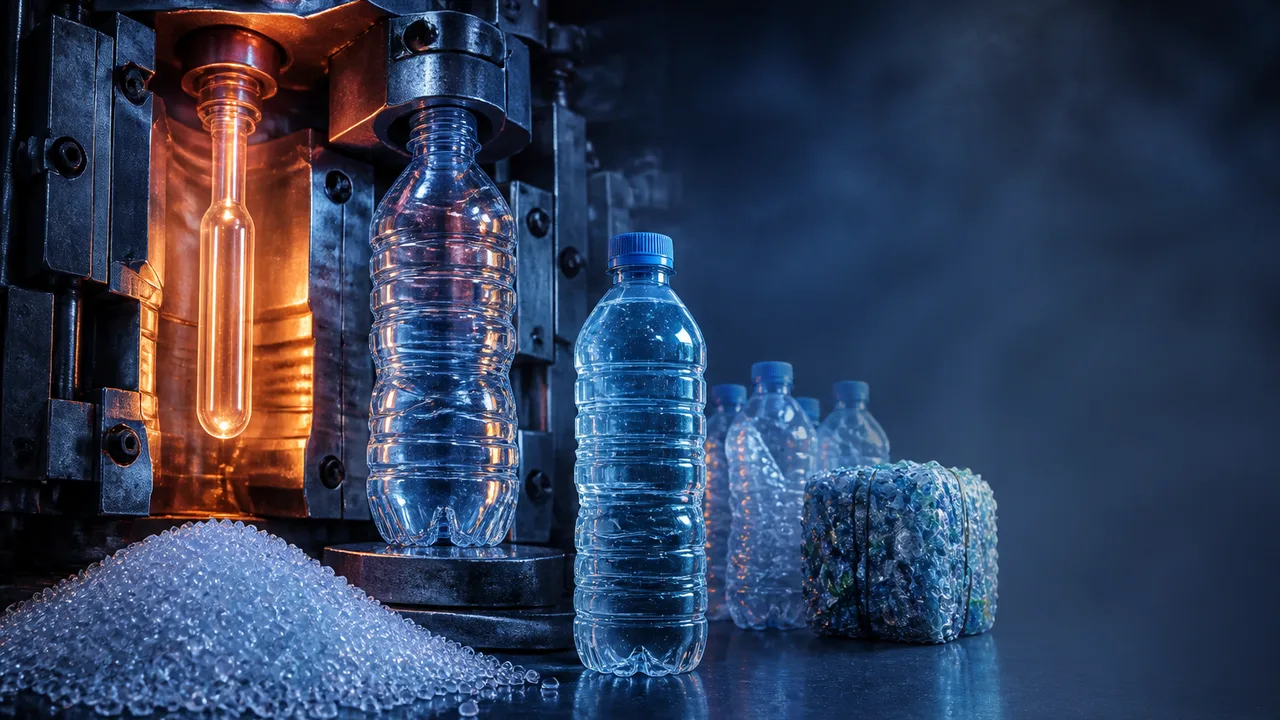
Photo: AI. Castor Belov
More than a million plastic bottles are consumed somewhere on earth every minute. People pick them up, drain them, set them down — and almost none of them pause to ask what they are actually holding. That incuriosity is understandable. The object is designed to be invisible: feather-light, crystal-clear, cheap enough to be disposable. The engineering required to make it that way is anything but.
A recent video from the YouTube channel Secrets of Everyday Things walks through the full manufacturing lifecycle of a PET water bottle, from raw pellet to recycling bin. The process is more chemically intricate than the finished product suggests, and the constraints embedded in that process have real consequences for how well recycling can actually work.
The Material and Its Unlikely Origin
The plastic in question is polyethylene terephthalate — PET, for everyone's sake. Chemists synthesized it in the 1940s, but it spent its first few decades as a textile fiber, not a container. The pivot to bottles came through a single engineer's failure.
In 1973, Nathaniel Wyeth, working at DuPont, received the patent for the first plastic bottle capable of surviving the internal pressure of carbonated soda. His path to that patent ran through an embarrassing experiment: he had poured soda into a plastic detergent bottle and watched it balloon and warp. That failure clarified the problem. What he needed was a plastic that could be oriented — its molecules aligned — in two directions simultaneously, not just one.
He borrowed the logic from textiles. Pull a nylon thread taut and its molecules line up, making it dramatically stronger. Wyeth's insight was to apply that principle in both the vertical and horizontal axes at once. The geometry he devised for the initial mold — threaded in a crossing diamond pattern rather than a simple spiral — became the structural foundation of an entire industry.
The video puts it plainly: "What made Wyeth's invention special was not the type of plastic, but the way he stretched it."
From Pellet to Preform
Every bottle begins as a small, clear pellet — visually indistinguishable from a grain of rice. Factories blend virgin PET pellets with flakes ground from previously used bottles. The ratio of recycled to virgin material is not arbitrary, and this is where the chemistry gets complicated in ways that matter environmentally.
Each time PET is melted down and reformed, the long polymer chains that give it strength get shorter. The technical measure for this is intrinsic viscosity — a number that tracks average chain length and falls with each recycling cycle. Shorter chains mean a weaker, more brittle material. That degradation sets a hard ceiling on how much recycled content a structural bottle can contain while still performing safely.
Modern facilities address this with a solid-state polymerization process that partially rebuilds the broken chains, pulling recycled PET back toward its original properties. It works — but it is not magic. The qualitative constraint remains: you cannot simply substitute recycled plastic for virgin material without limit and expect the same bottle.
The video frames this as "a quiet race between protecting the planet and keeping your sip of water safe." That framing is accurate. It is also worth sitting with, because it reveals how even well-designed recycling systems operate under material constraints that consumer-facing messaging rarely acknowledges.
The blended pellets are fed into an injection molding machine, where intense heat melts them into a thick, syrupy liquid. That liquid is injected under high pressure into a mold, producing something called a preform. If you have never seen one, the description in the video captures it well: "a small, chunky, solid, thick-walled tube of plastic, with one end already carrying the bottle neck and the twisting threads that will later screw the cap on." Finger-length, heavy for its size, opaque with thickness — it looks nothing like a bottle, and everything like a test tube.
The Two-Second Transformation
The preform's journey to bottle shape is where Wyeth's original insight becomes kinetic. The preform is reheated — not to the point of melting, just to a soft, pliable state, like warmed candy — and loaded into a reheat stretch blow molding machine.
Two things happen simultaneously. A metal rod pushes down through the center of the preform, stretching it lengthwise. At the same moment, a blast of compressed air forces the softened plastic outward in every direction, pressing it against the walls of a bottle-shaped mold. The whole event takes under two seconds. The rod handles the vertical orientation; the air handles the horizontal. Together they replicate Wyeth's biaxial alignment: polymer chains locked in two directions at once, producing a wall thin enough to crumple in your hand but strong enough to contain carbonated pressure.
Cold water running through the mold walls sets the shape almost instantly. Without that rapid cooling, the bottle would relax back toward formlessness.
The throughput of this process is staggering. According to industry data from ACE Filling, modern water bottling lines can produce up to 750 bottles per minute, with the fastest machines reaching 1,200. That scale is necessary to meet a demand measured in billions of units per year — and it is part of what makes the downstream recycling problem so structurally difficult.
Getting Lighter Without Getting Weaker
One genuinely impressive trend the video highlights: the single-serve 16.9-ounce bottle has shed nearly half its weight over the past two decades. Around 2000, such a bottle weighed approximately 17 grams — roughly three U.S. nickels stacked. Today it typically weighs around 9 grams, and some designs have reached 7 grams.
This is not cost-cutting disguised as progress, though it is also that. Thinner walls require the biaxial orientation to work harder, which means the manufacturing process has to be more precise, not less. The engineering required to remove material while maintaining structural performance is real. And the environmental math is real too: less plastic per bottle means less raw material extracted, lighter shipping loads, and less mass in the waste stream.
The video notes that "less plastic means less raw material, lighter loads during shipping, and in the end, less waste left behind for the planet to carry." All true. Though the full accounting also has to include the volume of bottles produced — a smaller footprint per unit means less if total production is expanding.
The Number on the Bottom
PET carries the number 1 inside the recycling triangle — the designation that makes it, by a significant margin, the most commonly recycled plastic in the world. A bottle placed in the correct bin can, in principle, become a new bottle, or be converted into polyester fiber for clothing, carpet, or bags.
"A bottle you drop into the right sorting bin today can truly be ground up, cleaned, melted again, and turned into a new bottle or into fabric fibers for a shirt, a carpet, a bag," the video explains. That is accurate as far as it goes.
What the video gestures at but does not fully dwell on: the recycling system only functions if the bottle reaches a facility equipped to process it, and collection and sorting infrastructure varies enormously by region. The material science supports circular use. The logistics often do not.
The alternative end-of-life is not abstract. PET that reaches waterways does not biodegrade on any human timescale. The video invokes sea turtles that mistake floating plastic scraps for jellyfish — a real and documented hazard, not a rhetorical flourish.
What the Object Actually Is
There is something worth attending to in the gap between the engineering sophistication of a plastic water bottle and the casualness with which we treat it. Wyeth's biaxial stretch insight, the molecular chain-length constraints on recycled content, the precision cooling that locks a bottle into shape in under two seconds — none of this is visible in the finished object. The design goal was invisibility, and it succeeded completely.
"In the palm of your hand is not only a bottle of water, but nearly a century of chemistry," the video observes. That's not sentiment — it's a reasonably accurate accounting of the material history compressed into something most people crush flat without thinking about it.
Whether knowing that changes what you do with the bottle after you drain it is, in the end, a question only you can answer.
More Like This

Microplastics: The Unseen Invaders in Our Lives
Explore the hidden world of microplastics in our daily lives and what you can do to minimize exposure.

Rethinking Cosmic Acceleration: A Local Illusion?
Exploring the debate on whether the universe's acceleration is a local phenomenon, challenging the concept of dark energy.

How the Asteroid Impact Ended the Dinosaur Era
Explore the catastrophic asteroid impact that ended the dinosaurs, its immediate aftermath, and the long-term environmental changes.

Subcritical Reactors: Nuclear Power's Safety Fix?
A new generation of subcritical reactors promises to make nuclear meltdowns physically impossible. But can they deliver on cost, scale, and timeline?

Understanding the Real Risk of Brain-Eating Amoebas
Explore the facts and myths surrounding brain-eating amoebas. How real is the threat, and can climate change affect its spread?
How Nanoparticles Are Already Changing Everyday Life
From self-cleaning glass to cancer detection, UCL's Professor Ivan Parkin maps what nanoparticle science can actually do right now — and where it still falls short.

The Aurochs Is Gone. Should We Bring It Back?
The wild ancestor of cattle vanished in 1627. Now scientists are using back-breeding to resurrect it—and the ecological stakes extend across all of Europe.

Spain's 2026 Total Solar Eclipse: Best Cities to Watch
On August 12, 2026, a total solar eclipse crosses Spain. Here's which cities sit in the path of totality — and what it actually means to be there.