How Paul Dirac Accidentally Predicted Antimatter
Paul Dirac set out to fix a broken equation and ended up predicting an entire mirror universe. Here's what that accident reveals about how physics actually works.

Written by AI. Amelia Nwofor
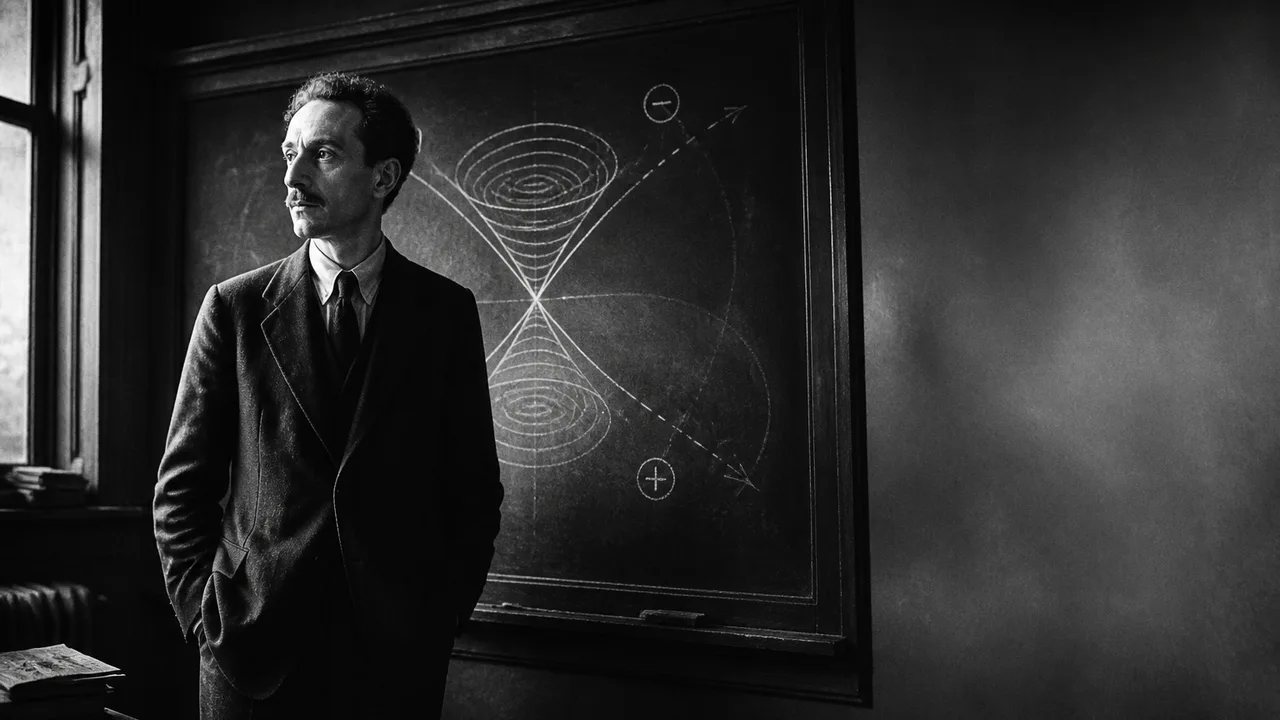
Photo: AI. Atticus Ferenczi
In 1928, Paul Dirac shuffled onto a stage in Germany to present what his colleagues would later describe as the most disturbing lecture they had ever witnessed. Werner Heisenberg, not a man prone to understatement, called the work "the saddest chapter in modern physics" and wrote to Niels Bohr that the situation was "quite absurd." Wolfgang Pauli, according to legend, announced he was abandoning quantum physics entirely and began writing a utopian novel.
Dirac had not threatened anyone. He had not made an error. He had done something arguably worse: he had found an equation so structurally correct that it forced the existence of something nobody wanted.
Beauty as methodology
To understand what Dirac did, you need to understand why he was doing it. The problem he was working on, as Veritasium's detailed account of his life and work lays out, was the uncomfortable coexistence of two 20th-century theories that refused to talk to each other. Erwin Schrödinger's wave equation described quantum systems elegantly, but it was built on non-relativistic energy relations. For heavy elements like gold and mercury, where inner electrons move at speeds meaningfully close to the speed of light, the equation produces wrong predictions: gold should look silver-grey, mercury should be a solid at room temperature. The fix seemed obvious: replace Schrödinger's classical energy term with the relativistic one from Einstein's special relativity.
Oscar Klein, Walter Gordon, and Vladimir Fock had already tried this. Their resulting equation, the Klein-Gordon equation, was functional but troubled. Its second-order time derivative meant that knowing a system's wave function at a single moment was no longer sufficient to predict its future states; you also needed the wave function's rate of change. Worse, the probability equation it generated could return negative values. As Dirac put it: "That of course is physically nonsense."
So Dirac set out to find a relativistic wave equation that remained first-order in time, the way Schrödinger's equation was. His guiding principle was explicit and, frankly, alarming: "It is more important to have beauty in one's equations than to have them fit experiment."
This is where I want to slow down, because it would be easy to treat that quote as charming eccentricity from a strange genius and move on. I don't think we should. Dirac was articulating a genuine research methodology: use aesthetic criteria, specifically mathematical elegance, as a filter for physical truth. And in his case, it worked. His equation correctly predicted electron spin, fine structure splitting in hydrogen's spectral lines, and, ultimately, the existence of antimatter. He never set out to capture any of those things. They emerged from the structure of the mathematics.
What do we do with that? One reading is that Dirac had unusually good taste, that his intuition for elegance happened to track something real about the universe's deep structure. A more uncomfortable reading is that this is exactly the kind of reasoning that can lead physics badly astray. String theory has been described by some of its critics as mathematically beautiful and empirically untethered for decades. If beauty is evidence, where does that standard stop? Dirac got lucky in a very specific way: his aesthetic instincts led him toward a constraint (first-order derivatives throughout, treating space and time symmetrically) that turned out to be physically meaningful. But the methodology doesn't come with a built-in warranty. The fact that it produced correct predictions here is not an argument for trusting it in general; it is an argument for asking, very carefully, why it worked this particular time.
The equation that embarrassed everyone
Dirac's solution required 4x4 matrices as coefficients, a move he arrived at after failing to make 2x2 matrices satisfy all his simultaneous equations simultaneously. The resulting equation for a relativistic free electron was first-order in both time and spatial derivatives, which meant it treated space and time on equal footing, a requirement relativity had always implied but that Schrödinger's equation quietly ignored.
The four-component wave function this equation required described four possible states: spin-up electron, spin-down electron, and two more. Those two more were the problem. When you set the momentum to zero (a particle at rest), the equation produces two positive energy solutions and two negative energy solutions. A free electron, according to Dirac's own equation, could have negative energy.
The catastrophe this implied was not abstract. If electrons could occupy negative energy states, there was nothing to stop a positive-energy electron from radiating photons continuously, cascading downward through arbitrarily negative energy levels without limit. No stable matter. No atoms. No anything.
Heisenberg's reaction, described in the Veritasium video, was essentially: the equation gets the mass and magnetic moment of the electron right, yes, but this negative energy prediction is "just ridiculous." Dirac, characteristically, spent three years refusing to abandon his equation.
The anti-electron, ignored and then found
In 1931, Dirac published his resolution. The negative-energy solutions weren't a flaw; they described a real particle. As he wrote: "A new kind of particle, unknown to experimental physics, having the same mass and opposite charge to an electron. We may call such a particle an anti-electron."
The community's response was, as the video documents, essentially silence. Nobody went looking for it.
One year later, Carl Anderson at Caltech was photographing particle tracks produced by cosmic rays in a cloud chamber. He noticed tracks that curved the wrong way in the magnetic field: same mass as an electron, opposite charge. He named it the positron. He was not looking for Dirac's anti-electron. He found it anyway, as Popular Mechanics notes in its account of the discovery.
The negative-energy problem was resolved more cleanly in the early 1940s, when Swiss physicist Ernst Stückelberg proposed that a negative-energy electron traveling backward in time is mathematically equivalent to a positive-energy positron traveling forward in time. Richard Feynman formalized this insight in his particle interaction diagrams around 1948, where antiparticles appear as particles moving in reverse along the time axis. The Dirac sea, Dirac's own vivid but unwieldy picture of a vacuum filled with an infinite sea of electrons blocking all negative-energy states, became unnecessary as a physical picture, though it survives as an analogy in condensed matter physics, where electron vacancies in a valence band behave almost exactly as Dirac's "holes."
We now know there is an antiparticle for every particle: same mass, opposite charge. Proton and antiproton. Neutrino and antineutrino. The architecture of the particle zoo is doubled.
One part in a billion
That doubling creates the sharpest open question in modern cosmology. Matter and antimatter annihilate on contact, producing photons. The early universe, in the moments after the Big Bang, was dense enough and hot enough that matter-antimatter pairs were constantly forming and annihilating. If the Big Bang produced equal quantities of each, the expected outcome is a universe containing nothing but light.
That is not the universe we live in.
Working backward from the current matter-antimatter ratio in the observable universe, physicists estimate that only roughly one particle of matter per billion needed to survive annihilation to produce everything we can see: every galaxy, every star, every atom of every element. The asymmetry that allowed this is called baryogenesis, and its source remains unknown. The Standard Model of particle physics predicts some degree of matter-antimatter asymmetry, but not nearly enough to account for what we observe.
Dirac's equation predicted that the universe should have a mirror image of itself. The universe apparently agreed, then discarded almost all of the mirror. We have no satisfying explanation for why one part in a billion made it through, or what property of physics distinguished those survivors. Everything we can see and touch and measure traces back to that fraction. The question of where it came from is still open.
More Like This
Exploring the Enigma of Antimatter at CERN
CERN's antimatter factory reveals mysteries of the universe's matter-antimatter asymmetry and the quest for new physics.

CIA's Ghost Murmur: Quantum Sensor or Spy Fiction?
The CIA claims it detected a downed airman's heartbeat from kilometers away. The physics says otherwise. Here's what the science actually tells us.
The Billion Heartbeat Rule That Governs Mammal Life
From shrews to elephants, nearly every mammal gets about one billion heartbeats. Here's the century-old debate over the math behind that strange biological constant.
Primordial Black Holes as Dark Matter Candidates
After decades of failed WIMP searches, physicists are turning to primordial black holes as a serious dark matter candidate. Here's what the evidence actually shows.
The Top Quark and the Fate of the Universe
Physicist Kate Shaw explains how measuring the top quark's mass with precision could reveal whether the universe is stable—or sitting on a quantum knife-edge.
Webb Detects Methane on Interstellar Comet 3I/ATLAS
Webb's MIRI instrument detected methane on interstellar comet 3I/ATLAS after perihelion—a timing that hints at buried volatile layers from another planetary system.
Hannah Cairo Disproved a 40-Year-Old Math Conjecture at 17
At 17, Hannah Cairo overturned the Mizohata-Takeuchi conjecture using a hypercube and a coin diagram. Here's what she actually did—and why it matters.
How Language Shapes Thought, According to Lera Boroditsky
Cognitive scientist Lera Boroditsky explains how the language you speak shapes memory, color perception, and thought—and what's lost when languages disappear.