The Billion Heartbeat Rule That Governs Mammal Life
From shrews to elephants, nearly every mammal gets about one billion heartbeats. Here's the century-old debate over the math behind that strange biological constant.

Written by AI. Amelia Nwofor
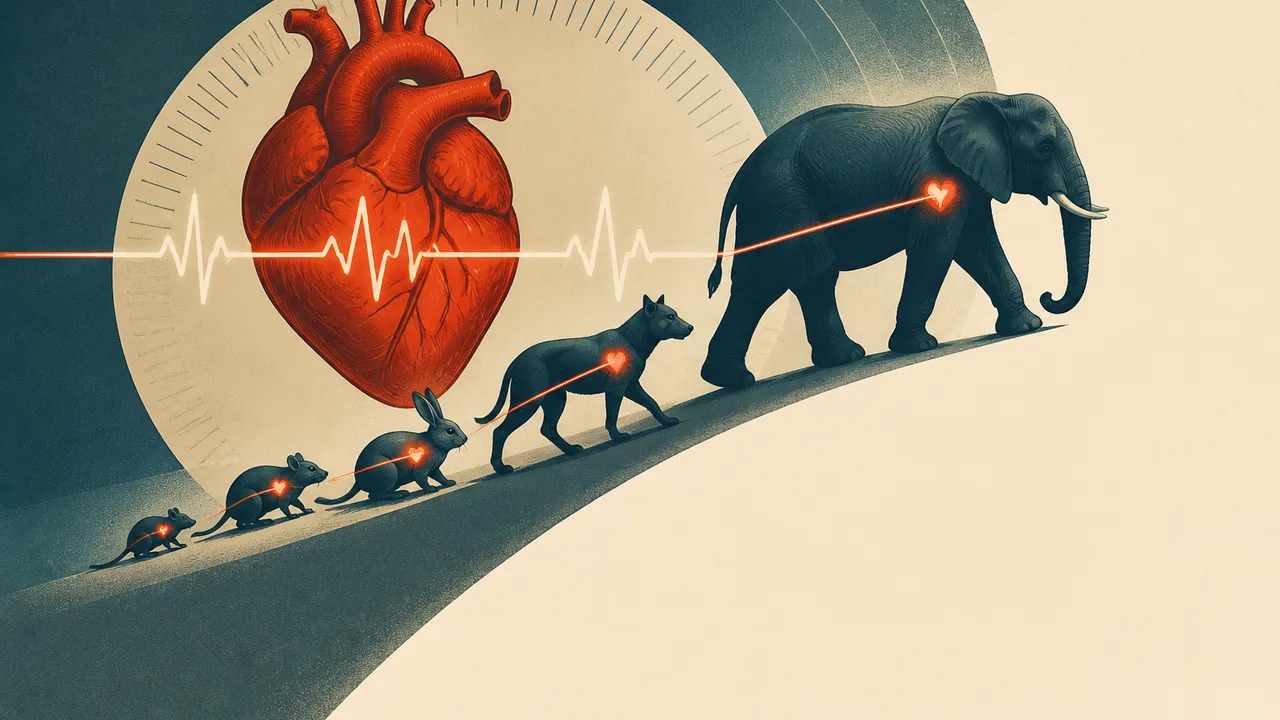
Photo: AI. Mika Sørensen
In 1962, researchers injected an Indian elephant named Tusko with nearly 300 milligrams of LSD. Their logic was straightforward: they knew the safe dose for a cat, and an elephant weighs roughly a thousand times more, so they multiplied accordingly. Tusko was dead within the hour.
The mistake wasn't recklessness, exactly. It was a failure to ask how things scale. The researchers assumed drug metabolism worked proportionally to body mass. It doesn't. And that one wrong assumption — linear scaling where the biology is decidedly non-linear — is what a recent Veritasium video uses as its entry point into one of biology's longest-running quantitative debates.
The pattern nobody fully agrees on
Here's the claim at the center of the video: an Etruscan shrew and an African bush elephant, despite being separated by orders of magnitude in size and years of lifespan, each accumulate roughly one billion heartbeats over the course of their lives. So does nearly every other mammal in between.
This isn't magic. It falls out of two intersecting scaling relationships. Heart rate, it turns out, scales with body mass to the negative one-quarter power — larger animals have slower heartbeats. Lifespan, meanwhile, scales with body mass to the positive one-quarter power — larger animals live longer. Multiply rate by duration, and the exponents cancel. You're left with a constant.
The Etruscan shrew, with a heart rate of around 1,200 beats per minute and a lifespan of roughly 1.5 years, racks up approximately 950 million beats. An African bush elephant, at around 30 beats per minute over a roughly 65-year life, clears just over a billion. The math works out with an almost uncomfortable tidiness.
But where do those quarter-power exponents come from in the first place? That's where things get genuinely contested.
Kleiber's law and its discontents
In 1932, Swiss biologist Max Kleiber plotted metabolic rates against body mass for animals ranging from a small dove to a large steer and found that the data fell on a straight line — but with a slope of 3/4, not 2/3 as the prevailing "surface law" had predicted. The surface law made intuitive sense: heat generated by metabolism has to escape through the skin, so metabolic rate should track surface area, which scales as mass to the 2/3. Kleiber's data said otherwise.
This became Kleiber's law: metabolic rate scales with body mass to the 3/4 power. The implications are substantial. An organism 100 times larger needs only about 31.6 times the metabolic energy, not 100 times. Size confers efficiency.
The mystery deepened when researchers noticed that other biological quantities — brain size, growth rate, blood volume per minute — also scaled with quarter-power exponents. Lifespan scales as mass to the 1/4. Heart rate as mass to the −1/4. These aren't all the same exponent, but they're all multiples of a quarter, which looked less like coincidence and more like a signal.
In 1997, physicist Geoffrey West, ecologist James Brown, and biologist Brian Enquist published what became known as WBE theory, attempting to explain where those quarter powers come from. Their argument rested on three premises: that biological distribution networks (like the circulatory system) must be space-filling to reach every cell; that the smallest terminals of those networks — the finest capillaries — are the same size regardless of organism size; and that evolution has optimized these networks for efficiency.
The mathematical consequence of those premises, via the geometry of self-similar branching fractals, is that metabolic rate should scale as mass to the 3/4. As mathematician Steven Strogatz noted in the video: "That's the really shocking thing about what they did. They had a table with something like, I don't know, 20 or 30 predictions of exotic exponents, and that's what you really see in the data. So, this one theory accounts not only for the 3/4 power of metabolism, but for literally dozens of other things that biologists have measured."
That's a genuinely impressive predictive record. A theory that makes 26 specific predictions and sees them largely confirmed in observed data deserves serious attention.
What the skeptics are actually saying
Here's the part that doesn't always make it into the headline: the research community is split, and the split runs deeper than disagreement about WBE's mechanism.
Some researchers, including Peter Sheridan Dodds at the University of Vermont, question whether the underlying data analysis holds up — arguing the data are noisy enough that firm conclusions about any particular exponent are premature. Others go further, suggesting Kleiber's 3/4 exponent may not be universal at all.
The video is candid about this. If you look only at large mammals, a 3/4 slope fits well. Zoom out to include smaller mammals, and the data appears to favor something closer to 2/3. Recent studies of bird metabolism also suggest a slope nearer to 2/3. Meanwhile, cold-blooded animals show slopes that can run higher than either. Many studies produce error bars wide enough to encompass both candidate exponents.
As one researcher put it in the video: "It needs to be measured again really well." That's not a dismissal of the field — it's an honest assessment of what the data can currently support.
A growing number of researchers now suspect there may be no single universal scaling exponent across all of life. The exponent might vary by taxa, by size range, by metabolic state. Which would mean the neat one-billion-heartbeat constant is real for many mammals, but rests on a foundation that's still being excavated.
Humans as the interesting outlier
The one mammal that demonstrably breaks the billion-heartbeat pattern is us. The Veritasium video argues that humans were historically much closer to the billion-heartbeat norm, and that advances in medicine and sanitation beginning in the mid-1800s started pushing average lifespan well beyond what body mass would predict. The average human now accumulates something closer to three billion heartbeats before death — a number that has ticked upward over centuries, with visible dips during events like the 1918 influenza pandemic.
What's remarkable about framing it this way is that it reframes public health not as an abstraction but as biology hacked. We didn't change our metabolic rate or our body mass. We changed the hazard environment. The result is that we now inhabit the lifespan range of animals significantly larger than ourselves.
The city parallel
The video makes an extended analogy to urban scaling: the observation that certain properties of cities — GDP, patent filings, wages — scale superlinearly with population (roughly with an exponent of 1.15), while infrastructure needs scale sublinearly (roughly 0.85). Larger cities produce disproportionately more economic and intellectual output per person, while requiring proportionately less physical infrastructure.
The analogy to biological scaling is suggestive, not mechanistic. Unlike WBE theory for organisms, there's no widely accepted explanatory framework yet for why cities scale the way they do. The exponents are empirically observed; their origin is still theoretically open. That distinction matters. A pattern isn't a theory, and a theory that predicts a pattern isn't automatically the correct explanation for it.
What both domains share — and what the video handles well — is the central point that linear scaling intuitions systematically mislead. Double the mass, double the dose. Double the population, double the crime. Both instincts turn out to be wrong, in ways that have real consequences.
The billion-heartbeat figure is, at minimum, a useful provocation: it forces you to ask what's actually being conserved across biological diversity, and why. Whether the answer is WBE's fractal geometry of distribution networks, something else, or a more complicated patchwork depending on organism type, is genuinely unresolved.
That's not a failure of the science. That's what an active research frontier looks like — and the question of how metabolic rate scales with mass has been one of biology's hardest problems for nearly a century. The fact that we still can't measure an elephant's metabolism well enough to settle a debate is, in its own way, instructive.
More Like This
Homo Erectus Survived 1.9 Million Years. We've Managed 300,000.
Homo erectus outlasted us by six to one. A new look at the fossil record asks whether our big brains are an advantage—or a liability with a slow fuse.
Exploring the Enigma of Antimatter at CERN
CERN's antimatter factory reveals mysteries of the universe's matter-antimatter asymmetry and the quest for new physics.
The Deeper Geometry Behind the Pythagorean Theorem
Explore why the Pythagorean Theorem appears in unexpected places, from geometry to relativity.

CIA's Ghost Murmur: Quantum Sensor or Spy Fiction?
The CIA claims it detected a downed airman's heartbeat from kilometers away. The physics says otherwise. Here's what the science actually tells us.
Why All Mammals Share Seven Neck Bones
Giraffes and humans both have seven cervical vertebrae. The evolutionary reason involves Hox genes, cancer risk, and the surprising anatomy of the diaphragm.

How Your Body Runs Itself Without You
From breathing to wound repair, your body manages thousands of processes without your input. Here's what the science actually says about how it works.
Neutrinos, Oscillation, and the Matter-Antimatter Mystery
Particle physicist Kirsty Duffy explains neutrino oscillation, what it broke in the Standard Model, and why DUNE may finally answer why matter exists at all.

Donald Hoffman: Evolution Hid Reality From Us
Cognitive scientist Donald Hoffman argues on StarTalk that evolution gave us a VR headset, not a window—and the math behind Darwin backs him up.