Why All Mammals Share Seven Neck Bones
Giraffes and humans both have seven cervical vertebrae. The evolutionary reason involves Hox genes, cancer risk, and the surprising anatomy of the diaphragm.

Written by AI. Nadia Marchetti
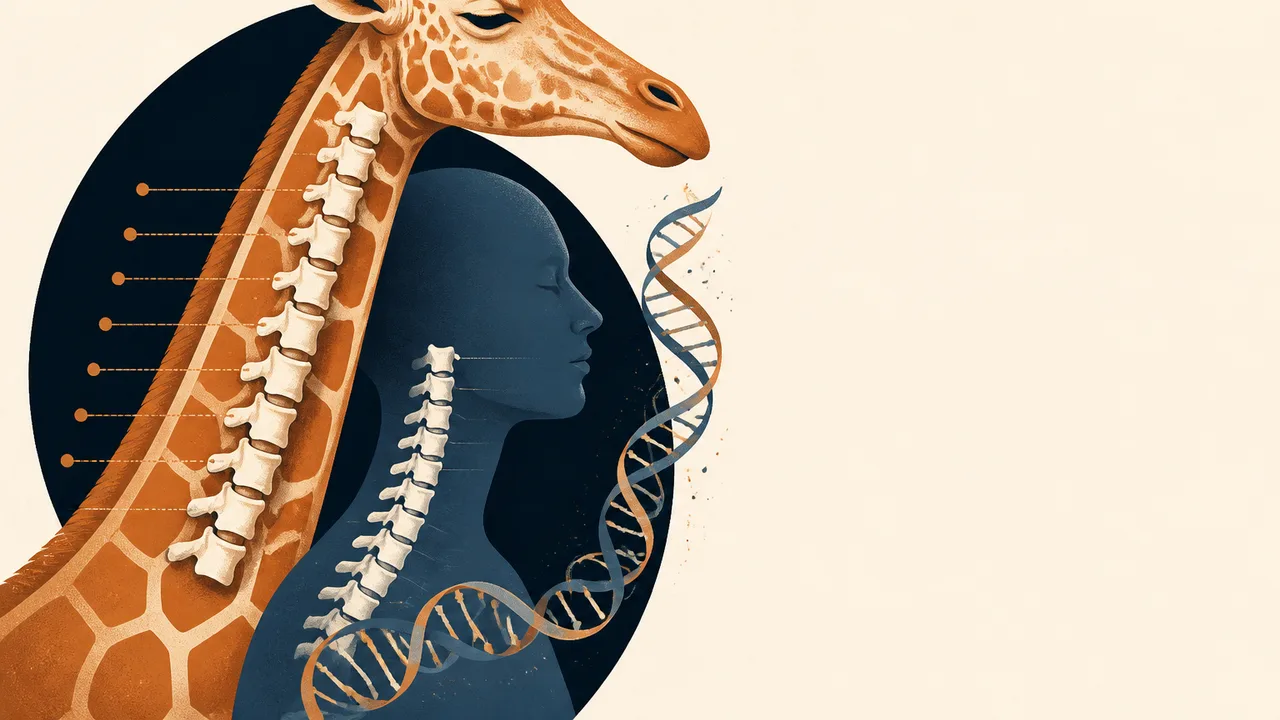
Photo: AI. Mika Sørensen
Here is a fun fact that sounds made up but isn't: a giraffe has the same number of neck bones as you. Seven. The same number you have, the same number a whale has, the same number in the stubby neck of a mole. Seven cervical vertebrae, nearly universal across every mammal alive today, maintained with an almost suspicious consistency across hundreds of millions of years of evolution.
That consistency bothers me a little. Biology is generally not tidy. So when something is this tidy, there's usually a constraint somewhere—something the genome keeps running into like a wall it can't climb. In a recent SciShow episode hosted by Deboki Chakravarti, that constraint gets mapped in satisfying detail. The answer turns out to involve at least two separate mechanisms, one of which is cancer, and neither of which is fully resolved.
The Vertebrate Baseline: Chaos, Except for Mammals
Start with the contrast. Outside of mammals, vertebral counts are all over the place. A 2011 analysis of squamates—the reptile group that includes snakes and lizards—found that vertebral numbers tracked closely with body shape demands. Dwarf chameleons had as few as 14 vertebrae total. Some snakes in the same study had more than 290. Salamanders can vary vertebral count based on the temperature of the egg they developed in—a fact that Chakravarti delivers with the appropriate mix of delight and bewilderment: "Yes, that's real and I don't know why."
Then there's the mammal class, which apparently got a different memo. Mammals pretty much always have 26 to 27 vertebrae total, with seven of those locked into the cervical position. The exceptions—out of thousands of living mammal species—are exactly three: the manatee (usually six cervical vertebrae), the two-toed sloth (as few as five), and the three-toed sloth (as many as ten). That's it. The same innovation that powered flight achieved three separate times across evolutionary history. As Chakravarti notes, that comparison should give you pause: "vertebrates only evolved powered flight three times. And that feels way more complicated than adding or subtracting a neckbone or two."
So it isn't that no mammal has ever needed a different cervical count. Giraffes seem like they'd benefit from a few extra bones to distribute the load of that neck. Camels and llamas have the same long-neck problem. Something else is going on.
The Hox Gene Lock
Vertebral identity—whether a given bone is a cervical, thoracic, or lumbar vertebra—is set during early embryonic development by a class of genes called Hox genes. These are among the most ancient and conserved sequences in animal genetics; they're essentially the master blueprint for segmented body organization, telling an undifferentiated cluster of cells where to put limbs, organs, and yes, which spine segments go where.
To change your cervical count, you have to tinker with Hox gene expression. Other vertebrate groups seem to manage this without much trouble—birds, lizards, and salamanders shuffle their Hox programs and produce functional, viable animals. Mammals largely cannot, or at least not in the neck. The question is why.
Frietson Galis, a researcher who published foundational work on this in 1999, approached it empirically: instead of asking why mammals can't change cervical vertebrae, she looked for humans who had changed them. The marker she tracked was the cervical rib—a small, rib-like bone sometimes attached to the seventh cervical vertebra, indicating a Hox gene expression mutation in neck development. If this mutation were neutral, you'd expect it to show up in the general population at modest, stable rates. Instead, Galis found it clustering in specific groups.
People with cancer—particularly childhood cancers and malignancies that developed in utero.
An earlier study of 1,000 children with tumors and 200 without found that 21.8% of children with malignant tumors had at least one rib abnormality, against 5.5% of children without tumors. For neuroblastoma, the rate was 33%. For leukemia and brain tumors, around 27%. In Galis's own later study, cervical ribs appeared in roughly 30% of miscarried fetuses and stillborn infants with no other visible abnormalities—and in over 60% of those with multiple major congenital abnormalities. Meanwhile, the rate of cervical ribs in adults, drawn from a literature review that included a study of over four million X-rays, ranged from just 0.05% to just over 2%.
The implication is stark: individuals born with this cervical Hox mutation are substantially less likely to survive to reproductive age. The mutation doesn't spread through the population because the population keeps filtering it out—through miscarriage, stillbirth, childhood cancer, or a degenerative nerve compression condition called thoracic outlet syndrome, which can severely limit arm function. The seven-vertebra rule isn't just maintained; it's enforced.
The Breathing Problem
The cancer hypothesis is compelling, but Chakravarti presents a second, anatomically distinct constraint: the diaphragm.
This is the one I find more structurally elegant. The diaphragm—the dome-shaped muscle below the lungs that drives mammalian breathing—has a developmental origin at the cervical spine. In early fetal development, the cells that form the diaphragm migrate down from the cervical region to their final position in the chest. The phrenic nerve that activates the diaphragm also originates in the cervical spine. So the neck and the breathing apparatus are physically entangled from the earliest stages of embryonic development.
It goes further. The diaphragm's position in the chest matters for breathing efficiency. For maximum lung expansion, the diaphragm needs to attach near the border between the movable lower ribs (which swing outward during inhalation) and the immovable upper ribs. Displace the diaphragm from that optimal zone, and your breathing becomes mechanically less effective.
Here's where the three exceptions become instructive. Two of them—two-toed sloths and manatees—have unusual rib cage proportions that already place the diaphragm in a non-standard position. They've effectively worked around the diaphragm constraint rather than being blocked by it. As the video explains: "when the two-toed sloths and manatees reduced their cervical vertebrae, it may have messed with the location of their diaphragm, too, but they just made it work."
This also explains why non-mammalian vertebrates can vary their cervical counts without apparent consequence: they don't have diaphragms. Birds use air sacs. Reptiles expand their ribs via other musculature. The developmental tether between cervical spine and breathing muscle simply doesn't exist in those lineages.
Why Don't Sloths Get More Cancer?
One open question hangs over this whole picture: if Hox gene mutations in the cervical region reliably co-occur with cancer in humans, why haven't sloths and manatees paid the same price for their evolutionary deviation?
The honest answer is that we don't fully know. The working hypothesis involves metabolic rate. Slower metabolism means fewer free radicals produced as cellular byproducts, which means less DNA damage, which means lower baseline cancer risk. Sloths are, famously, not metabolically aggressive animals. Manatees aren't sprinting anywhere either. Birds and reptiles also appear to have lower cancer rates in general—possibly due to protective mechanisms against oxidative DNA damage that mammals don't share.
It's a plausible story. It's also not confirmed. The mechanisms by which Hox gene dysregulation produces cancer risk in mammals aren't comprehensively mapped, and the question of why some lineages can tolerate cervical variation when others can't remains genuinely open research territory.
What's not open is the empirical pattern itself. The correlation between cervical rib presence and adverse outcomes in humans is documented across multiple study types and sample sizes. The near-universal conservation of seven cervical vertebrae across mammalian diversity is a real phenomenon with real consequences. The constraints—both the developmental entanglement with the diaphragm and the cancer association—are independently documented, and their combined effect is a genome that has been effectively locked in place for tens of millions of years.
You share your neck architecture with a giraffe not because evolution found seven vertebrae optimal for both of you. You share it because whatever mammal ancestor first landed on seven could not, without serious consequence, be anything else—and neither, it turns out, can you.
More Like This
Three Biology Breakthroughs That Rewrote Evolution's Rules
New research reveals intelligence evolved twice independently, fathers pass traits through sperm RNA, and evolution happens in bursts—not gradual change.
Medicine's Strangest History, Explained
Medical historian Richard Barnett unpacks lobotomies, Typhoid Mary, penicillin, and why the history of medicine is a mirror for the present.
How Fractals Moved From Math Curiosity to Tech
Fractals aren't just beautiful—they're inside your smartphone antenna, your microchip cooling system, and your eye exam. Here's how the math became engineering.
Why We Still Can't Simulate a Worm's 302 Neurons
Joscha Bach says neuroscience is mapping the telegraph network and calling it civilization. A 302-neuron worm is the uncomfortable proof.
Where Did Humans Actually Come From in Africa?
We know humans came from Africa—but where exactly? New genomic research points to Southern Africa as the crucible of modern Homo sapiens. Here's what the evidence says.

Science Spent Millions on Blue Roses and Failed Spectacularly
Decades of genetic engineering haven't produced a true blue rose. The quest reveals fascinating limits of plant biology—and human obsession.

Einstein vs Quantum Mechanics: The EPR Paradox Explained
Physicist Jim Al-Khalili unpacks the EPR paradox—Einstein's 1935 challenge to quantum mechanics that inadvertently gave us the concept of entanglement.

Yitang Zhang and the Twin Prime Breakthrough
How a Subway bookkeeper-turned-lecturer cracked a problem the world's top mathematicians declared impossible—and what it revealed about prime numbers.