How the LP and 45 Split the American Record Business
The LP and 45 began as rival formats, then divided albums and singles. Today's vinyl revival shows which half of that postwar settlement endured in America.

Written by AI. Margaret "Maggie" Holloway
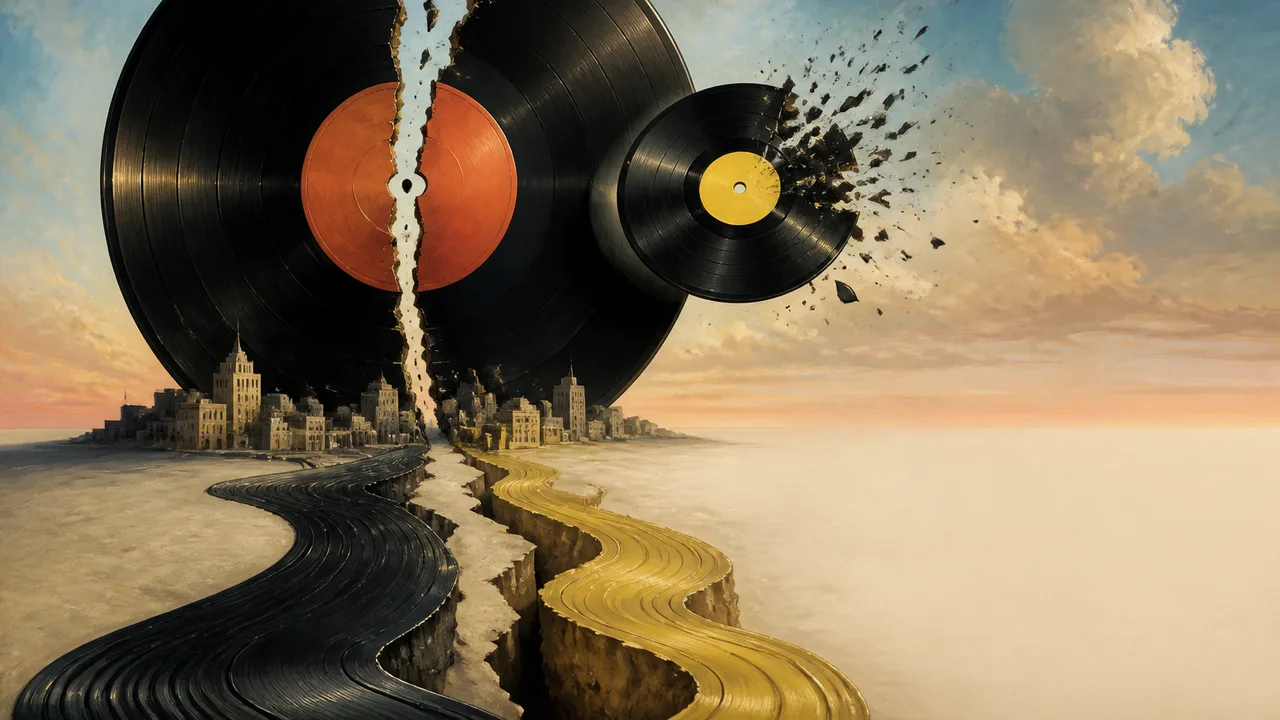
Columbia Records introduced its microgroove LP in June 1948 with a photograph that made the old record business look like warehouse work. A company executive stood beside an eight-foot stack of 78s while holding a one-foot stack of LPs; each contained the same 101 albums of music.
The picture reduced a complicated engineering argument to furniture. The LP needed less shelf space, survived handling better than brittle shellac and held more than 20 minutes per side. A conventional 78 managed about four. Columbia had built a record for symphonies, cast recordings and any music that objected to being interrupted every few minutes.
RCA Victor answered on March 31, 1949, with the seven-inch 45 rpm single. It was small, light and designed around one song per side. RCA also offered a compact changer that could stack ten discs and play more than 50 minutes without attention. The machine turned a pile of singles into a mechanical playlist, complete with a thick central spindle that looked capable of mooring a modest boat.
This confrontation became known as the “war of the speeds.” Yet the outcome makes more sense as a division of labor. The LP became the home of the album, while the 45 carried the hit single into radio stations, jukeboxes and teenagers’ rooms. Multi-speed players eventually removed much of the consumer’s need to choose. Both formats survived because each had found a different job.
Before Vinyl, Music Came in Breakable Parcels
The old 78 rpm record imposed its own architecture on recorded music. Its coarse grooves and shellac body provided only a few minutes per side. Longer works arrived in sets of discs stored together in sleeves, the source of the word “album.” Listening to a symphony required repeated journeys to the phonograph.
World War II delayed attempts by Columbia and RCA to replace that system. When development resumed, vinylite offered a tougher, quieter surface on which engineers could cut grooves closer together. The SPARK Museum’s history of the formats describes the resulting jump from roughly four minutes on a 78 to more than 20 minutes on an LP side. Capacity changed the commercial object: one disc could now contain a sustained work rather than one short performance.
Columbia’s format also made an economic argument. An account drawing on a 1958 history in High Fidelity says a 12-inch LP containing a symphony sold for $4.85, compared with $7.25 for five conventional 78s holding the same music. Its first 12-inch catalogue number, ML 4001, carried Nathan Milstein’s performance of Mendelssohn’s Violin Concerto with Bruno Walter and the Philharmonic-Symphony Orchestra of New York.
RCA approached the same engineering possibilities from the opposite end of the repertoire. Its 45 preserved the single-song unit while shrinking the disc and improving fidelity. The large center hole supported RCA’s fast changer, but it also advertised incompatibility: buyers needed the proper spindle and equipment. This was competition over hardware, licensing and control as well as sound.
The precise birth date deserves care. The Engineering and Technology History Wiki places the 45’s introduction in late 1947. Stronger evidence for the commercial launch points to 1949. A later researcher’s transcriptions of RCA distributor bulletins say the March 21 and March 28, 1949 issues still listed new releases under the company’s 78 rpm prefixes. The March 28 bulletin instead carried an advertisement for March 31 declaring, “Today’s the day.” That record trail, although available through a reproduction rather than the original bulletins, supports March 31, 1949 as the public release of RCA’s system.
The Market Declined to Pick One Winner
Four years after Columbia’s launch, the supposedly obsolete 78 still accounted for slightly more than half of US record units sold. Figures reproduced in an account of the LP’s introduction put the 45 at 30.2 percent in 1952 and the LP at 16.7 percent. Roughly a decade after the new formats appeared, the LP represented 58 percent of dollar sales, while the 78 had fallen to 1.2 percent.
Those figures capture two features that winner-and-loser histories blur. Format changes take years because households own machines, retailers hold stock and record companies maintain catalogues. Unit share and revenue also tell different stories. A format carrying more expensive albums can command the larger portion of revenue without supplying most individual discs.
The eventual settlement followed use. The engineering history says most companies adopted both formats within a few years, issuing singles on 45 and classical albums on LP while manufacturers built players that handled 33⅓, 45 and 78 rpm records. Broadway cast recordings, film soundtracks and popular albums expanded the LP’s territory. Radio and jukeboxes favored the cheaper, easily distributed 45.
The 45 therefore had an ample victory of its own. SPARK Museum reports that US sales of seven-inch singles peaked at 200 million discs in 1974. The LP organized music into a long-form statement with a large sleeve; the 45 organized popular music around the song that could travel by itself. One encouraged sitting down for a side. The other was built to circulate.
Today’s Revival Has Chosen the Album
The present vinyl boom resembles the postwar transition in one respect: an older format can remain commercially important while another medium dominates everyday listening. The scale and purpose have changed, however.
RIAA figures reported by The Hollywood Reporter show US vinyl units rising from 43.4 million in 2024 to 46.8 million in 2025, while vinyl revenue grew 9.3 percent. Taylor Swift’s The Life of a Showgirl alone sold 1.6 million vinyl copies in 2025, according to Luminate figures cited by the publication. Yet streaming supplied $9.47 billion of the industry’s $11.5 billion in recorded-music revenue that year.
The revival’s internal composition points toward the LP side of the old settlement. Chartlex, summarizing RIAA and Luminate data, labels the leading physical category “Vinyl LP” and estimates that catalogue releases older than 18 months account for roughly 70 percent of vinyl sales. New pop albums, colored variants, signed copies and store exclusives supply another visible source of demand. The biggest reported sellers are albums by Taylor Swift, Sabrina Carpenter, Kendrick Lamar and Billie Eilish.
Available industry reporting does not provide a recent breakdown for seven-inch 45s, so the size of that market cannot be stated from these figures. The evidence still supports a narrower inference: the mass revival described by sales reports is centered on albums and album collecting. It does not resemble the 45’s mid-century economy of inexpensive current singles moving through jukeboxes and radio promotion.
Streaming now performs much of the old single’s work. It moves an individual song rapidly, lets listeners assemble sequences and requires no dedicated shelf space. Vinyl occupies another role: ownership, artwork, catalogue preservation and the deliberate playing of an album. This is an interpretation of how the formats function, rather than a claim that every purchaser listens or collects for the same reason.
The comparison with 1949 has a firm limit. Columbia and RCA asked households to choose between incompatible physical systems, until multi-speed equipment softened the dispute. Streaming and vinyl can divide listening and ownership without sharing hardware at all. A person can discover a song through a subscription and buy the album as an object, allowing the supposed rivals to feed one another.
The war of the speeds ended when the record business learned to sell two containers for two scales of musical attention. The modern revival has returned the larger container to the shelf, while the single’s old job travels at the speed of a tap.
More Like This
George Washington: The Man Behind the Monument
From battlefield defeats to a death made worse by his own doctors, Washington's life is more complicated than the marble monument version suggests.
Homer's Odyssey and Mycenaean Religion: Fact vs. Myth
Homer set the Odyssey in the Bronze Age but wrote it 500 years later. How accurate is his religion? Linear B tablets reveal a startling gap.