GTA VI's Album Turns Radio History Into Merchandise
Rockstar's 34-track GTA VI album pairs six new songs with tiered vinyl editions. What changed, what remains unknown, and whether to preorder.

Written by AI. Sarah O'Brien
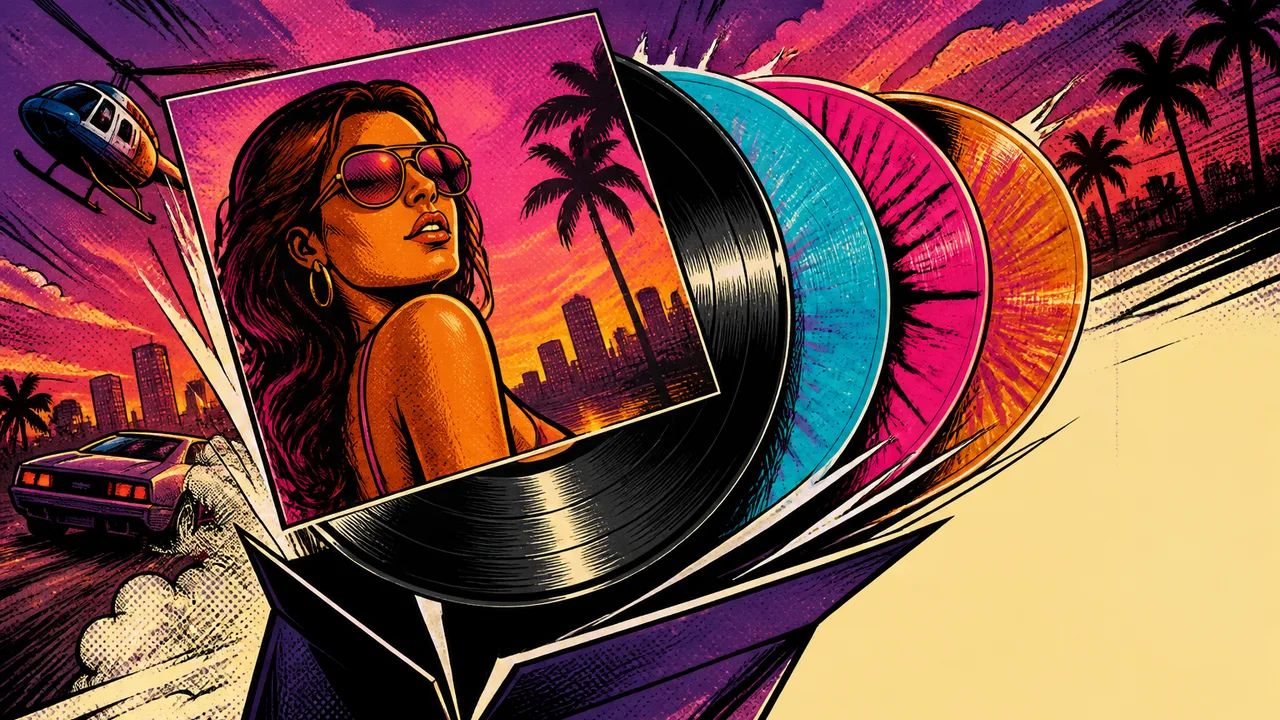
Rockstar Games and Atlantic Records have turned Grand Theft Auto VI music into a 34-track album, a streaming release and a shelf of collectible physical editions.
That sentence covers the announcement. It does not quite cover the sales machinery surrounding it.
Grand Theft Auto VI: The Album is scheduled to arrive alongside the game on November 19, 2026. Six songs are streaming now, leaving 28 unrevealed. Buyers can choose a $19.98 double CD, a $49.98 standard double vinyl set or a $124.98 limited edition containing two transparent magenta records filled with blue liquid. If ever an object invited the phrase “do not store near a radiator,” this is it.
Every version contains the same 34 tracks, according to IGN's breakdown of the editions. The higher prices buy format, packaging and artwork rather than additional music. That distinction matters when the expensive record is being sold before most of its track list has been disclosed.
Six Songs Carrying 34 Tracks of Expectation
The opening selections stretch from contemporary rap and dance music to country, Latin pop and blues:
- Yung Lean, “That’s It,” featuring Future and Metro Boomin
- Travis Scott, “RHYNO,” produced by Guy-Manuel de Homem-Christo
- CA7RIEL & Paco Amoroso, PinkPantheress, Fred again.. and Etienne de Crécy, “Sexy Magic”
- Morgan Wallen, “Last Thing You Need”
- Rauw Alejandro, “Macacoa 2000”
- Keith Richards, “Bright Lights, Big City”
The Atlantic and Rockstar release reported by Pitchfork confirms both the partnership and the unusually broad cast. Rockstar calls it a “genre-defying roster,” promotional language that the first six songs can at least support in the literal sense. A listener who moves smoothly from Morgan Wallen to Yung Lean and then Keith Richards may exist, but Rockstar does not need every purchaser to be that listener. A fictional radio dial can make incompatible audiences part of one product.
Richards’ contribution supplies a small bridge across music history. “Bright Lights, Big City” is a cover of Jimmy Reed’s 1961 blues song; the Rolling Stones recorded their own version in 1963, although it emerged later. Stereogum traced that lineage. The track therefore arrives with cultural history that substantially predates Grand Theft Auto, even though Rockstar’s packaging places it inside Leonida.
The unrevealed 28 tracks place firm limits on any judgment of the album. We cannot yet assess its overall genre balance, how many artists remain unannounced or whether the opening six represent its strongest commercial names. Buyers are being shown the spine and a few pages, then asked to order the book.
The Teaser Campaign Became a Preorder Campaign
On September 15, artists including Travis Scott, Future, Metro Boomin, Morgan Wallen, Yung Lean and Keith Richards posted GTA-styled artwork. Travis Scott referred to his “return to game,” while other posts offered images of yachts, pools and a Corvette bearing a Leonida plate. At that stage, Rockstar had not confirmed whether the artists would provide songs, host stations or appear as characters.
Two days later, the ambiguity resolved into six streaming singles and physical preorders. That sequence is useful for understanding the rollout. Each artist carried Rockstar’s visual language into a separate social audience, while the delayed explanation encouraged speculation about the artists’ roles. The eventual announcement then provided an immediate place to spend money.
That does not prove the campaign was planned around manufactured confusion; coordinated teaser campaigns routinely withhold details. The observable structure is still clear: scattered celebrity posts created attention, six songs converted attention into listening, and multiple physical editions converted it into preorders.
The product range extends beyond three basic formats. Gematsu's account of the announcement lists Rockstar-store exclusives plus color variants and new artwork for Blood Records, Best Buy, Walmart, Amazon, Barnes & Noble, Target, Urban Outfitters and independent retailers. One recording can therefore support numerous collectible objects without changing a note of the music.
Dexerto reported that the liquid-filled edition had sold out for UK and European customers through Rockstar’s store shortly after the announcement. That establishes limited availability in one storefront and region, not the size of the pressing or demand across the entire market. Without inventory numbers, a sellout cannot tell us whether ten copies vanished or ten thousand did. It can, however, put pressure on collectors to buy before the remaining songs are known.
For anyone deciding today, the cleanest question is whether the object itself justifies the price. All editions contain the same music, and six tracks can already be streamed. A buyer interested chiefly in the songs loses little by waiting for the other 28. Someone collecting retailer artwork or liquid-filled records is making a different purchase, one based on scarcity and design.
What Changed from Earlier GTA Radio
Grand Theft Auto has spent decades treating radio as part of world-building. Its stations combine licensed songs, original material, hosts and advertisements into something closer to an audio portrait of a place than a conventional background score. GTA V already featured Travis Scott alongside artists including Kendrick Lamar, Rihanna and Lorde, as Consequence noted while tracking the initial teasers.
Celebrity participation also has a long pedigree. Kyle MacLachlan appeared in GTA III, Karl Lagerfeld played himself in GTA IV, and Cara Delevingne joined GTA V. Those precedents explain why the September artwork prompted theories about character appearances as well as music. The album confirms songs from the named performers; it does not, by itself, confirm acting roles or artist-hosted stations.
The useful comparison with GTA V has a limit. Famous artists and mixed musical styles continue an established formula. The announced package changes the emphasis by presenting 34 original songs as a coordinated Atlantic release, complete with advance singles, retailer variants and premium vinyl. Music that once helped sell the game is now also being sold as a product line before the game arrives.
Even so, the album should not be mistaken for the complete radio archive. Rockstar has already confirmed older songs by Sexxy Red, Kodak Black and Phil Collins for the game, as Pitchfork documented before the album reveal. Pure Xbox also reported that the 34 album tracks represent only part of the music expected in the finished game. The album preserves one commissioned layer, while licensed recordings, station sequencing, presenter dialogue and fictional advertisements may remain outside it.
That distinction matters historically. A standalone CD or vinyl set can survive after a console storefront closes or a streaming license expires. It still cannot reproduce the experience of changing stations during a rainstorm in Vice City, hearing a presenter interrupt a song or discovering what licensing changes removed years later. Physical media preserves the tracks it contains, not the whole broadcast system around them.
What Remains Behind the Tinted Glass
The most consequential unanswered question concerns Rockstar’s reference to the “next evolution of in-game radio,” reported alongside the album announcement. Nothing disclosed so far explains that phrase. It could describe station technology, artist involvement, programming structure or another feature entirely. The 34-song album offers no basis for choosing among those possibilities.
The release date also deserves a small caution. Multiple announcement reports place both game and album on November 19, while IGN lists the album for November 20. Buyers concerned about delivery timing should treat retailer listings as provisional until Rockstar or the relevant shop resolves that discrepancy.
For now, Rockstar has disclosed enough to establish an ambitious commercial album and too little to establish what GTA VI radio will become. The six songs show range; the physical editions show a sophisticated collectibles strategy; the 28 blank spaces still contain most of the musical answer.
More Like This
GTA 6 Drops Microtransactions at Launch, But Read the Fine Print
Rockstar confirms GTA 6 launches in November without microtransactions or generative AI. Here's what that promise means, and what "at launch" actually guarantees.
Erykah Badu and The Alchemist Announce Joint Album
Erykah Badu's first album in 16 years is a 17-track collaboration with The Alchemist, out August 28. Here's what it means and why it matters.
Suno v6 Tests Whether Licensed Training Data Changes the Deal
Suno's v6 model is the first built with Warner and BMG licensed data. What the undisclosed deal covers, what it leaves open, and what artists should watch next.

Arca Announces Album XXXXX: 16 Tracks, No Previews
Arca's first album in five years, XXXXX, arrives July 31 via XL Recordings — announced with zero sonic material and a Barcelona livestream tagged 'Dive.Experimental.'

Miami Beach Split 4-3 Over Rockstar's $4 Million GTA 6 Ad Deal
Miami Beach commissioners approved negotiations on a $4 million GTA 6 marketing campaign, and the vote split 4-3. What the deal means for the city and the game.
GTA 6's Deliberate Miss Mechanic Changes the Series
GTA 6 lets players deliberately miss shots to avoid killing cops and civilians. What this mechanic means now—and what it will mean when the servers go dark.
What Minecraft 26.2 Removes and What You Can Keep
Minecraft 26.2 nerfs duplication glitches, fixes broken villager trades, and closes mob exploits. Here's what changes and what carries over.
WoW Midnight's Economy and the Memory Stored in Icons
A WoW streamer's gold-making stream revealed something unexpected: twenty years of item iconography living as folk knowledge inside a player community.