How Genomes and Fossils Put Bat Origins in Europe
A 103-genome, 44-fossil analysis places bat origins in Europe. How the combined method changed the family tree, and what scientists cannot know yet.

Written by AI. Priya Sharma
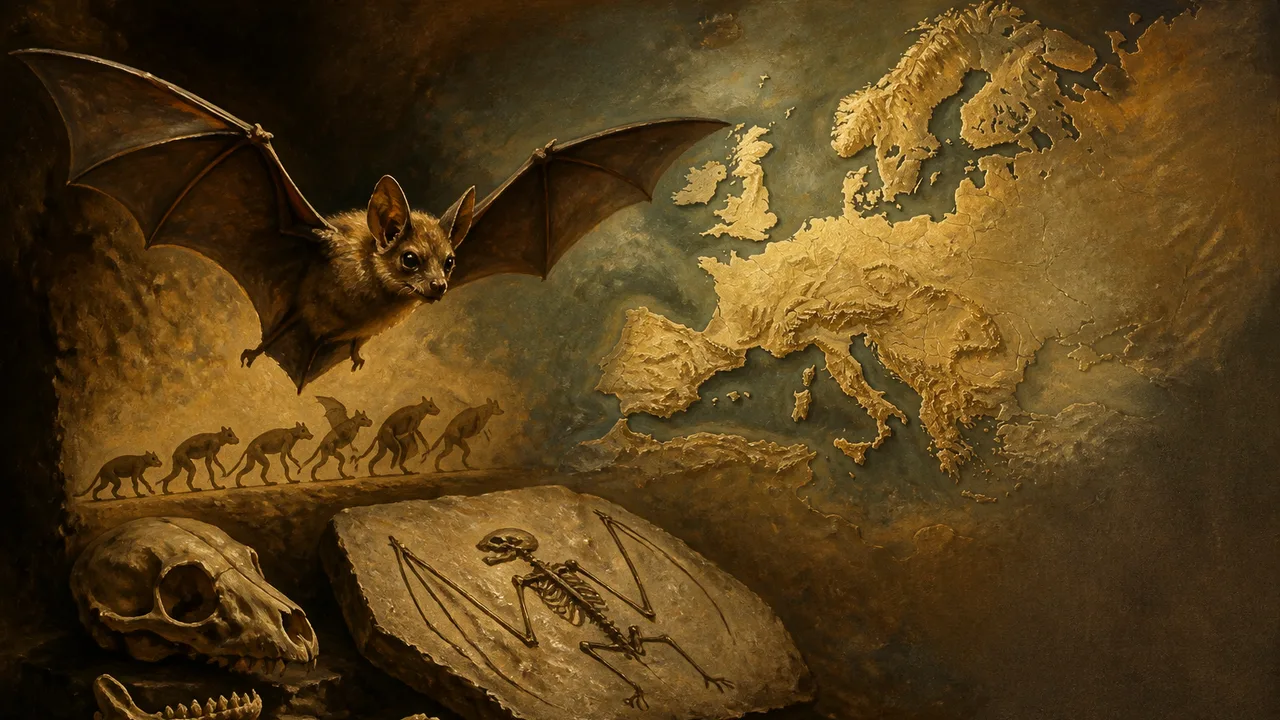
A Nature study published on September 23 places the common ancestor of bats in Europe roughly 65 million years ago, near the beginning of one of mammals’ most improbable careers.
The result comes from the Bat1K consortium, which combined chromosome-level genomes from 103 living species with 699 anatomical characteristics drawn from 65 species, including 44 fossil species. Its statistical analysis assigned a 99.2% probability to a European origin in the Late Paleocene, according to a detailed account of the research.
That is strong support inside the researchers’ model. It is still a model result, conditional on the fossils, genomes, evolutionary assumptions and geographic categories included in the analysis. No 65-million-year-old bat left a luggage tag saying Europe.
The study’s larger contribution is methodological. Earlier attempts had placed bat origins in Asia, Africa or North America. This project treated living genomes and fossil anatomy as evidence that must fit into the same evolutionary history. The resulting tree offers a testable account of where bats arose, how they spread and when their defining abilities appeared.
Why the Bat Family Tree Resisted Reconstruction
Bats are unusually diverse. More than 1,500 living species account for about one-fifth of mammal species, yet their earliest history has remained difficult to resolve. Flight lets animals disperse across barriers that constrain most mammals, while a rapid early expansion can leave short intervals between evolutionary branches. Both conditions complicate attempts to infer ancestral geography from living species.
Past genomic studies reached several continental answers. Study co-author Liliana Dávalos told Gizmodo that those efforts often depended mainly on living bats or preceded the discovery of important fossils. The Bat1K collaboration began in 2017 with the eventual aim of sequencing every living bat species.
Genome data brought its own argument. Different regions of the bat genome have produced conflicting evolutionary signals, possibly because early lineages exchanged genes. A summary of the new research reports that a region of the X chromosome retained an especially clear signal, helping the team resolve relationships that other genomic regions had blurred.
The comparison between the earlier genome-led reconstructions and the new combined analysis explains why the geographic answer changed. Living genomes preserve relationships among surviving lineages, but extinct branches can disappear from that record. Fossils supply those missing branches through anatomy and location, although fossil preservation is patchy and DNA generally does not survive across such immense spans of time. Combining the two sources lets each constrain the other.
That approach also has limits. A larger, integrated dataset can reduce uncertainty without abolishing dependence on the model. Newly discovered fossils, different anatomical coding or alternative assumptions about evolutionary rates and dispersal could alter parts of the tree. The 99.2% figure expresses how decisively Europe won among the tested alternatives under this analysis; it does not give Europe a 99.2% share of every conceivable reconstruction.
A European Origin Changes the Route Map
Under the new tree, bats arose in Europe during the Late Paleocene and moved into Africa, forming a Europe-Africa hub before spreading into Asia, Australia and the Americas. For the superfamily Noctilionoidea, the analysis favors travel from Europe to North America across the North Atlantic around 54 million years ago. It rejects a route into South America based on island-hopping from Africa.
Those reconstructions depend on ancient geography and climate as well as ancestry. The researchers place the rapid diversification of major bat lineages around 56 million years ago, coinciding with the Paleocene-Eocene Thermal Maximum, an episode of sharp global warming. Coincidence in time cannot establish that warming caused the radiation. A warmer world and expanding tropical habitats could have opened routes and ecological opportunities, but testing that explanation requires evidence beyond the family tree itself.
Historical context prevents the European result from becoming a simple contest between continents. Asia, Africa and North America were reasonable candidates under narrower datasets. The new work changes the evidentiary balance by incorporating all 21 recognized living bat families alongside dozens of fossils and their ages. Future discoveries could move that balance again, particularly because the earliest stages of bat evolution remain represented indirectly.
The Europe finding therefore works best as the leading reconstruction from the broadest combined analysis yet conducted, rather than a final geographic coordinate. Evolutionary trees improve by becoming easier to challenge with new specimens and better models. Certainty by press release is less useful.
Flight and Echolocation Appear Close Together
The revised tree also addresses an older puzzle: whether powered flight or laryngeal echolocation came first. The fossil record already showed early bats capable of flight, but the history of echolocation has been harder to place.
The team positioned Vielasia sigei, a roughly 50-million-year-old fossil bat from southern France, within the oldest branch of the bat family tree. Its anatomy shows evidence of advanced echolocation. As Live Science reported from the researchers, that placement indicates echolocation preceded the diversification of modern bats.
The evidence supports a sequence in which powered flight evolved early and laryngeal echolocation followed soon afterward. It does not reveal every intermediate step, and Vielasia is considerably younger than the inferred common ancestor. The inference depends on where the fossil sits in the reconstructed tree.
The comparison with later bat diversity is illuminating. Modern bats occupy more than 1,500 species and display extraordinary dietary and ecological variation. If flight and echolocation were already present near the base of the lineage, later diversification began with access to aerial movement and navigation in darkness. That combination provides a plausible explanation for ecological expansion, although the tree alone cannot prove that the two traits caused today’s species richness. Survival, extinction, climate and geography also shaped the tally.
A resolved tree gives researchers a framework for asking narrower questions about longevity, immunity and disease resistance. Some bats live eight to 10 times longer than expected for mammals of similar body size, and researchers hope the genome collection will help identify relevant molecular mechanisms. Human-health applications remain prospective. A bat gene associated with longevity or inflammation would still require extensive functional testing before inspiring a safe intervention.
The resource is incomplete by design. The 103 genomes cover every recognized bat family, while Bat1K ultimately seeks genomes from all living bat species. Dávalos has said that reaching that goal will require substantial funding, and Sonja Vernes described the team’s ancestral-genome reconstruction as a first attempt rather than a finished account.
That leaves a productive tension at the center of the study. Its dataset is large enough to reorganize the bat family tree, but small beside the living diversity it is intended to explain. Europe now has the strongest statistical claim to the birthplace of bats. The next fossil or genome will test how well that claim can fly.
More Like This

Bolivia's New Tiger Cat Rewrites a Spotted Family Tree
A genome study identifies Bolivia's Leopardus tilcayo, reshapes tiger cat taxonomy, and shows why scientific names matter for conservation in the wild.
Why Birds Fly in a V Formation: The Physics of Drafting
Birds save energy by riding invisible upwash from flockmates' wingtips. The physics behind the V formation, from ibis wingbeats to goose leadership shifts.
The Billion Heartbeat Rule That Governs Mammal Life
From shrews to elephants, nearly every mammal gets about one billion heartbeats. Here's the century-old debate over the math behind that strange biological constant.

How the First Trees Conquered a Barren Earth
From acid-secreting fungi to lignin-packed wood, the 385-million-year story of how trees came to dominate Earth is stranger than most people realize.

How Cruise Ships Stay Upright in Rough Seas
Cruise ships look impossibly top-heavy. The engineering that keeps them upright is layered, counterintuitive, and more fragile than the brochure suggests.

How Plate Tectonics Shapes Earth's Past and Future
From the Ring of Fire to future supercontinents, plate tectonics explains how Earth's surface has been reshaping itself for 3 billion years—and what comes next.