Bolivia's New Tiger Cat Rewrites a Spotted Family Tree
A genome study identifies Bolivia's Leopardus tilcayo, reshapes tiger cat taxonomy, and shows why scientific names matter for conservation in the wild.

Written by AI. Mei Zhang
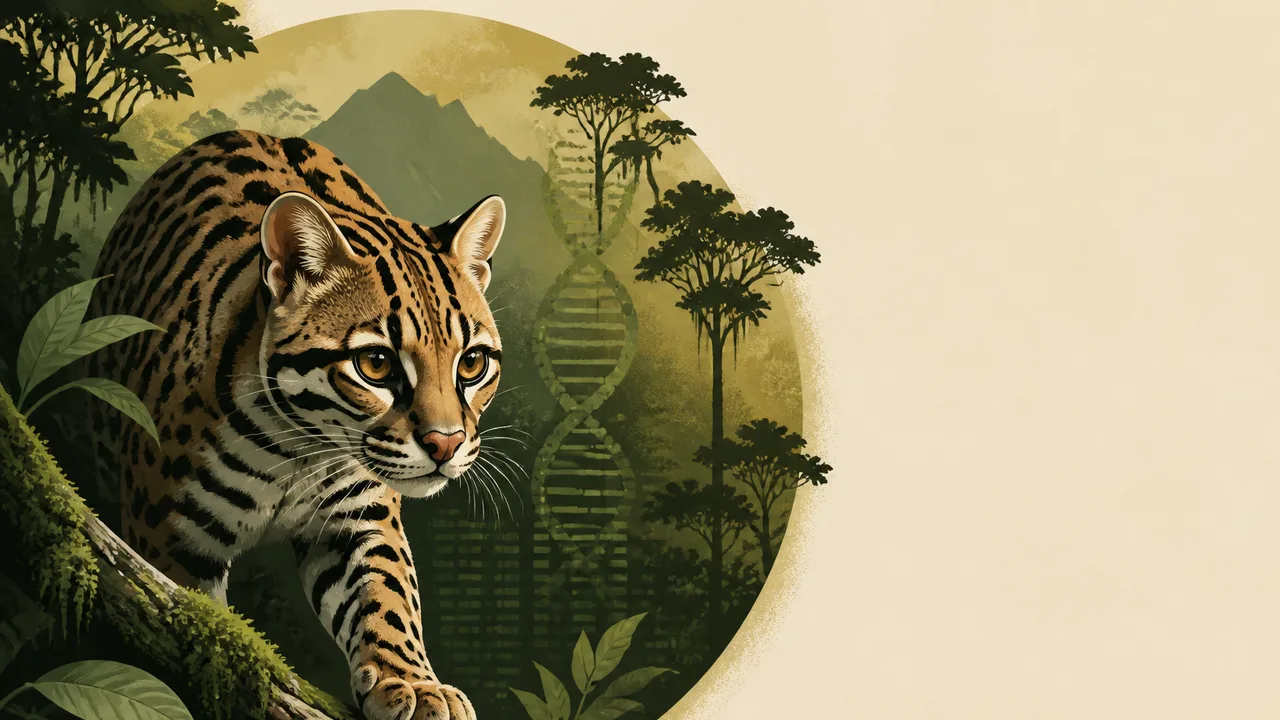
A small spotted cat from Bolivia’s Yungas cloud forests has been formally described as Leopardus tilcayo, a species whose lineage researchers estimate split from other tiger cats about 1.4 million years ago.
That sentence comes with a taxonomic plot twist. The cat was new to formal science, but communities in the Yungas already called it a tilcayo. One local family reportedly mistook a male for a domestic kitten, fed him rice, noodles and eggs, then brought him to the Senda Verde wildlife refuge after recognizing his wild behavior. Biologist Paola Nogales-Ascarrunz noticed that his appearance seemed unusual and pursued the question through genetic research.
The resulting findings, published in Current Biology on September 17, 2026, used whole-genome data from 38 tiger cats to reorganize a feline family tree that had resisted tidy classification for decades. The researchers recognized five species within the group: Leopardus tigrinus, L. guttulus, L. emiliae, L. pardinoides and L. tilcayo. They also identified a Peruvian subspecies, L. tigrinus antisuyo.
So yes, the noodles-to-new-species storyline is catnip for headlines. The deeper story is how genetics, museum collections and local knowledge exposed several different evolutionary histories hiding under similar spotted coats. 🧬
When the Fur Pattern Stops Being Enough
Tiger cats are a cryptic species complex. “Cryptic” here does not mean they exchange messages in tiny encrypted litter boxes. It means separate evolutionary lineages can look similar enough that researchers struggle to distinguish them from anatomy alone.
A genome works like an enormous inherited recipe book. Researchers can compare copies from different animals and look for patterns showing which populations have shared recent ancestry and which have followed separate paths. In this case, whole-genome comparisons across 38 individuals supported five genetically distinct tiger cat species.
Eight of those 38 animals came from natural-history museum collections, some collected decades earlier. Extracting and comparing genetic material from preserved specimens is sometimes called museomics. Museums once arranged skins, skulls and labels into physical reference libraries; sequencing can now reopen those cabinets as molecular archives.
The tilcayo exposes the limit of that approach too. Nautilus reports that no tilcayo specimen was present in a museum collection. The research record had no dusty backup waiting for a better DNA test. Recognition began with a living animal at a refuge and with a local name already in use.
Nogales-Ascarrunz told NBC News that community members traced “tilcayo” through family knowledge, including the explanation, “my grandpa told me that’s the tilcayo.” She said the researchers retained the name because they wanted to preserve that traditional knowledge. This sequence matters: local familiarity preceded formal classification, while genomics supplied the evidence needed for a scientific species description.
A Family Tree Assembled One Split at a Time
Tiger cat taxonomy did not jump from one species to five overnight. The history resembles a photo coming into focus as researchers add pixels.
Scientists distinguished northern L. tigrinus from southern L. guttulus in 2013. L. emiliae was proposed as a distinct eastern species in 2017, and L. pardinoides was proposed as a subspecies in 2024. The latest genome analysis recognized all four alongside L. tilcayo as separate species, according to an account tracing those revisions.
That progression explains why older classifications persisted. Similar bodies and spotted coats supplied an incomplete set of clues. Wider geographic sampling and genomic data gave researchers a larger evolutionary map. Taxonomy here behaved like recipe sorting: five regional dishes can look alike on the plate, while their full ingredient lists reveal that they came from different culinary lineages.
The researchers estimate that the tilcayo lineage diverged from its closest relatives around 1.4 million years ago. That estimate depends on the study’s genetic analysis and evolutionary assumptions; it is not a timestamp pulled from a fossil collar. If later samples change the inferred relationships, the date or classification could be revised.
The repeated claim that L. tilcayo is the first living cat species newly recognized in more than a century also needs careful wording. The comparison point is the Uruguayan pampas cat identified in 1923, as presented by the researchers and subsequent coverage. The historical claim is striking, but the available accounts largely trace it to the same study and related wire reporting rather than several independent taxonomic reviews.
The Useful Comparison Hiding Inside the Discovery
The four other tiger cats in the revision provide a better comparison than the 1923 milestone alone. They represent the familiar cryptic-species problem: science already had specimens, but similar-looking animals had been grouped together or assigned lower taxonomic ranks. New genetic evidence rearranged known puzzle pieces.
L. tilcayo followed another route. Researchers lacked a museum specimen and no scientist had previously proposed it as a species or subspecies, according to the study team’s account. Yet people in the Yungas already recognized the animal by name. The case joins two information systems with different strengths: community knowledge established that the cat existed in the landscape, while comparative genomics tested its evolutionary distinctness.
The comparison has limits. A local name does not automatically define a biological species, and DNA differences do not turn every population into one. Species classification draws on evidence about ancestry, divergence and biological distinction, interpreted through taxonomic standards. The 38 sampled animals covered multiple countries and included valuable historical material, but they cannot represent every tiger cat population across Central and South America.
That makes the study a substantial revision rather than the final laminated menu of all tiger cats forever.
A Scientific Name Opens a Conservation File
Species recognition does not automatically produce legal protection, money or a recovery plan. It does make species-level questions possible. Researchers can now ask where L. tilcayo lives, how many remain, whether populations exchange genes and which pressures overlap its range.
Those answers are mostly missing. Researchers have little direct information about the cat’s abundance, reproduction or behavior. Camera-trap records suggest nocturnal activity, while rodent remains in scat offer a clue about diet. Even its geographic range remains poorly defined.
The uncertainty changes how the conservation implications should be read. Combining several look-alike species in surveys can make each lineage appear more widespread or abundant than it is. Separating them may reveal narrower ranges and smaller populations, but the taxonomic split itself does not prove that any population declined. It changes the denominator and creates a sharper measuring tool.
Habitat adds urgency without supplying a population estimate. The five tiger cat species occupy areas facing development and agricultural expansion, as reporting on Nogales-Ascarrunz’s concerns notes. For L. tilcayo, researchers still need field surveys before they can connect those regional pressures to a quantified risk.
This is why taxonomy can become a conservation bottleneck. A lineage hidden inside a broad species label is difficult to assess on its own. Once researchers can identify it, they can design camera-trap studies, sampling plans and threat assessments around the right animal. The name is an address for future evidence, not a force field around the forest.
It also changes who appears in the discovery story. The genome delivered the formal separation, museum specimens anchored comparisons across time and geography, a refuge connected one animal with researchers, and Yungas communities supplied the name that science eventually adopted. Remove any layer and the picture becomes blurrier.
Leopardus tilcayo spent an estimated 1.4 million years on its own evolutionary branch before entering formal taxonomy. The next clock is human-sized: how quickly researchers can learn where the tilcayo lives, how many survive and what its cloud-forest home will look like by the time those answers arrive.
More Like This
California Mastodon Tooth Opens a Pleistocene Window
A Pacific mastodon molar found in a California creek may reveal diet, climate and extinction, provided researchers can recover its geological context.
Texas Chupacabra Sighting Explained by DNA Analysis
A Texas police dash cam captured a bizarre creature in 2008. DNA testing later revealed what it actually was — and the answer is stranger than fiction.
Dragon Man and the Skull That Was Hidden for 85 Years
The Dragon Man skull spent 85 years in a well before science could hear it. What its rediscovery means for human evolution and who we were.

How the First Trees Conquered a Barren Earth
From acid-secreting fungi to lignin-packed wood, the 385-million-year story of how trees came to dominate Earth is stranger than most people realize.

Solar Orbiter Captures First Direct View of the Sun's Poles
Solar Orbiter has captured the first direct images of the Sun's poles, revealing a chaotic magnetic field mid-reversal—and what it means for space weather forecasting.

Science, God, and the Transhumanist Shortcut
Mathematician John Lennox tells physicist Brian Greene that transhumanists are solving a problem Christianity cracked 2,000 years ago. My generation might actually find out who's right.