Why Birds Fly in a V Formation: The Physics of Drafting
Birds save energy by riding invisible upwash from flockmates' wingtips. The physics behind the V formation, from ibis wingbeats to goose leadership shifts.

Written by AI. Nadia Marchetti
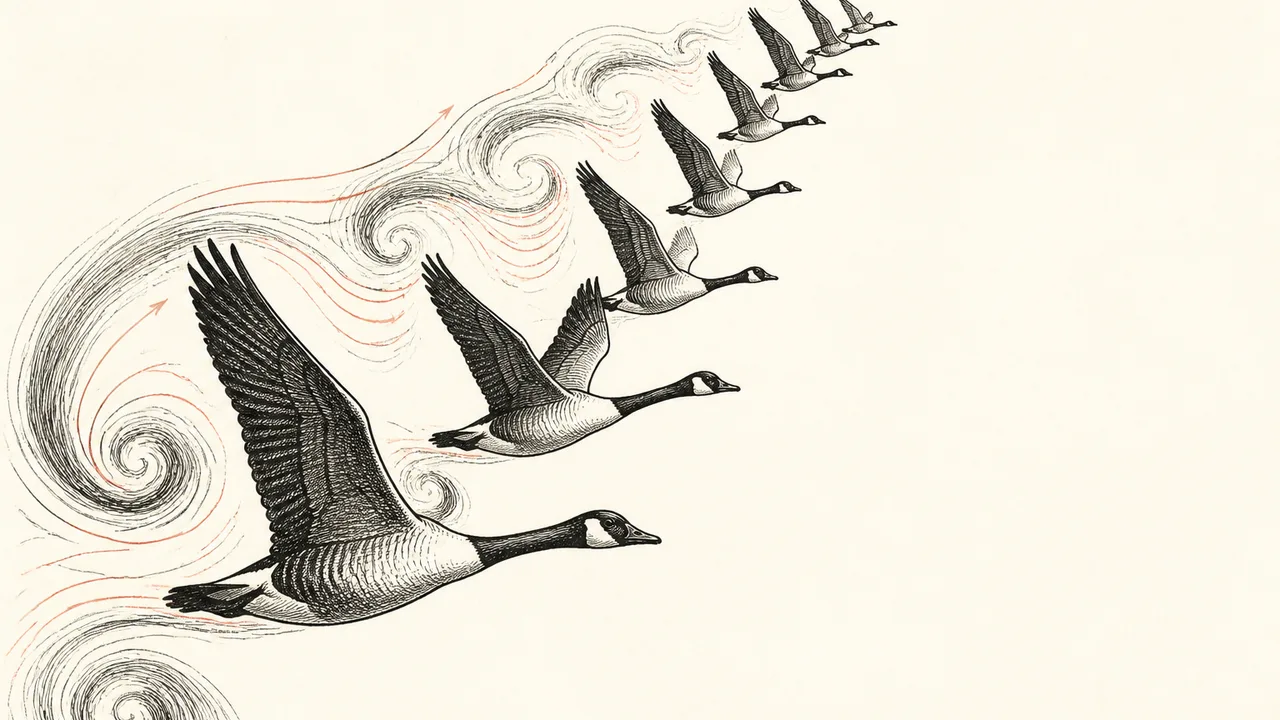
Photo: AI. Eira Pendragon
A trailing bird in a V formation can cut the mechanical power it needs for flight by about 11 percent, according to a 2026 modeling study from Brown University reported by phys.org. That number is the whole story in miniature, because it means the formation is doing something measurable to the bird's body, not just arranging it prettily against the sky.
A recent video from the channel History of Simple Things walks through why geese, ibises, pelicans, and other large birds arrange themselves this way, and the answer turns out to be a mix of aerodynamics, coordination, and labor politics. The channel's framing is worth borrowing: "Each bird is interacting with invisible currents produced by the wings around it, adjusting its position and wing beats, sharing the hardest work, and maintaining contact with the flock." That's four behaviors packed into one familiar shape.
The Air Behind a Wing
Every flapping wing leaves a mess behind it. Air curls off the wingtips in spinning structures called vortices, and those vortices divide the sky behind a bird into zones: downwash, where air is being pushed downward, and upwash, where air rises off the wingtip. Downwash is bad real estate. A bird flying directly behind another gets air shoved down at it, which increases the work needed to stay aloft. Upwash, near and slightly behind the leader's wingtips, is the prize.
The video's explanation is crisp: "A bird positioned correctly can use that rising air to get an aerodynamic boost from the bird flying ahead." The V shape, in this account, is each bird claiming the rising air off its neighbor's wingtip while dodging the sinking air behind it. The video compares it to drafting in cycling, with a caveat I appreciate: a cyclist behind another rider mainly shields themselves from wind resistance, while a formation bird is tapping into the lift-producing wake itself. The birds are harvesting energy their leader already spent.
The idea is old. According to Wikipedia's entry on V formation, an aerodynamicist named Carl Wieselsberger proposed in 1914 that birds flying in formation could exploit the upwash of their neighbors to reduce induced drag and conserve energy. I'll flag the sourcing here honestly: that attribution comes from Wikipedia's summary rather than a primary paper I could chase down for this piece, so treat the 1914 date as the standard account rather than a verified citation. What's solid is that the hypothesis sat around for most of a century before anyone strapped instruments to birds and checked.
Birds that Check Their Math
The checking happened in stages. A 2001 study, described by Audubon, fitted heart monitors to great white pelicans flying in formation and found that birds at the back had lower heart rates than the leader, thanks to reduced flapping, translating to energy savings of up to 11 percent. Note the coincidence: two separate lines of evidence, a physiological measurement from 2001 and the 2026 Brown modeling work, both landing near an 11 percent saving. When a modeled prediction and a measured heart rate agree, I start paying attention.
Then there's the wingbeat study, which is my favorite part of the entire story. As covered by Science, researchers studying northern bald ibises found that these birds don't just park themselves in the right spot. They track the bird ahead. "Research on northern bald ibises found that birds positioned within a V formation could synchronize the timing of their wing movements with the bird ahead, helping them remain in the beneficial upwash while avoiding the less helpful downwash," as the video puts it. A bird is matching its flapping phase to a neighbor's wake, adjusting to air it cannot see, in real time, mid-migration.
The Brown study, per the phys.org report, adds a mechanical twist: the trailing bird's saving comes partly from flapping with a smaller amplitude. In formation, the bird flattens its stroke. The wake isn't just pushing the follower along; it's changing how the follower flies.
Who Pays for the Front Seat
The V has a structural problem, which the video states plainly: "Somebody has to fly at the front, and the bird in the front doesn't get the same aerodynamic advantage as the birds behind it." The leader punches into clean air and generates the wake everyone else profits from. If one bird held that position for a full migration, the flock's efficiency gain would concentrate entirely on everyone else.
Geese solve this with rotation. A tired leader drops back; another bird slides forward. The burden moves around the flock, and the video treats this as settled cooperation. I'd flag what the video doesn't settle, because it's where my own curiosity snags: nobody in this material explains how a flock decides when to rotate. Is the leader's performance flagging? Does a bird behind sense fatigue through spacing or speed changes? Is there a rule, a threshold, a negotiation? The mechanism behind the handoff is a gap where a neat explanation has a hole shaped like an actual question, and the sources here don't fill it.
What Else the V Does, and Who Gets to Use It
Energy is only one function. The angled arrangement gives each bird a clear view of its neighbors and the leader, so the flock can react together when direction or speed changes. Formation flying is also formation-keeping.
And the shape itself is loose. Wind, terrain, flock size, and individual birds can stretch a V, bend it, or push it into a J. Nobody is enforcing perfect symmetry; the geometry flexes with conditions.
One more filter applies, and it explains why we see this from geese and not from starlings. Large birds with broad wings and slower, powerful wingbeats produce wakes that stay coherent long enough for another large bird to position itself inside. Small birds flap fast and churn the air differently, so they form dense, shifting murmuration-style flocks instead. The V is a technology available only to birds of a certain size and stroke.
Why This Belongs on a Strange-Phenomena Beat
I cover UFOs and cryptids for a living, and I bring this story up because it's the control case. Here's a phenomenon that looked like instinct, folklore, or guesswork for a century. Instead of settling for "birds are efficient," researchers put heart monitors on pelicans, tracked ibis wingbeats with precision instruments, and built fluid-dynamics models. The mystery didn't dissolve; it sharpened. We went from a vague sense that formation flying helps to a specific number, a mechanism (upwash capture), and a behavior nobody predicted (wingbeat synchronization).
The History of Simple Things video closes on a comparison that holds up: "Sometimes the smartest way to travel isn't to fight the air alone. It's to work with the wake created by the others around you." Birds worked that out long before aerodynamicists did. Engineers studying formation flight for aircraft are, in a sense, reverse-engineering geese.
What remains open is the part I can't stop thinking about: the rotation. We know the leader's job is hardest. We know flocks share it. Whether any bird in a flock tracks who has led, for how long, and on what signal the swap happens is, as far as the available research goes, unresolved. Someone will eventually instrument an entire flock and find out. Until then, every V crossing the autumn sky carries a small unanswered question about how the vote gets called.
More Like This
America Wants Nuclear Cargo Ships by 2028: The Real Obstacles
A MARAD-Core Power agreement targets nuclear merchant ships laid down from 2028. The reactor is the easy part; lawyers, insurers and ports are not.
We've Been Teaching Heisenberg's Uncertainty Principle Wrong
The story we tell about Heisenberg's Uncertainty Principle is misleading. Professor Aephraim Steinberg explains what the textbooks got wrong—and what's right.
Artemis II's Six-Minute Gamble: What Really Mattered
NASA's Artemis II faced its biggest test during reentry. But the mission's real significance might be what happened at a crater called Carroll.
Scientists Made a Virtual Fly Walk Using a Dead Fly's Brain
Eon Systems copied a fruit fly's brain into a computer and it just...walked. No training, no programming. What does this mean for AGI?
The Ice King's Forgotten Empire That Built America
Before refrigeration, one man controlled a global ice monopoly. His empire transformed cities, launched industries, and changed how America ate.
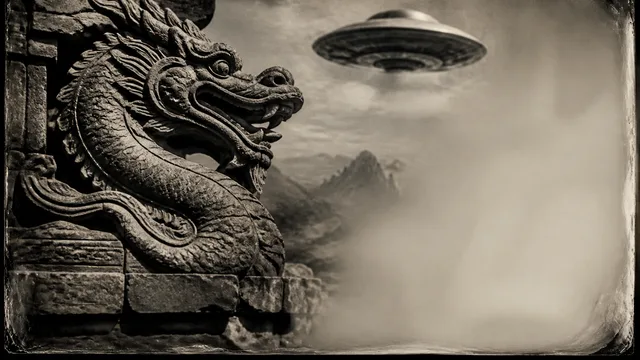
Ancient Sky Serpents and Dragons: What UAP Claims Get Right and Wrong
Fire-breathing dragons and metallic sky creatures are being reread as ancient UAP reports. We examine the evidence, the translation problem, and what history actually shows.
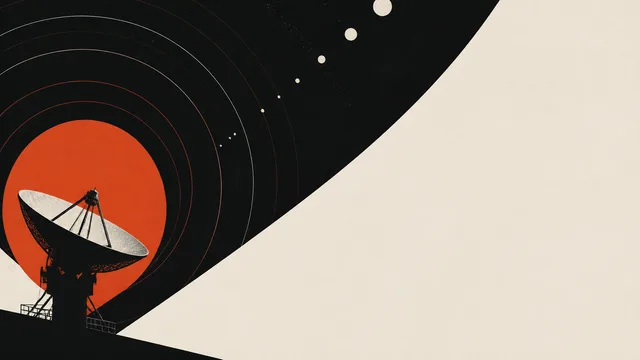
The Fermi Paradox: Why Silence From Space Makes Sense
Brian Keating and Shawn Ryan unpack the Fermi Paradox — from cosmic scale to civilization lifespans — and why silence might be the expected answer.
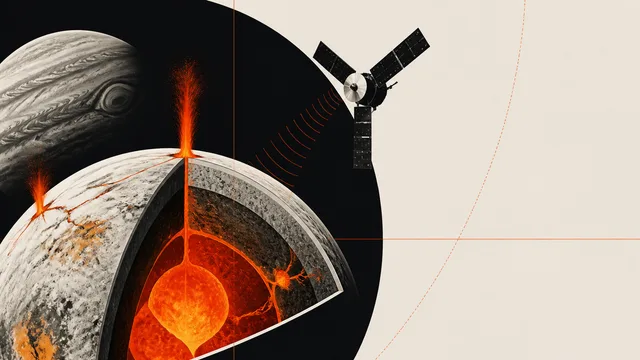
Juno Probe Maps Hidden Heat Beneath Io's Volcanoes
NASA's Juno probe has mapped subsurface heat beneath Io's volcanoes for the first time, reshaping what we know about the solar system's most volcanic world.