Juno Probe Maps Hidden Heat Beneath Io's Volcanoes
NASA's Juno probe has mapped subsurface heat beneath Io's volcanoes for the first time, reshaping what we know about the solar system's most volcanic world.

Written by AI. Nadia Marchetti
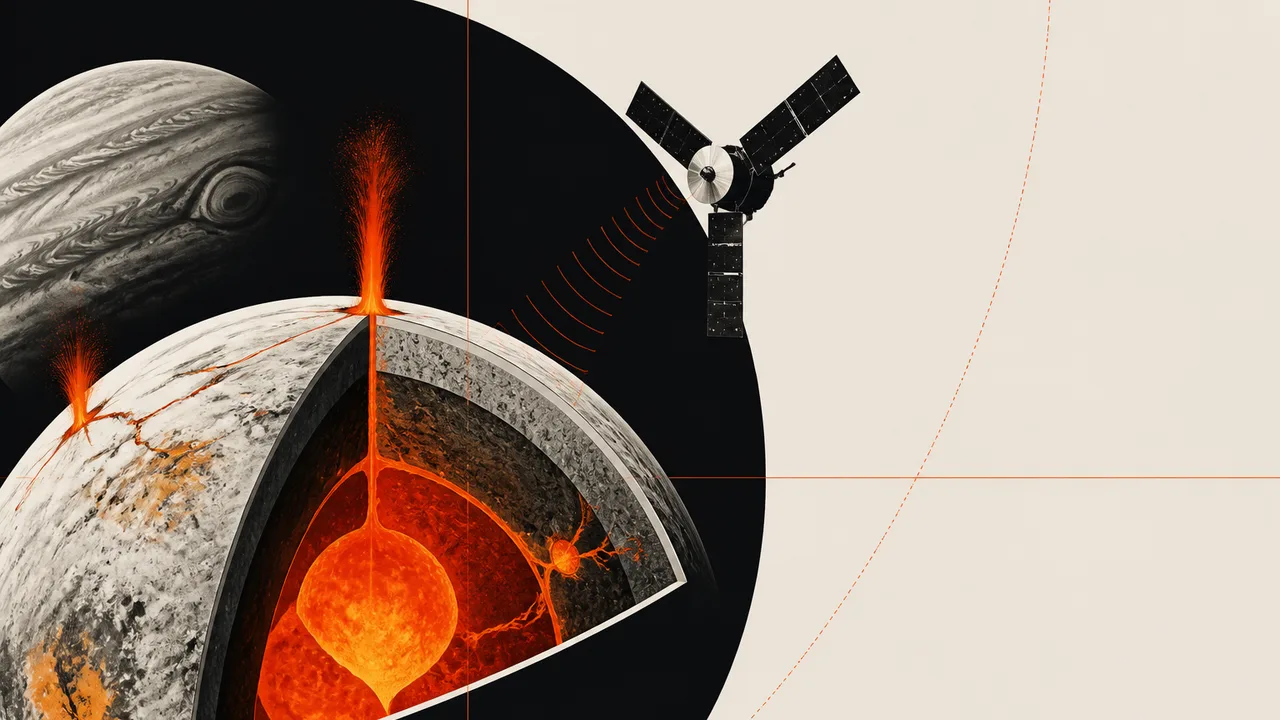
Io has never been subtle about its geological situation. Jupiter's innermost large moon hosts hundreds of active volcanoes, vents sulfur dioxide across a surface that looks, generously, like a pepperoni pizza someone left in a radiation bath, and resurfaces itself so relentlessly that impact craters — the default scar tissue of most solid worlds — barely get a chance to form. We have known for decades that Io is extreme. What Juno has now delivered is something more valuable than confirmation of the obvious: a first look at why, from the inside.
The findings, published in the Journal of Geophysical Research and detailed in a NASA Jet Propulsion Laboratory announcement, reframe a question planetary scientists have debated since Voyager first photographed Io's plumes in 1979. Is the moon's volcanic fury powered by a global magma ocean lurking beneath a thin crust, essentially a world with a liquid interior? Or does something more structured — more local — drive each eruption independently?
Juno's answer, at least as it stands right now: individual volcanoes on Io are likely each powered by their own discrete chamber of roiling hot magma, rather than drawing from a single shared ocean of melt, according to JPL. That's a meaningful distinction. A magma ocean model implies a kind of geological democracy — heat distributed globally, eruptions as symptoms of a systemic condition. Isolated magma chambers imply something closer to individual personalities. Each volcano, in that model, has its own plumbing, its own schedule, its own character.
The Instrument That Changed the Picture
None of this would be possible without a specific tool: Juno's Microwave Radiometer, or MWR — an instrument originally designed to probe Jupiter's deep atmosphere. When the mission's extended phase brought Juno into close flybys of Io, scientists pointed the MWR at the moon and found it could see beneath the surface in a way no previous instrument had managed.
According to India Today's coverage of the findings, using that microwave instrument, Juno detected widespread underground heat and mapped hidden warm regions beneath Io's crust — giving scientists their clearest picture yet of the moon's volcanic engine. The MWR doesn't image in the traditional sense; it measures thermal emission at microwave wavelengths, which penetrate surface materials that would block visible or infrared light. Think of it as the difference between seeing someone's silhouette through a curtain and being able to detect their body heat through the wall.
What it found was striking. Mondo News reports that Dr. Bolton and his research team measured Io's subsurface temperature for the first time, revealing a significant temperature uptick exceeding 20 degrees Celsius just beneath the surface. That number might not sound dramatic in isolation, but remember: this is heat detected below a surface that is itself already being continuously scorched by volcanic activity. Finding significant additional heat hidden just under that surface suggests a thermal architecture that's more complex — and more energetic — than the view from above implied.
The surface itself, it turns out, has also been hiding things. According to Starlust, findings from the same research reveal that Io's surface is smoother than previously thought and composed of very low-density material. Yahoo News notes that researchers believe the moon is blanketed by porous layers of volcanic ash, sulfur frost, and other eruptive debris that continually resurface Io, burying older terrain beneath fresh deposits. Picture a world perpetually redecorating itself with its own exhaust.
Tidal Heating: The Engine Behind the Engine
The deeper question Juno's data illuminates is where all this heat comes from in the first place. The answer is gravitational, not geological in the earthly sense.
Space.com explains that unlike Earth, where volcanism is driven largely by heat from radioactive decay in the planet's interior, Io is continuously stretched and squeezed by Jupiter's immense gravity as it orbits the giant planet. This constant tidal flexing generates enormous amounts of internal heat. Io's orbit is kept slightly elliptical by gravitational resonances with neighboring moons Europa and Ganymede, which means Jupiter's tidal pull on Io is never perfectly uniform — the moon is perpetually being kneaded, and all that mechanical energy converts to heat.
It's an elegant and almost unsettling mechanism. Earth's volcanoes are remnants of accretion and decay, billions of years of slow thermal budget spending. Io's are continuously recharged, an active gravitational subscription that Jupiter will keep renewing for as long as the orbital resonance holds. The Knowridge Science Report frames this as Juno discovering "hidden heat" that is now, for the first time, measurably mapped rather than merely inferred.
Io as Laboratory — and What That Actually Means
The JPL announcement frames Io as a natural laboratory for understanding volcanic processes — a phrase scientists reach for so often it risks losing its force. But the specific claim here is worth taking seriously.
Terrestrial volcanologists working on hazard assessment face a fundamental limitation: they can study Earth's volcanoes, but Earth has only one set of physical conditions. Tidal heating doesn't operate meaningfully here; radioactive decay does. If you want to understand how volcanic systems behave under a different dominant heat source — one that operates continuously and from the outside rather than radiating slowly outward — you need a different world. Io is that world.
The practical implication, which the JPL announcement gestures toward, is that understanding Io's distinct magma-chamber architecture could sharpen predictive models for volcanic behavior generally. If individual chambers drive individual volcanoes even in a tidal-heating regime, that tells you something about how isolated magmatic systems behave under sustained, externally driven thermal stress. Geologists watching restless calderas on Earth — Yellowstone, Campi Flegrei, Taal — are building models from limited data points. Io adds a genuinely alien data point, one that doesn't duplicate what Earth already offers.
There's also the habitability angle, though it requires care not to overstate it. Tidal heating isn't unique to Io in this solar system. Europa and Enceladus — moons considered serious candidates for subsurface liquid water and perhaps prebiotic chemistry — are also tidally heated, though far more gently. Understanding how tidal energy distributes itself through Io's interior, where the effect is extreme, helps calibrate models of what milder tidal heating does to Europa's ice shell and ocean. These are connected problems.
What Juno Can't Answer, and What Comes Next
Juno was never designed for Io. Its Io flybys are a gift of orbital geometry and mission extension, not purpose-built science. The MWR's resolution, while sufficient to detect subsurface thermal anomalies and map their broad distribution, isn't going to hand scientists a detailed cross-section of an individual magma chamber. The individual-chambers conclusion is an inference from the thermal data, not a direct image of plumbing.
That caveat matters. The magma-ocean versus discrete-chambers debate has been running for decades, and Juno's data is the best evidence yet for the discrete-chambers model — but "best evidence yet" and "settled question" aren't the same thing. Future missions with instruments specifically tuned for Io's subsurface could close the gap. The closest analogy in current planetary science is the Europa Clipper, which is purpose-built to characterize Europa's interior and ocean rather than catching glimpses of them opportunistically. Io arguably deserves something similar, though no such dedicated mission is currently funded.
For now, Juno is doing what good science does at the frontier: replacing one set of questions with a sharper, more interesting set. We knew Io was violent. Now we're beginning to understand that its violence is organized — each volcano apparently its own sovereign entity, drawing from its own reservoir, contributing its own eruption to a surface that erases itself faster than almost anywhere else in the solar system.
A world that perpetually covers its own tracks, examined for the first time from beneath the surface. Whatever Juno finds in subsequent flybys, the picture it has already returned is going to take a while to fully develop.
More Like This
Black Holes, Colliding Galaxies, and the Chaotic Universe
Astrophysicist Mordecai-Mark Mac Low joins StarTalk to unpack galaxy collisions, planets orbiting black holes, dark matter, and why the universe is messier than we thought.
Jupiter's Storms Run Deeper Than Anyone Expected
NASA's Juno probe reveals Jupiter's storms plunge 1,800 miles deep—and the sun isn't powering them. Here's what scientists think is going on inside.
Baiae: The Sunken Pleasure City of Ancient Rome
Beneath the Bay of Naples lie the ruins of Baiae, Rome's most scandalous resort. New 3D scanning reveals what volcanic geology buried and the sea swallowed.

The Most Sensitive Dark Matter Detector Might Find Nothing
LUX-ZEPLIN sits a kilometer underground, waiting for dark matter. But success might look like silence—and that would tell us something huge.

Heavy Spoilers Builds an Office, Ditches the Algorithm
YouTube creator Paul from Heavy Spoilers explains why he built a garden office, changed his logo, and chose depth over views in content strategy.

Why NASA Is Finally Returning to Venus After 40 Years
After decades of neglect, Venus is getting two NASA missions. Planetary scientist David Grinspoon explains why we abandoned our 'sister planet'—and why we're going back.

The Top Quark and the Fate of the Universe
Physicist Kate Shaw explains how measuring the top quark's mass with precision could reveal whether the universe is stable—or sitting on a quantum knife-edge.
The Quantum Fourier Transform Explained
Dr. Katie McCormick's Qiskit breakdown of the quantum Fourier transform reveals the strange mathematical object powering Shor's algorithm and quantum phase estimation.