How Birds Navigate Thousands of Miles by Instinct
Birds cross oceans without GPS using sun, stars, magnetic fields, smell, and memory. Here's what the science actually confirms—and where it's still open.

Written by AI. Amelia Nwofor
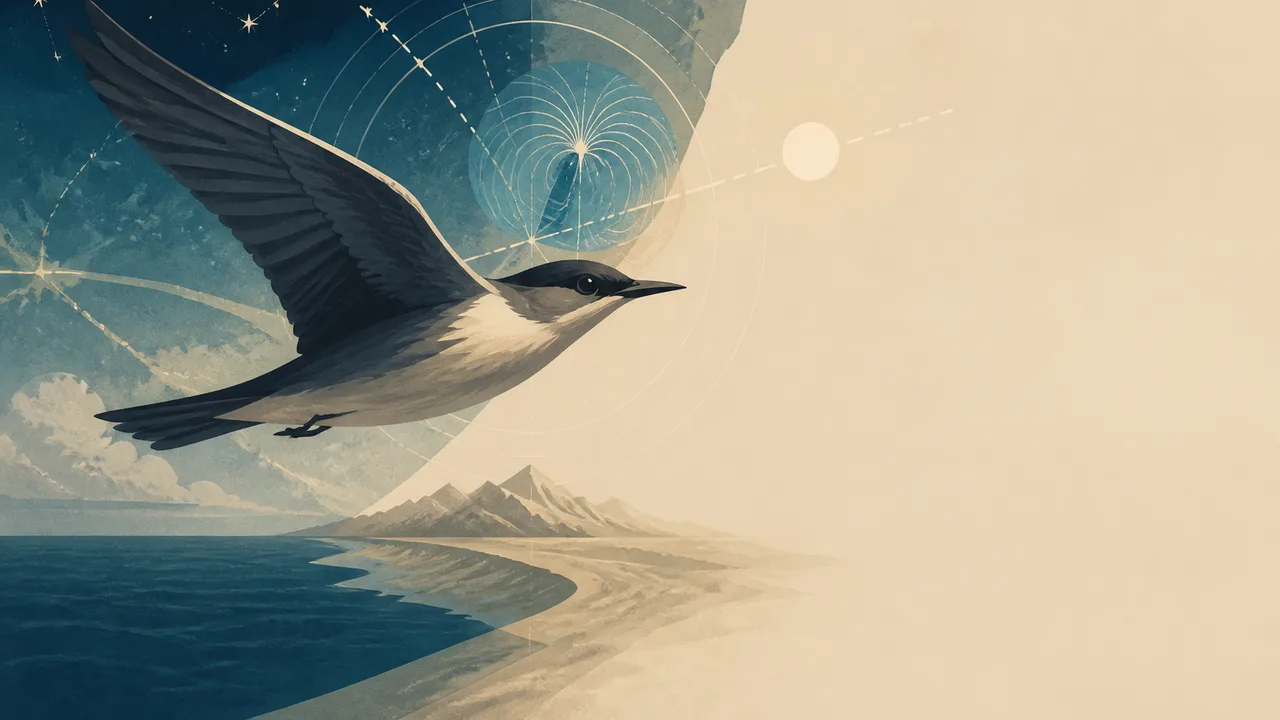
Photo: AI. Mika Sørensen
A young bar-tailed godwit lifts off from Alaska and flies to New Zealand. More than 11,000 kilometers. No landmarks. No older bird running point. Nothing below but the Pacific, nothing above but sky. It arrives.
If you want a single image that captures what makes bird navigation so hard to explain, that's the one. Not because it's the most dramatic migration—plenty of species rack up comparable distances—but because it strips the problem down to its essentials. The godwit can't be following coastlines. It can't be reading terrain. Whatever is guiding it is operating on something else entirely.
The Ordinary Mystery's recent video on bird navigation walks through the current scientific picture, and it's a useful overview: sun compass, star compass, magnetic sensing, landmarks, olfaction, memory. The evidence for most of these is solid. But the video, sensibly, is careful with its language—"birds may be able to," "scientists believe"—and that tentativeness is doing real work. The navigation toolkit is not uniformly well understood. Some pieces of it are established. Others are hypotheses that are plausible, well-supported in some species, and genuinely unresolved in others.
The parts we're confident about
Start with what's been demonstrated cleanly.
The sun compass is the best-characterized system. In the 1950s, German ornithologist Gustav Kramer ran a series of experiments that remain foundational: he shifted the circadian rhythms of birds by manipulating their light exposure, then released them. The birds consulted the sun as usual—and flew in the wrong direction. The internal clock was off, so the solar reading was off, so the heading was off. The logic is crisp: birds aren't tracking the sun's position in isolation, they're tracking it relative to the time of day. Throw off the clock, throw off the compass.
The star compass is similarly well-supported. Birds don't navigate by memorizing constellations the way a sailor might. They track rotational patterns—the point around which the night sky appears to turn. In planetarium experiments, researchers demonstrated that when you change the apparent rotation point, the birds reorient accordingly. What's notable is when this calibration happens: birds appear to learn the sky's rotation pattern early in life, before their first migration. The sky teaches them before they ever need to use what they've learned.
Both systems share an obvious limitation: they require a visible sky. Overcast conditions, open-ocean crossings, extended low-visibility flight—the sun and stars drop out. Something else has to carry the load.
The proposed mechanism that raises real questions
There is strong behavioral evidence that many bird species can sense Earth's magnetic field. The field's inclination angle—how steeply it dips relative to the surface—changes with latitude, growing more vertical near the poles and flattening toward the equator. Birds appear to use this gradient not just as a directional cue (which way is poleward?) but possibly as a positional one (where along the latitude gradient am I?). That would give them something closer to a map than a compass, which is a significant claim.
The behavioral evidence for magnetic sensitivity is reasonably well-established across multiple species. The proposed mechanism, however, is where the uncertainty concentrates—and where the science gets genuinely interesting to scrutinize. The leading hypothesis involves a protein called cryptochrome, found in the retina, which reacts to blue light. The hypothesis is that Earth's magnetic field influences the quantum spin states of electrons during the chemical reactions this protein undergoes—and that those spin-state differences translate into something the bird's visual system can detect. Not glowing arrows, but perhaps subtle gradients of light and shadow overlaid on normal vision.
That's quantum chemistry serving as a navigation sensor, embedded in a bird's eye. It's not that the idea is implausible—the physics is real, cryptochrome does react to magnetic fields in laboratory conditions, and the hypothesis has been taken seriously by serious researchers. But demonstrating that this mechanism is what birds actually use in flight, as a reliable navigational signal, is a different and harder problem. The behavioral evidence and the molecular hypothesis have been developed somewhat in parallel, and tying them together conclusively remains active work.
The bar-tailed godwit's transoceanic crossing is the sharpest argument for magnetic sensing mattering enormously. When there's nothing to follow and no sky to read, something is still working. That something is most plausibly magnetic. But "most plausibly" is where the science currently lives.
The layers that accumulate with experience
Closer to the destination, the toolkit shifts. Landmarks become useful—rivers, coastlines, mountain ridges. Homing pigeon research has shown that birds don't necessarily fly straight lines; they follow recognizable ground features, which, from altitude, function like navigational infrastructure. A river running hundreds of miles reads differently from a few hundred feet up than it does from a car window. The scale of the cue changes what it's useful for.
Olfaction is the layer that still surprises people. The ocean doesn't smell uniform—different currents, different productivity zones, different chemical signatures. Experiments in which seabirds had their olfactory capacity temporarily reduced showed significant drops in navigational accuracy, suggesting that for at least some species, a scent map is not supplementary. It's load-bearing.
And then there's memory, which the video correctly flags as underappreciated. As The Ordinary Mystery notes: "A young bird making its first migration may rely heavily on information that is already built into its behavior. It knows roughly which direction to travel and for how long. But older birds have something young birds do not. Experience." That distinction matters for how we think about what we're actually studying when we study bird navigation. A naive first-year bird and a veteran of a dozen migrations are running different software, in some sense. Studies that collapse those populations together are measuring something, but it's not a single clean thing.
The variation nobody talks about enough
Here's what the tidy multi-system summary tends to obscure: individual birds vary substantially in navigational accuracy, and we don't have a complete account of why. Within the same species, some individuals track more precisely. Some populations show stronger magnetic sensitivity. Some rely more heavily on olfaction. The navigation systems don't fire in a fixed hierarchy—they interact, they compensate for each other, and the weighting of each probably shifts based on conditions, experience, and individual variation that we're only beginning to characterize.
That's not a failure of the research. It's an accurate reflection of how biological systems work: they're redundant, flexible, and messier than the elegant summary suggests. A migratory bird isn't running a clean algorithm. It's running something that evolved to be robust to failure—if the sky is cloudy, lean on the magnetic field; if the magnetic field is locally perturbed, fall back on landmarks; if you've been this way before, trust what you remember. The robustness is the point.
What we know, collectively, is that birds are navigating using multiple overlapping systems, that the evidence for most of those systems is strong at the behavioral level, and that the mechanistic picture—how, precisely, the magnetic field becomes a navigational signal—remains one of the genuinely open questions in sensory biology. The bar-tailed godwit lands in New Zealand on schedule. We can describe the toolkit it likely used to get there. We still can't fully describe the physics of seeing the Earth's field in real time. Those are different levels of understanding, and both are true.
The fact that a bird can do something our instruments still only partially explain is worth sitting with—not as wonder-bait, but as an honest description of where the research stands.
More Like This

Bees and Polarized Light: Nature's Navigation Unveiled
Discover how bees use polarized light to navigate and inspire new technology.
The Deeper Geometry Behind the Pythagorean Theorem
Explore why the Pythagorean Theorem appears in unexpected places, from geometry to relativity.

Ancient Maps That Modern Archaeology Proved Accurate
From a Bronze Age rock carving to Ptolemy's coordinates, ten ancient maps have been verified by modern archaeology. What does that tell us about lost knowledge?

MindTopo Tests AI Spatial Reasoning With Paths and Knots
MindTopo is a new benchmark probing how well AI vision-language models handle topology—paths, fences, knots. The results reveal real gaps that matter for robotics and navigation.

Why Light Beams Seem to End: Physics Explained
Discover why searchlight beams appear to stop and how physics and atmospheric conditions contribute to this phenomenon.

Donald Hoffman: Evolution Hid Reality From Us
Cognitive scientist Donald Hoffman argues on StarTalk that evolution gave us a VR headset, not a window—and the math behind Darwin backs him up.

Gravity's Strangest Effects, From Time to Cosmic Voids
From gravitational time dilation to the Dipole Repeller and LIGO's detections, here's what gravity actually does—and what it still can't explain.
JWST's Little Red Dots May Be Cocooned Black Holes
New JWST spectral data on a single "little red dot" galaxy offers the strongest case yet that they're supermassive black holes wrapped in dense gas cocoons.