MindTopo Tests AI Spatial Reasoning With Paths and Knots
MindTopo is a new benchmark probing how well AI vision-language models handle topology—paths, fences, knots. The results reveal real gaps that matter for robotics and navigation.

Written by AI. Marcus Chen-Ramirez
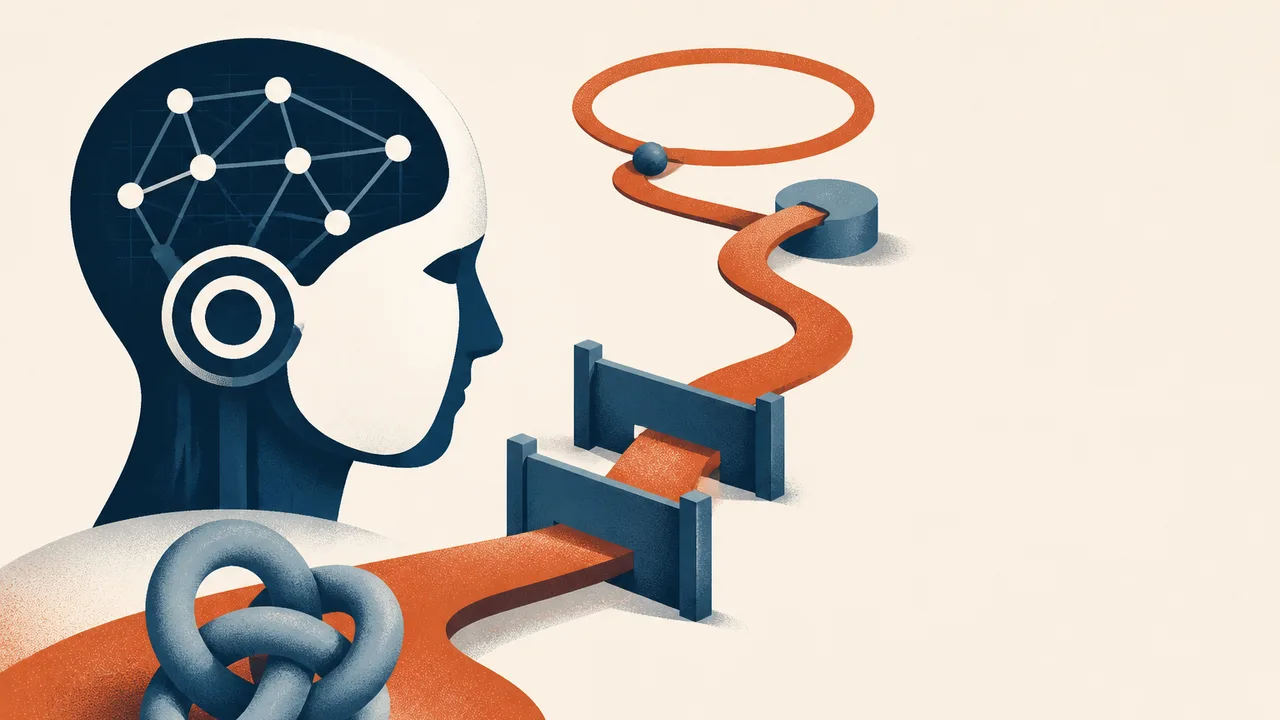
Here is a test. Look at this picture of a tangled rope. Does the loop form a knot, or does it just look like one? Can you trace a path from point A to point B without crossing a fence? Is that cable threaded through the ring, or merely draped over it?
Humans process these questions almost without noticing—we've been navigating physical space since before we had words for it. AI systems, it turns out, find them surprisingly hard. Not always. Not uniformly. But hard in ways that matter enormously if you want to deploy these models in robots, autonomous vehicles, or any system that has to interact with a physical world that doesn't stay still.
MindTopo is a new benchmark designed to expose exactly this weakness. Developed and detailed by Microsoft Research, it focuses on topological spatial reasoning—the branch of mathematics and perception concerned not with precise distances or angles, but with relationships of connection, enclosure, and continuity. Whether a path is open or closed. Whether two objects are linked or merely adjacent. Whether a shape contains another or surrounds it.
That focus is deliberate, and it's worth sitting with for a moment, because it's what separates MindTopo from the crowded field of AI spatial benchmarks.
Topology Is Not Geometry
Most spatial benchmarks test geometry: Can the model estimate how far that chair is from the wall? Can it tell which box is bigger? Those questions have measurable, metric answers. Topology asks something different. It asks about structure—the kind of spatial knowledge that survives even when you stretch, compress, or distort the objects involved, as long as you don't tear or glue anything.
A knot is still a knot whether the rope is thick or thin, long or short, held taut or loosely coiled. A fence still divides inside from outside whether it's a picket fence or a stone wall. These relationships are fundamental to how physical space actually works—and they're the kind of thing a robot navigating a cluttered environment, or an autonomous drone choosing a flight path, needs to get right.
According to the MindTopo project site, the benchmark organizes its evaluation around 13 tasks, grouped under five topological properties, with performance measured across both reasoning and planning subtasks. The specifics of how individual models scored across those tasks aren't fully detailed in publicly available summaries, but the broader pattern Microsoft Research describes is pointed: current visual language models (VLMs) have real gaps here, and MindTopo is built to find them.
A Pattern the Research Has Been Circling For Months
MindTopo doesn't arrive in a vacuum. A cluster of recent benchmarking work has been converging on the same uncomfortable finding: these models look more spatially capable than they are, and the illusion tends to collapse under pressure.
Research published on OpenReview is blunt about the scale of the problem: "The apparent competence of these models decreases significantly under spatial reasoning tasks that require any dynamic transformation and manipulation of spatial information. On average, their performance parallels random guessing." That last phrase is worth rereading. Not "slightly below human performance." Not "room for improvement." Random guessing.
That's the failure mode: models that can describe a scene fluently, name every object in it, and even make plausible inferences about what's happening—but fall apart when asked to mentally rotate an object, trace a path through space, or determine whether a transformation has changed a fundamental spatial relationship.
A separate benchmarking effort, ViewSpatial-Bench, identified a more specific version of the same problem: current VLMs "excel primarily at egocentric spatial reasoning (from the camera's perspective) but fail to generalize to allocentric viewpoints when required to adopt another entity's spatial frame of reference." In plain English: the models understand space from the position the camera occupies. Ask them to reason about space from someone else's position—where is the cup relative to the person sitting across from you?—and performance degrades significantly.
Meanwhile, work aggregated on ResearchGate benchmarking 13 mainstream VLMs against humans found that these models mirror human hierarchies of difficulty—strongest in 2D orientation, weakest in 3D rotation—but also turned up something counterintuitive: many smaller models outperform larger ones on specific spatial tasks. Scale, in other words, doesn't reliably buy you spatial competence. That matters for anyone whose mental model of AI progress is "bigger model = better at everything."
The SpatialVLM project has been explicitly trying to address the 3D spatial reasoning gap, acknowledging that VLMs lack "capabilities in 3D spatial reasoning, such as recognizing quantitative relationships of physical objects like distances or size difference." The approaches vary—specialized training data, architectural changes, targeted fine-tuning—but the problem they're all solving is the same one MindTopo is now measuring more precisely.
Why Topology, and Why Now
The timing of MindTopo's arrival is not accidental. The robotics and autonomous navigation industries are at a point where language models are being seriously considered as planning and reasoning components—not just narrators of what a camera sees, but active participants in deciding what to do next. That ambition runs directly into the spatial reasoning gap.
Topology is particularly important for navigation and planning tasks because it captures the categorical structure of space rather than its precise geometry. A robot doesn't need to know exactly how wide a gap is to know whether it can pass through; it needs to know whether the path is open or blocked. A navigation system doesn't need exact coordinates to know whether a route crosses a boundary it shouldn't cross. These are topological questions, and getting them wrong has consequences that imprecision in distance estimates might not.
MindTopo's design—structured around paths, fences, knots, and related concepts—seems built to stress-test exactly this layer of spatial understanding. The benchmark's 13 tasks spanning five topological properties give researchers a more granular map of where models succeed and where they fail, which is the prerequisite for targeted improvement.
What a Benchmark Can and Can't Do
There's a version of the benchmark-announcement story that treats the creation of a new evaluation framework as progress in itself. It isn't, quite. Benchmarks are diagnostic tools. A better thermometer doesn't reduce your fever; it tells you more precisely how high it is.
What MindTopo can do—if the research community adopts it seriously—is prevent a particular kind of self-deception. Without rigorous topological evaluation, it's possible to believe that a VLM's general spatial fluency extends to topological reasoning when it doesn't. Models that score well on geometric benchmarks may still be guessing when the question is structural rather than metric.
The broader benchmark landscape is also worth watching carefully. Benchmarks can be gamed—models can be trained, inadvertently or deliberately, to perform well on the specific evaluation tasks without developing the underlying capability. The history of AI evaluation is littered with examples of benchmark saturation: models that "solve" a test without solving the problem the test was supposed to measure. Whether MindTopo is robust to that failure mode depends on details of its design that aren't fully public yet.
That's not a reason to be cynical about the effort. It's a reason to watch what researchers do with the results—whether MindTopo becomes a tool for genuine capability development or another scoreboard to optimize.
The Question Underneath the Benchmark
The deeper issue MindTopo surfaces is one the field hasn't fully resolved: what does it mean for a system to understand space, rather than to have learned statistical patterns about spatial descriptions?
A model trained on billions of images and captions will have seen enormous numbers of examples involving paths, enclosures, and connections. It can talk about them fluently. But talking about a knot and knowing whether something is knotted are not the same thing—a distinction that feels obvious when stated plainly, and that the research is now measuring in detail.
Whether that gap is closeable with more data, better training procedures, architectural changes, or some combination is genuinely open. The answer matters for every application that depends on AI systems not just describing the world but navigating it.
MindTopo doesn't answer the question. It sharpens it. That's a start.
More Like This
Claude Marketing Skills Ranked by GitHub Stars (2026)
Which Claude Code marketing skill repos actually earn their stars? We map the top packages—from CRO to paid media—and ask what GitHub popularity really measures.

Gemma 4's Architecture Rethinks Multimodal AI
Google DeepMind's Gemma 4 ditches separate vision encoders for a unified architecture. Here's what that design choice actually means for open-source AI.

How AI Is Actually Tested for Human-Level Intelligence
ARC AGI 3 tasks AI with figuring out video games from scratch — and current models can barely start them. Here's what that reveals about the gap between AI and human reasoning.

Building Secure AI Agents With Bigtable and ADK
Google's Bora Beran demos a healthcare AI agent built on Bigtable and ADK—and the security layers that make it worth taking seriously.

OpenAI's Codex Is Growing Up Fast—And Getting Weird
OpenAI's latest Codex updates add browser control, AI-reviewed approvals, and... animated pets? A look at where AI coding tools are actually heading.
When AI Benchmarks Meet Reality: Testing Two New Models
OpenAI and Anthropic released competing models simultaneously. Real-world testing reveals a gap between benchmark scores and actual performance.

Google's Open Knowledge Format for AI Agents
Google's Open Knowledge Format promises to fix how AI agents navigate knowledge bases. Here's what it actually does, what it doesn't, and why the structure matters more than the tool.
AI Detects Hidden Seismic Patterns Before Earthquakes
A new study from GFZ Helmholtz used unsupervised AI to find behavioral patterns in small earthquakes before major ones—a step toward smarter forecasting.