AI Detects Hidden Seismic Patterns Before Earthquakes
A new study from GFZ Helmholtz used unsupervised AI to find behavioral patterns in small earthquakes before major ones—a step toward smarter forecasting.

Written by AI. Marcus Chen-Ramirez
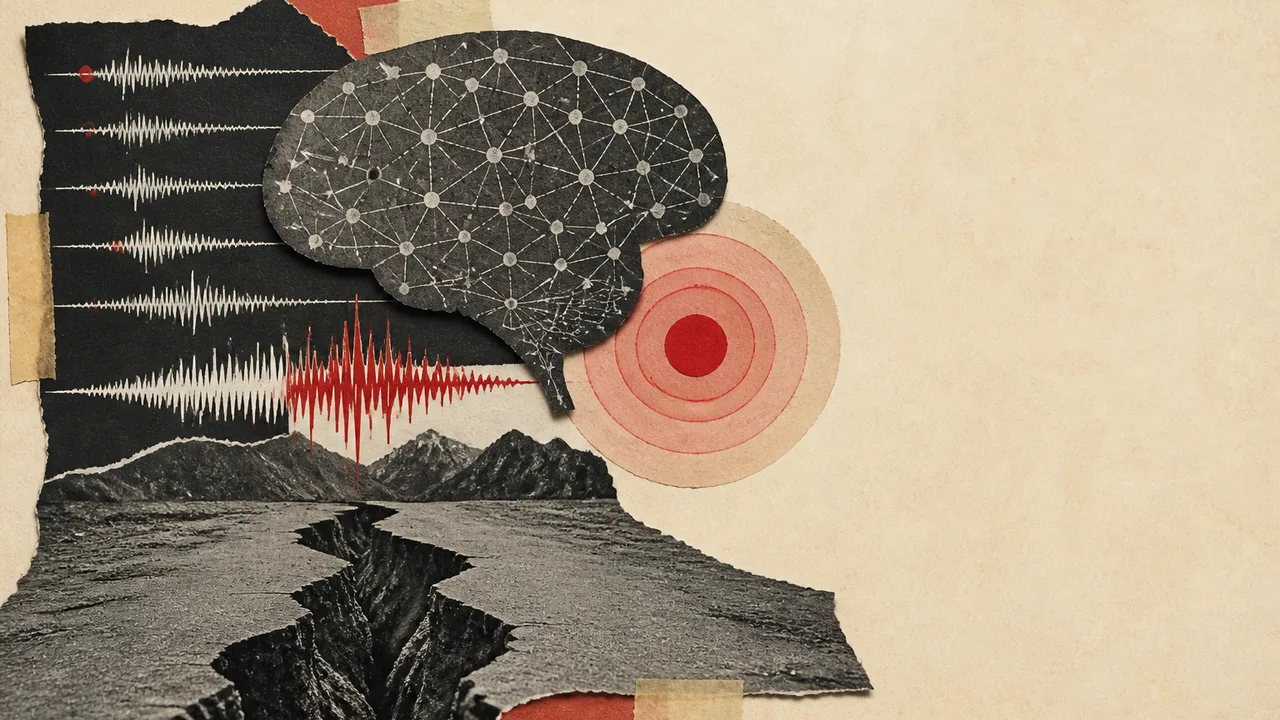
Photo: AI. Wren Sugimoto
There's a version of this story that writes itself: AI cracks the earthquake prediction problem, scientists celebrate, humanity breathes easier. That version is wrong, and the researchers behind a new study published in Nature Communications seem aware of it. Which is exactly what makes their work worth paying attention to.
The study, led by researchers at GFZ Helmholtz-Zentrum für Geowissenschaften and collaborating institutions, used unsupervised machine learning to scan historical earthquake catalogs—not hunting for a specific signal, but asking the algorithm to find whatever structure existed in the data. What it found, before some major earthquakes, were subtle behavioral shifts in clusters of smaller quakes. Not more earthquakes. Different earthquakes—more organized, more spatially concentrated, more consistent with a fault system ratcheting toward rupture.
The distinction matters enormously, and it's where most coverage of this kind of research goes sideways.
The Signal in the Noise
Active seismic zones are never quiet. Small earthquakes happen constantly, and the overwhelming majority of them are just... small earthquakes. The perpetual challenge for seismologists isn't detecting seismic activity—it's figuring out which activity means something. A spike in minor tremors could be a prelude to a major rupture, or it could be Tuesday.
What the GFZ team looked for wasn't quantity but quality of behavior. They studied what they call "seismic families"—groups of small earthquakes linked by location, timing, and magnitude, treated as components of a single evolving system rather than independent events. The machine learning method then asked: is this system behaving the way it normally does, or has something changed?
When tested against the historical record of several major earthquakes, the results were striking in some cases. Before the 2023 Kahramanmaraş earthquake in Turkey—which killed more than 50,000 people—the algorithm detected the kind of behavioral shift it was looking for. Same before the 2014 Iquique earthquake in Chile and the 2009 L'Aquila earthquake in Italy. The smaller quakes in the lead-up period became less random, clustering more tightly in time and space, releasing strain in patterns that suggest a fault moving toward a more critical state.
As the researchers described it, these changes "suggested that the fault system was shifting into a more organized state before rupture."
That's genuinely interesting science. But here's where the study's intellectual honesty becomes its most valuable feature.
The Gaps Are the Point
The same algorithm found no clear pre-earthquake signal before the 2016 Amatrice earthquake in Italy or the 2024 Noto earthquake in Japan. Two significant earthquakes, same method, no detectable pattern. The researchers don't paper over this. They treat it as a core finding rather than an inconvenient footnote.
This matters because earthquake precursor research has a long and somewhat embarrassing history of false dawns. Scientists have chased radon gas emissions, animal behavior, ionospheric disturbances, groundwater changes—and while some of these occasionally correlate with seismic events, none has produced a reliable, universal warning system. The graveyard of "breakthrough" earthquake prediction methods is well-populated.
The GFZ study's approach is more epistemically honest than most. Rather than claiming to have found the precursor signal, it's asking whether a class of precursor signals exists, in what circumstances, and with what consistency. The negative results from Amatrice and Noto aren't failures of the method—they're data points suggesting that earthquakes may not all follow the same script.
"The Earth may not always give the same kind of clue," the researchers noted. That's a sentence worth sitting with.
The unresolved question underneath all of this is one of the deepest in seismology: do major earthquakes begin suddenly—a fault that reaches a threshold and snaps without warning—or do some faults go through a measurable preparation phase before rupturing? The honest answer, based on current evidence, is probably "both, depending on the fault, the tectonic setting, and factors we don't fully understand yet."
What Unsupervised Learning Actually Does Here
It's worth being precise about the machine learning component, because "AI" has become a term that generates more heat than light.
The method used here is unsupervised—meaning the algorithm wasn't given labeled examples of "pre-earthquake behavior" to learn from. It wasn't trained on a dataset of known precursors and then asked to spot them elsewhere. Instead, it was pointed at earthquake catalog data and asked to find structure: patterns, clusters, anomalies that deviate from baseline behavior. The human researchers then interpret what the algorithm surfaces.
This approach has real advantages for a problem like this. It doesn't assume you already know what you're looking for. It can potentially surface patterns that would be invisible to human analysts reviewing the same data. And it sidesteps one of the classic pitfalls of earthquake precursor research, which is confirmation bias—finding the pattern you went looking for while ignoring the data that doesn't fit.
The limitation is that unsupervised methods can also find patterns that are statistically real but physically meaningless. Distinguishing between "this pattern reflects something genuinely happening in the fault system" and "this is an artifact of how the monitoring network happened to be deployed in this region" requires exactly the kind of follow-up testing the researchers are calling for.
From Discovery to Forecasting
The practical ambition here isn't earthquake prediction in the Hollywood sense—a scientist announcing that a major quake will hit a specific city on a specific date. That remains, by the judgment of most seismologists, likely impossible for the foreseeable future, if not fundamentally so. Fault systems are too complex, our subsurface monitoring too sparse, and the triggering dynamics too sensitive to initial conditions.
What's more achievable—and what this research points toward—is operational forecasting: continuously monitoring a fault system's behavior and flagging when that behavior deviates meaningfully from its own baseline. Not "earthquake imminent," but "this fault is doing something unusual and deserves closer attention."
"The value may be in recognizing when a fault system starts behaving differently from its own past behavior," the researchers suggest. That framing shifts the problem from prediction (nearly impossible) to anomaly detection (merely very hard), which is a useful reframe.
Combined with other data streams—GPS ground deformation, satellite radar, slow-slip observations, real-time seismic monitoring—a system like this could give scientists a richer picture of how stress is accumulating and migrating underground. No single tool cracks the problem; a constellation of tools might meaningfully improve the odds of catching something before it becomes catastrophic.
The catch, and it's a genuine one, is public communication. If scientists identify unusual seismic behavior using a method that carries significant uncertainty, what do they say, and to whom? The L'Aquila earthquake is instructive here in the darkest possible way: in 2009, Italian scientists were criminally convicted (later acquitted on appeal) partly for failing to communicate earthquake risk adequately before a quake that killed 309 people. The social and legal stakes of both over-warning and under-warning are real. Any operational system would need not just scientific validation but a communication framework that can convey genuine uncertainty without triggering either complacency or panic—a problem that is, honestly, as hard as the seismology.
The next phase of this research involves testing the method across more fault systems, more tectonic settings, more historical earthquake sequences. The goal is to understand not just whether the signal exists, but why it appears before some earthquakes and not others. Is it a property of the fault? The rock type? The depth? The presence of fluids? The quality of the local monitoring network?
Those are questions worth asking carefully. Because the difference between a method that works sometimes and a method that works reliably enough to act on is not a minor technical detail. It's the entire ballgame.
More Like This

Building Secure AI Agents With Bigtable and ADK
Google's Bora Beran demos a healthcare AI agent built on Bigtable and ADK—and the security layers that make it worth taking seriously.

What Rocks Know That Scientists Forgot
Earth scientist Anjana Khatwa argues indigenous knowledge and geology tell the same stories. Mei Zhang on why that matters—and who decides which stories count.

OpenAI's Codex Is Growing Up Fast—And Getting Weird
OpenAI's latest Codex updates add browser control, AI-reviewed approvals, and... animated pets? A look at where AI coding tools are actually heading.

Alibaba's Qwen 3.6 Max Tests Better Than Opus 4.5—At Half the Price
Alibaba's Qwen 3.6 Max Preview outperforms Claude Opus 4.5 in coding and agent workflows at $1.30 per million tokens. Here's what the tests actually show.
AI 'Skills' Are Creating a Security Nightmare
LLM 'skills'—markdown files that enhance AI capabilities—are spreading malware, hallucinated commands, and supply chain attacks. Here's what's going wrong.
SETI Is Shifting From Radio Waves to Laser Beams
A new paper by Ben Zuckerman argues SETI's radio-first assumptions are obsolete. Here's what a smarter alien search actually looks like in 2025.
ByteDance's Seedance 2.5 Raises the Bar for AI Video
ByteDance's Seedance 2.5 promises 30-second native clips, 50 reference inputs, and a copyright platform. Here's what's confirmed, what's hype, and what it means.

Building a Personal Agent OS: One Dashboard for AI
Julian Goldie's custom Agent OS centralizes AI agents, shared memory, and autonomous loops. A look at what it does, how it works, and what it can't yet promise.