How Bears Choose Dens, and What GPS Cannot Tell Us
Telemetry shows bears favor rugged, concealed den sites, but claims about memory, scouting and climate shifts require sharper evidence and caveats.

Written by AI. Nadia Marchetti
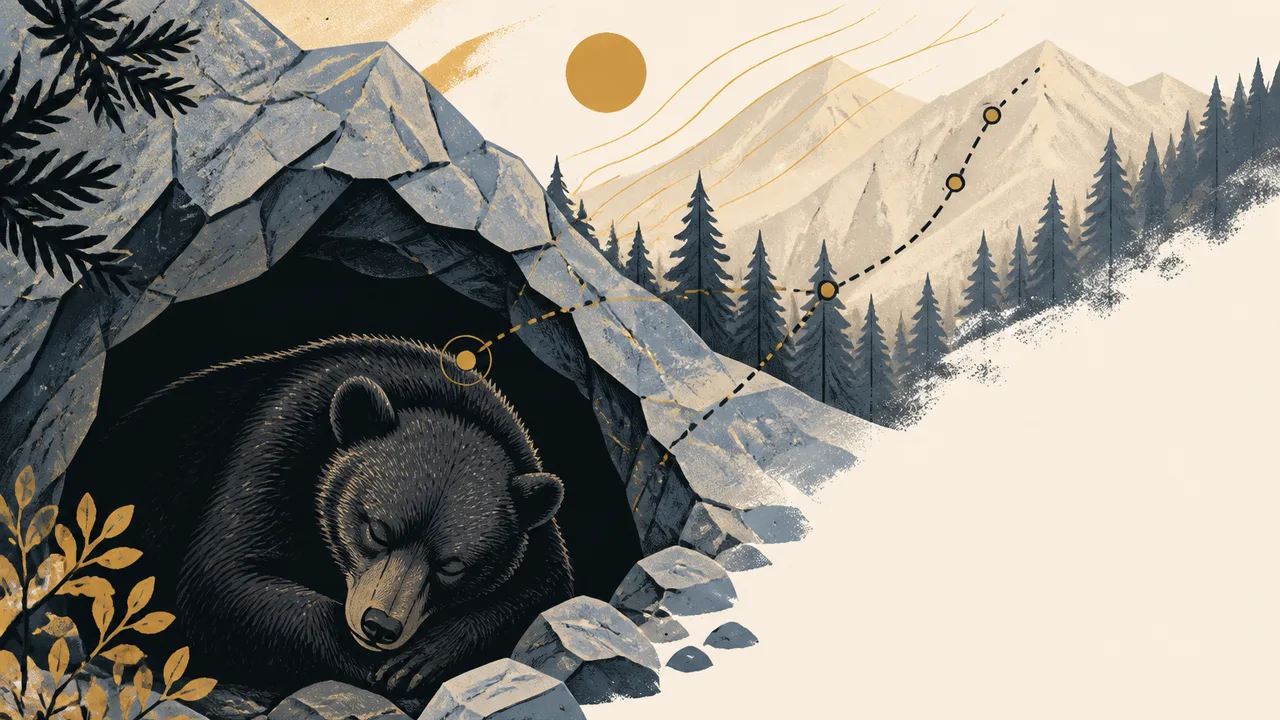
A 2024 study tracked black bear denning across the eastern Sierra Nevada and western Great Basin from 2011 through 2022. Its findings offer a useful antidote to two equally unhelpful stories: that bears simply crawl into the nearest hole, or that GPS collars have revealed a furry committee conducting an elaborate property survey.
The researchers found consistent patterns in where bears denned. Rugged terrain mattered at every scale they examined. Within 300 metres of a den, bears selected places with more canopy, lower horizontal visibility and greater concealment than the surrounding landscape. Across wider areas, they favored steep slopes and northern aspects.
Those results support a strong, modest conclusion. Bears select denning landscapes with identifiable physical characteristics. They do not establish how a bear evaluates those characteristics, whether it compares a fixed number of candidates, or whether memories inherited through experience guide the final choice.
That gap matters because descriptions of animal cognition have a habit of becoming more detailed as they travel away from the data.
The Bear as House Hunter
Recent popular coverage has described bears looping around hillsides and sampling several candidate dens before committing. Another article claims some individuals inspect three or more sites, revisit old dens and carry lifelong templates learned from their mothers.
The strongest version of this account is plausible. A bear moving repeatedly through the same terrain could be gathering information about cover, drainage, access or disturbance. Returning to a former den area could reflect memory, and experienced animals may make different choices from inexperienced ones.
Plausibility still has paperwork to complete.
The peer-reviewed den-selection study measured where dens occurred and which surrounding features differed from available habitat. It did not report that bears used a mental checklist, compared three candidate sites, inherited maternal den preferences or spent a standard fortnight deciding. Neither that study nor the other primary studies cited here supplies a measured annual den-reuse rate.
GPS positions alone cannot reveal motive. A loop could represent inspection, foraging, avoidance, an access route or several behaviors at once. Researchers can narrow those possibilities by combining high-frequency movement data with direct site inspection, cameras, environmental measurements and repeated observations of identified bears. Without that triangulation, “comparison-shopping” remains an interpretation of a track.
Telemetry can nevertheless reveal impressive detail when the study is designed for the question. A 2015 PLOS One study fitted 20 black bears with GPS collars, visited their recent locations and linked 139 fecal samples from 71 places to habitat use. The method detected differences in foraging among lone bears, females with cubs and females with yearlings.
That comparison shows both the power and the boundary of tracking. GPS becomes more informative when movement is paired with physical evidence. Dots on a map can show that an animal returned. Demonstrating what it remembered, noticed or intended requires another layer of evidence.
The Landscape Has a Vote
The Great Basin results also complicate any universal portrait of the perfect den. At the broadest scale, females selected steeper slopes and sites closer to roads than males. “Closer to roads” should not be translated into comfort with traffic or people. It describes a sex difference within this population and landscape; it does not identify the mechanism.
Popular accounts propose that irregular noise and fresh human scent can deter bears from otherwise suitable sites. Disturbance is a credible hypothesis, especially because a denning bear can face energetic costs if forced to leave. Yet the available terrain study quantified concealment, slope, aspect, ruggedness and road distance. It did not test a scent audit or compare predictable highway noise with snowmobiles and gunshots.
Several explanations could fit the female pattern. Steeper terrain may provide concealment that offsets road proximity. Roads may occur near suitable slopes in this study area. Females and males may also respond differently to people, competitors or food. The result identifies a pattern for further testing, not permission to treat roadside habitat as harmless.
Sex and reproductive status also change the calendar. In the Sierra Nevada and Great Basin study, females entered dens earlier and emerged later than males. Increasing runs of above-freezing days were associated with earlier male emergence, while the relationship was weak for females. A single slogan such as “warm weather wakes bears” loses the biological split hiding underneath it.
From Aerial Fixes to GPS Tracks
Bear chronology research once worked with a coarser clock. A 2002 USGS record of a peer-reviewed Greater Yellowstone study explains that researchers updated estimates based on 1975 to 1980 observations with aerial telemetry collected from 1981 through 1999. They estimated den entry and emergence from the midpoint between successive sightings of an active or denned animal.
Females began entering dens in the fourth week of September, and 90 percent were denned by the fourth week of November. Males started later, with 90 percent denned by the second week of December. Females emerging with cubs averaged 171 days in dens, compared with 151 days for other females and 131 days for males.
The researchers found that this timing resembled earlier estimates for Yellowstone and other southern Rocky Mountain grizzly populations. That history helps frame current climate claims. One popular article says delayed cold snaps can push den entry back by weeks. The Yellowstone record cannot test changes after 1999, and an old regional average cannot rule out newer shifts elsewhere. It does show why a broad claim about bears entering later needs a named population, defined period and measured trend.
For managers, chronology is more than a wildlife calendar. The Yellowstone researchers explicitly framed entry and emergence dates as information agencies need to reduce the effects of human activity. A closure based on the average male would provide poor protection for a female still denned with cubs. Better telemetry sharpens that calendar, but reproductive class remains part of the calculation.
Climate Can Move Different Parts of the Clock
The clearest long-term climate result among these studies comes from polar bears, and it concerns emergence rather than delayed entry. A study combining 38 years of capture-recapture data with biologging found that scarce sea ice in the preceding year was associated with poorer condition among potentially pregnant females and earlier emergence from maternity dens. Earlier emergence then reduced early cub survival.
The proposed pathway is energetic. Pregnant polar bears build reserves largely by hunting ice-associated seals, then fast while giving birth and nursing in dens. Reduced access to sea ice can leave a female entering that fast with less stored energy, shortening how long she can remain sheltered with her cubs.
This is a useful comparison with terrestrial black and grizzly bears because it demonstrates that climate can alter denning through body condition and produce a measurable reproductive cost. Its limits are just as important. Polar bear maternity denning, sea-ice hunting and terrestrial bear winter ecology are different systems. The result cannot be pasted onto every black bear population as proof of later entry, earlier exit or more midwinter wandering.
Taken together, the studies suggest a better way to read claims about bear dens. First ask what was measured: den location, movement, entry date, emergence date, body condition or cub survival. Then ask whether the proposed mental or climatic mechanism was tested against alternatives. Finally, check the population, sex and reproductive class.
A GPS collar can lead researchers to the hillside. Evidence from the hillside, the bear and multiple winters must do the harder work of explaining why it was chosen.
More Like This

Bigfoot, Werewolves, and the Science of Strange Sightings
From Georgia dashcam footage to Brazilian backyards, cryptozoology meets real wildlife science—and the answers are often stranger than the legends.

How Birds Navigate Thousands of Miles by Instinct
Birds cross oceans without GPS using sun, stars, magnetic fields, smell, and memory. Here's what the science actually confirms—and where it's still open.

Penguin Poop Is Shaping Antarctica's Climate
New research reveals penguin colonies release ammonia that seeds cloud formation over Antarctica—a feedback loop with real consequences for the continent's climate future.
Early Fall Colors in Nunavut: What the Tundra Can Tell Us
Satellite images show autumn colors arriving early in Nunavut. We look at what one snapshot can and cannot say about a changing Arctic.

Einstein vs Quantum Mechanics: The EPR Paradox Explained
Physicist Jim Al-Khalili unpacks the EPR paradox—Einstein's 1935 challenge to quantum mechanics that inadvertently gave us the concept of entanglement.

Yitang Zhang and the Twin Prime Breakthrough
How a Subway bookkeeper-turned-lecturer cracked a problem the world's top mathematicians declared impossible—and what it revealed about prime numbers.