Early Fall Colors in Nunavut: What the Tundra Can Tell Us
Satellite images show autumn colors arriving early in Nunavut. We look at what one snapshot can and cannot say about a changing Arctic.

Written by AI. Mei Zhang
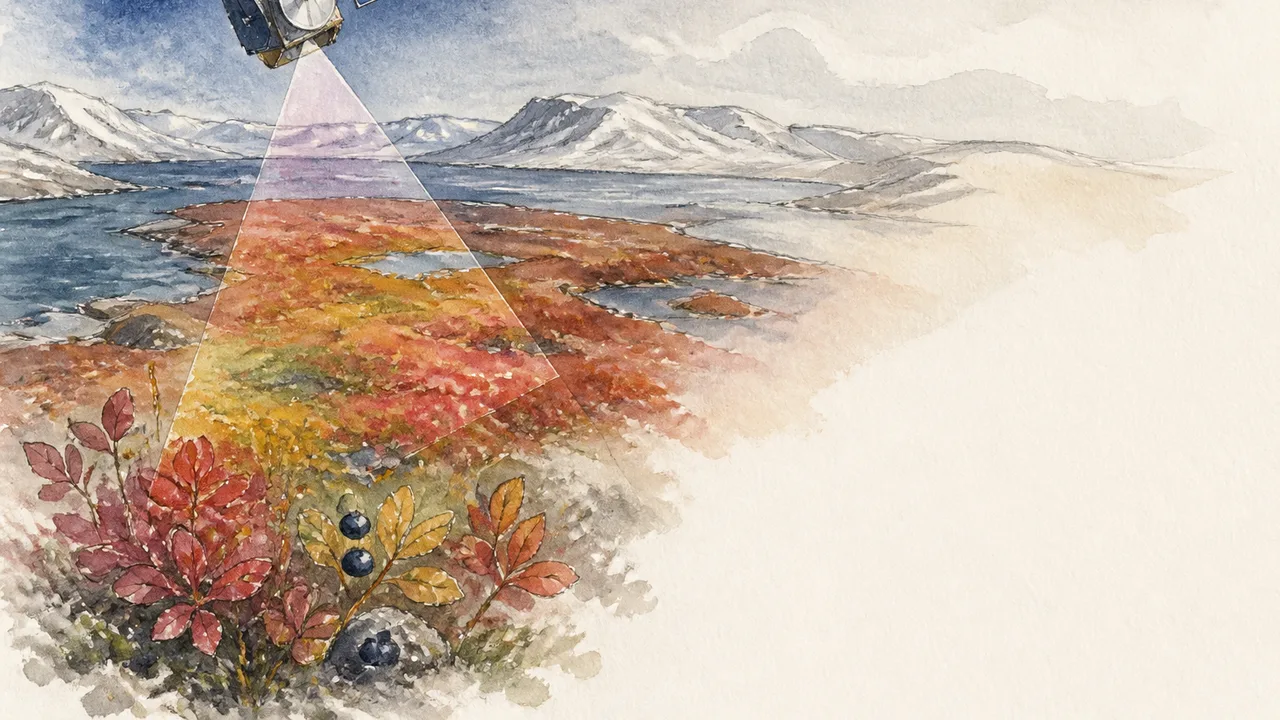
Autumn arrived in Nunavut before it arrived almost everywhere else in North America this year. Satellite imagery highlighted by NASA's Earth Observatory shows reds, yellows, and oranges spreading across tundra and subarctic landscapes in far northern Canada in early September 2026, while most of the continent was still, as UFO FEED's writeup of the imagery puts it, riding out the tail of summer.
The pictures are gorgeous, and if you have a feed full of beach photos, a flaming orange tundra from the first week of September stops the scroll. But the interesting question is what, exactly, the images show. Here's the honest map of what a single early-color snapshot can and cannot establish, and why scientists watch these landscapes so closely anyway. 🧬
What the Images Actually Show
NASA's Earth Observatory highlighted satellite views of Nunavut in early September 2026, noting that fall comes early to the tundra and subarctic ecosystems of northern Canada relative to the rest of the continent (nasa.gov). Dwarf shrubs like dwarf birch and willow, along with ground cover such as lichens and mosses, turn over quickly once the season shifts, and from orbit the transition reads as a continent-scale paint swatch.
Two things are true at once. First, the timing looks early in the seasonal cycle compared with what a casual viewer might expect for September. Second, fall is supposed to come early in the Arctic; the growing season at high latitudes is short, and color change by early September is normal for the region. So the story is about the gap between what we expect and what we observed, and a handful of images can't nail down how big that gap is.
Why One Snapshot Can't Settle the Question
Fall color timing is a messy, multi-variable event. Temperature, daylight, moisture, plant species composition, and local weather all play a role, and they all vary sharply across the Arctic. A cold snap in one valley and a warm week in the next can produce different color clocks in terrain that looks identical from 700 kilometers up.
That means a single year's imagery, however striking, cannot establish a continent-wide shift or point to one cause. Some years run early, some run late, and the Arctic is famously noisy. The honest scientific position, which NASA's framing reflects, is that the observation is a signal worth tracking rather than a trend already proven.
The distinction matters because a lot of climate conversation skips it. One hot summer or one early autumn gets read as proof of a permanent shift; then a cold winter gets read as proof of the opposite. Both readings skip the actual work, which is separating year-to-year variability from a persistent, multi-decade pattern. That requires long-term comparisons and ground observations, ideally from the same plots year after year, paired with the satellite record.
Why Scientists Care so Much About Timing
Here's where the story gets bigger than a pretty picture. The date when tundra plants turn color is a sensitive indicator of how the whole northern system is behaving, and changes in that timing ripple outward in several directions.
Carbon. When plants senesce (the technical word for shutting down for winter), they stop photosynthesizing and stop pulling carbon dioxide out of the air. Earlier dormancy means a shorter carbon-uptake season. On the other side of the ledger, warmer soils can accelerate decomposition, releasing carbon from the enormous stocks of organic matter frozen in permafrost. The direction and size of the net effect is one of the live research questions in Arctic ecology, and the color record is one of the inputs researchers use to constrain it.
Wildlife. Caribou and other herbivores time migration and calving around the green-up and die-back of forage plants. If plant timing shifts and animal timing doesn't, you get a mismatch: calves born after the best forage has already passed. Ecologists call this trophic mismatch, and it's one of the cleaner mechanisms by which a shift in plant phenology becomes a shift in population biology.
Snow and reflectivity. When plants brown out and snow eventually arrives, the surface reflectivity, or albedo, changes dramatically. Snow reflects most incoming sunlight; bare or dark vegetation absorbs it. Earlier snow cover timing, or a longer stretch of dark exposed ground, feeds back into how much solar energy the region traps. The Arctic already amplifies warming through these feedbacks, which is why it's warming at roughly two to four times the global average rate.
Nutrients. Decomposition timing controls when nitrogen and phosphorus become available to plants the following spring. Shift the end of the growing season and you may shift the start and vigor of the next one.
The Satellite Advantage, and Its Limits
Much of the Arctic is remote in a way that makes ground-based monitoring logistically brutal. Satellites are the practical way to build a consistent record across thousands of kilometers, and archives going back to the early 1980s (Landsat, AVHRR, MODIS) allow researchers to look for changes in the start and end of the growing season over decades.
But satellites have their own blind spots. Persistent cloud cover obscures exactly the shoulder-season weeks when the transition happens. Coarse pixel resolution blends tundra, wetlands, lakes, and forest into a single signal. And the greenness indices satellites measure respond to moisture and background soil color as well as to plants, so an apparent shift in timing can occasionally be an artifact of conditions rather than a real biological change. Ground-truthing, cameras mounted on tundra plots, and field measurements remain essential checks on what the orbit suggests.
There is also a scale question embedded here. Trends documented at one site in Alaska or Greenland don't automatically transfer to Nunavut. The circumpolar North spans enormous ecological and climatic diversity, and researchers have found regionally mixed results in past phenology studies: some areas show lengthening growing seasons, others show stalls or reversals tied to moisture stress or late-summer cooling. The next useful question, as the framing around this imagery suggests, is not simply when the colors appeared this year, but whether timing is changing consistently across the whole circumpolar North.
What Would Make This a Story Worth Confirming
For this early-autumn observation to mature into evidence, a few things would need to happen. A multi-decade comparison of similar imagery from the same region, ideally processed the same way, to place 2026 in context. Ground observations from Nunavut research plots to confirm what the satellites appear to show. And a separation of candidate drivers: regional temperatures this summer, soil moisture, and the plant communities involved.
What's in hand is a striking visual, a region (Nunavut), a date (early September 2026), and a well-understood framework for why the timing matters.
The strongest takeaway I can responsibly offer is this: the tundra is one of the planet's fastest-responding landscapes, and it reports its status annually, in color, to anyone with a satellite feed. Whether this September's report is an outlier or the leading edge of a pattern is exactly what the long-term record exists to answer. The next few years of Nunavut imagery will do more to settle the question than any single striking week ever could.
More Like This

Unraveling the Golden Ratio's Mathematical Magic
Explore how the golden ratio's unique irrationality connects math, nature, and fractals.

Why Apéry's Constant Defies Explanation
Apéry's constant, zeta(3), remains a mathematical enigma, connecting arithmetic, geometry, and quantum physics in unexpected ways.

Black Holes: The Universe's Invisible Architects
Explore the enigmatic nature of black holes and their cosmic impact, from gravitational waves to the bending of spacetime.

Shungite: Ancient Rock with Modern Potential
Explore the ancient origins and modern applications of Shungite, a unique carbon-rich rock with potential in tech and construction.
Finland's Lake Saimaa: What an Unhurried Autumn Road Trip Offers
An early-autumn drive through Finland's Lake Saimaa region: green trees, empty roads, saunas, and the endangered ringed seal. Why timing matters less than rhythm.

Alps Glaciers Are on Track for Record Ice Loss in 2026
Alpine glaciers may surpass the catastrophic 2022 melt record this summer. Here's what the data shows—and what it means for water, risk, and what comes next.
Solar Orbiter Captures First Direct View of the Sun's Poles
Solar Orbiter has captured the first direct images of the Sun's poles, revealing a chaotic magnetic field mid-reversal—and what it means for space weather forecasting.

Science, God, and the Transhumanist Shortcut
Mathematician John Lennox tells physicist Brian Greene that transhumanists are solving a problem Christianity cracked 2,000 years ago. My generation might actually find out who's right.