DC Is Releasing 600,000 Mosquitoes to Fight Mosquitoes
Washington DC is deploying 600,000 Wolbachia-infected male mosquitoes this summer to crash local populations. Here's the biology, the stakes, and the bigger picture.

Written by AI. Mei Zhang
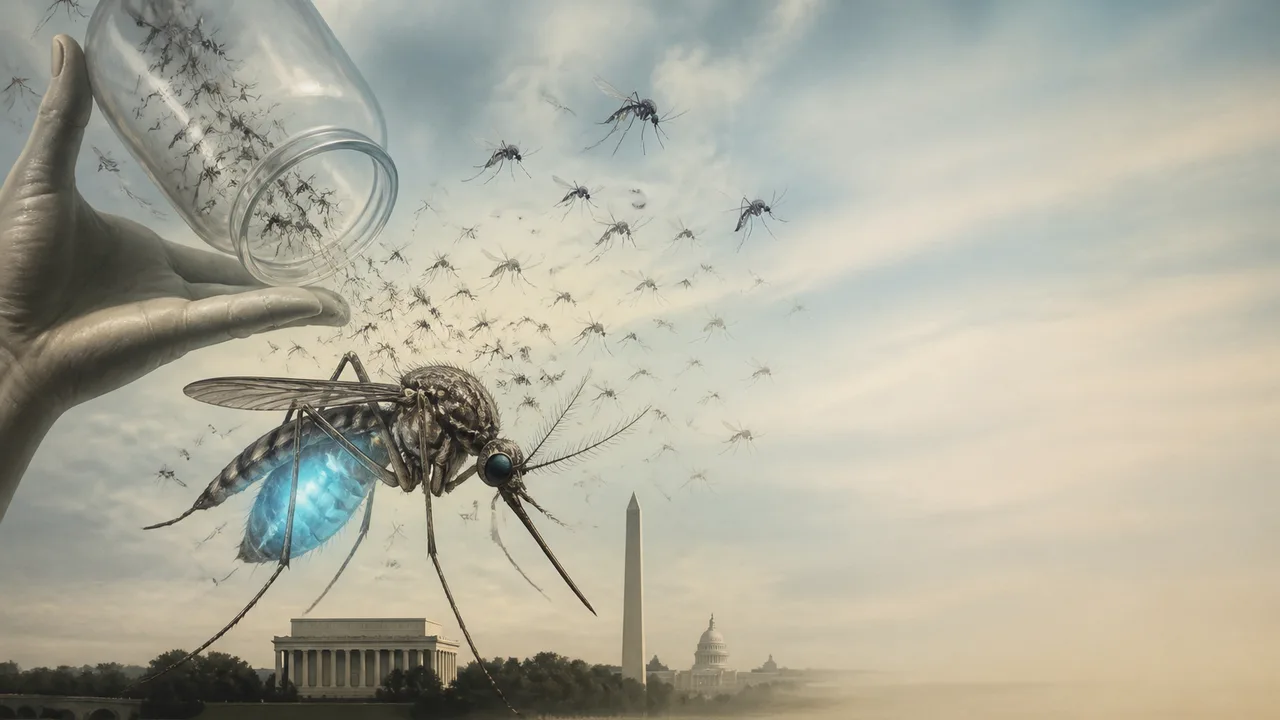
Photo: AI. Iolanthe Fenwick
Six hundred thousand mosquitoes are being released into Washington, D.C. this summer — on purpose, by humans who would like fewer mosquitoes. This is either the most counterintuitive public health strategy you've ever heard of, or it's elegant once you understand the mechanism. Probably both.
The mosquitoes in question are male, they don't bite, and they're carrying a bacterial payload designed to quietly sabotage reproduction across the local mosquito population. The company deploying them, Be Safe Mosquito Control, is run by Todd Montgomery — and according to Montgomery, his operation is "the only one doing this residential in the United States."
So how does it actually work?
Meet Wolbachia — the Bacteria Doing the Heavy Lifting 🧬
The key is a gut bacterium called Wolbachia. It naturally occurs in many mosquito species already, including the ones Be Safe is targeting. The twist: the zap males being released carry a different strain of Wolbachia than the wild local females do — and those two strains are incompatible with each other.
When a zap male mates with a local female, the resulting eggs don't hatch. This phenomenon is called cytoplasmic incompatibility, and it's well-documented in the scientific literature — per ScienceDirect's overview of cytoplasmic incompatibility, a strain mismatch between incompatible Wolbachia carriers causes developmental failure in the eggs. Crucially, the female herself isn't sterilized. She can keep mating and producing clutches — they just won't be viable. It's not a one-and-done hit on her reproductive capacity; it's more like a recurring bad outcome every time she encounters a zap male. Scale that up across a population, and you get a generational crash.
Professor Elizabeth McGraw, department head of biology at Penn State's Eberly College of Science, explained the logic in the BBC segment: "When you release these mosquitoes with a different strain of this bacterium, that really shuts down the reproductive success of the local mosquitoes... it's an exciting technology to sort of crash the mosquito population, which should then reduce nuisance biting... but also reduce the potential for transmission of pathogens that can cause disease."
The mosquito life cycle is short — around 10 days per generation — which means effects can show up within weeks of a release, not months. That's a faster feedback loop than most pest control approaches can claim.
The Practical Logistics
Under the residential model Be Safe is piloting, homeowners pay to have 1,500 zap males released weekly throughout the summer. Once released, the males stay within roughly a 200-meter radius — so this is genuinely hyperlocal, yard-scale biology.
One D.C.-area resident captured the customer experience succinctly: "I was like, 'Sign me up. Let me know how much it costs, and let's do it.'"
That's it. That's the pitch. A backyard you can actually use in summer is apparently a compelling enough value proposition that people will enthusiastically invite hundreds of mosquitoes onto their property.
The Ongoing Release Question
Here's the real wrinkle in the technology: you have to keep releasing. McGraw is direct about this — if wild males are still out there mating with females, some portion of the population will keep reproducing normally. The releases need to be continuous to maintain pressure on the population.
There's a caveat that's specific to D.C.'s geography, though. McGraw noted that the city sits near the northern edge of these mosquito species' range. Populations overwinter but contract significantly, which means a sustained knockdown during summer months might produce longer-lasting effects than you'd see somewhere warmer. The math is more favorable when you're starting each season with a smaller local population to begin with.
Further south, the continuous-release calculus looks different — and the stakes are considerably higher.
Dengue Is Not a Tropical Disease Anymore, and That Should Bother You
McGraw flagged something in the BBC interview that I genuinely can't stop thinking about: local dengue transmission is now happening in Florida and Texas.
Let me sit with that for a second. Dengue fever — the disease I grew up reading about as something you caught in Southeast Asia or sub-Saharan Africa if you were unlucky, the one that sends international travelers to the ER with fevers and joint pain so severe it earned the nickname "breakbone fever" — is now spreading domestically in American suburbs. Not imported cases. Local transmission. The mosquito bit someone there, then bit you.
I cover genomics and biotech for a living, which means I spend a lot of time tracking how biological systems shift in response to environmental pressure. But there's still something cognitively jarring about watching a disease migrate across a map in real time because the map itself has changed. McGraw put it plainly: "We keep seeing these diseases that were traditionally really only present in the tropics marching northwards."
The two mosquito species McGraw specifically flagged — Aedes aegypti and Aedes albopictus — thrive in urban environments and are adapting to warming temperatures across the continental U.S. These aren't rare edge cases. They're the same mosquitoes that make sitting outside in a D.C. backyard miserable. The line between "nuisance" and "public health threat" is thinner than most people realize, and climate change is actively eroding it.
Is This Safe? (Yes, But Here's Why That Question Is Worth Asking)
The ecosystem concern is the one that gets raised every time someone proposes biological pest control, and it's worth taking seriously rather than batting away.
McGraw addressed it directly: Wolbachia is naturally occurring in these mosquitoes already. Predators — fish, birds — are unaffected when they eat the released males. The bacterium can't be transmitted to humans through bites, because the released mosquitoes are male and don't bite, and even females carrying Wolbachia can't transfer it to humans when they do. The species being targeted are two specific invasive or semi-invasive species, not the full mosquito ecosystem; there are many other mosquito species providing food for birds, salamanders, and fish that this intervention doesn't touch.
The honest answer to "but what about the food web?" is that selectively reducing one or two species out of hundreds is unlikely to cascade dramatically through the ecosystem. McGraw's framing was measured and accurate: mosquitoes do serve as food, and some even serve as pollinators, but targeting these two specific species doesn't create a vacuum in the broader ecology.
That said, the technology is new to the U.S. residential market — Be Safe is genuinely the first operator offering this at the homeowner level here. "New" doesn't mean unsafe, but it does mean the long-term data at scale is still accumulating.
The Bigger Picture
What's happening in D.C. this summer is a small, granular experiment in using biology against biology — deploying a natural bacterial incompatibility to outcompete a pest at the population level, without pesticides, without genetic modification, without anything that isn't already present in nature.
What's interesting is where the technology sits in the broader toolkit. It's not a silver bullet. It requires ongoing investment. It's hyperlocal. A resident with deep pockets and a usable backyard benefits more immediately than a low-income neighborhood without the resources to hire a weekly service. The equity dimension of private mosquito control is genuinely underdiscussed when most of the coverage focuses on the wow factor of "releasing more mosquitoes to kill mosquitoes."
Meanwhile, the diseases that make mosquito control urgent aren't waiting for the market to figure out its pricing model. Dengue is already in Texas. The range maps keep expanding. The question isn't really whether Wolbachia-based control works in a backyard in suburban D.C. — the question is whether we can get this technology deployed at a scale and accessibility that matches the actual scope of the problem.
More Like This

How Maxwell Unified Electricity and Magnetism
A compass needle twitched in 1820 and set off a chain of discoveries that now powers every wireless signal in your life. Here's the physics behind it.
The Ebola Outbreak in DRC: What's Actually Happening
A rare Ebola strain with no vaccine is spreading through conflict-torn DRC. Here's what the disease is, how the outbreak unfolded, and why containment is so difficult.
Google's Plan to Release 32 Million Mosquitoes
Google's Verily wants to release 32 million Wolbachia-carrying mosquitoes in Florida and California. The science is real. The questions are bigger than the video admits.

Brain-Computer Interfaces Are Coming. Who Can Afford Them?
Brain chips can restore movement to paralyzed patients. But at $50,000 a surgery, the real question isn't who wins the tech race — it's who gets left out.
Drone Detectors From the Front Lines, Tested
A Ukrainian battlefield drone detector meets consumer-grade SIGINT tools. What happens when war tech goes civilian? More than you'd expect.

Black Hole Paradox: Are Reference Frames the Key?
Exploring how reference frames might resolve the black hole information paradox.
Calculus Indeterminate Forms Explained With Limits
DIBEOS unpacks the seven indeterminate forms in calculus—0/0, ∞/∞, and more—and why mastering limits matters far beyond the classroom.

Indigenous Star Lore Is Reshaping Astrophysics
A new arXiv paper argues Indigenous astronomical traditions aren't just cultural history—they're a scientific resource. But who controls how that resource gets used?